
A Brief History of the Cipatat–Padalarang Railway Line
The state-owned railway company, Staatsspoorwegen (SS), was the first to construct a railway network in the Priangan region. The line was built from Buitenzorg (Bogor) to Bandung via Sukabumi and Cianjur.
The purpose of this construction encompassed both economic and military factors. From an economic perspective, it was designed to streamline the transport of export commodities from plantations in the Priangan hinterland to the port in Batavia (Jakarta). The fertility of the Priangan region represented a major economic asset for the area. From a military standpoint, the line served as a means of defense, given that the mountainous and rugged terrain of the Priangan hinterland was highly strategic for establishing defensive strongholds.
According to S. A. Reitsma in Korte Geschiedenis der Nederlandsch-Indische Spoor- en Tramwegen published in 1928, the construction project for the Bogor–Cianjur–Bandung railway line was inaugurated in phases. The sequential order of completion was Bogor–Cicurug, Cicurug–Sukabumi, Sukabumi–Cianjur, Cianjur–Bandung, and Bandung–Cicalengka.
Table 1. Inauguration of the Bogor–Bandung–Cicalengka Railway Line
No | Line | Length (km) | Inauguration Date |
|---|---|---|---|
| 1 | Bogor–Cicurug | 27 | October 6, 1881 |
| 2 | Cicurug–Sukabumi | 31 | March 21, 1882 |
| 3 | Sukabumi–Cianjur | 39 | May 10, 1883 |
| 4 | Cianjur–Bandung | 60 | May 17, 1884 |
| 5 | Bandung–Cicalengka | 27 | September 10, 1884 |
(Source: Korte Geschiedenis der Nederlandsch-Indische Spoor- en Tramwegen)
Initially, SS conducted surveying and mapping for the line's construction starting in 1878. The execution of these surveying and mapping tasks was contracted out to third parties under the supervision of European, Chinese, and indigenous foremen. The Cipatat–Padalarang section was included within the 3.5 km Cisokan–Cipadalarang section, which was completed in 1880. Following the surveying and mapping phase, SS proceeded with land acquisition.
The geographical landscape of the Priangan region consists largely of mountainous terrain with undulating ground. To level the land, extensive excavation and embankment work was required. In the Cisokan–Cipadalarang section alone, the volume of earth excavated and filled reached 2.1 million m³.
During the excavation process, dynamite was utilized to break through hard rock and crags. Additionally, to facilitate easier digging, controlled flooding was implemented by building small-squared dams across flowing water.
Materials required during the construction process, such as sand and lime, were sourced through indigenous and Chinese suppliers. Meanwhile, stone was obtained from nearby rivers located not far from the railway alignment.
Before laying the tracks, wooden sleepers (ties) had to be installed. The timber used was teakwood, procured from a contractor based in Jepara, the Dijkman Company. Rails and other iron components were imported from Europe and shipped in via the port in Jakarta. The track gauge utilized was 1,067 mm. Track laying in the Cipatat area had to be elevated due to the sloping contours of the land. The section between Tagogapu and Padalarang featured a steep gradient of 1/25 with curves stretching between 150 to 200 meters.
To serve as stopping points for boarding and discharging passengers and cargo, stations and halts were established. Along the Cianjur–Bandung line, which opened on May 17, 1884, several stations and halts were built, namely Maleber Halt, Selajambe Halt, Cipeuyem Halt, Cipatat Halt, Tagogapu Halt, Cipadalarang Halt, Cimahi Halt, and Bandung Station.

Image 1: Railway stops along the Cianjur–Padalarang line around 1890. Key: 1. Cianjur St., 2. Maleber H., 3. Selajambe H., 4. Ciranjang H., 5. Cipeuyem H., 6. Cipatat H., 7. Tagog Apu H., 8. Padalarang H. (Source: Maps.library.leiden.edu)
Based on the SS Westerlijnen train timetable printed in 1884, the Cipatat–Padalarang line initially saw four daily train services. These services consisted of round-trip trains running the Bogor–Cicalengka route and round-trip trains running the Cianjur–Cicalengka route. At that time, the average speed of the trains ranged between 25 and 30 km/h. A journey from Bogor to Cicalengka took approximately 7.5 hours, while the Cianjur–Cicalengka leg took about 3.5 hours.

Image 2: The SS Westerlijnen train timetable for the Bogor–Cicalengka line in 1884. (Source: Spoorwegstation op Java)
Fares for train travel were categorized by class. In 1900, for a journey from Bandung to Cipatat, Class 1 passengers (Europeans) had to pay 1.75 guilders. For the same route, Class 2 passengers (Foreign Orientals: Chinese, Arabs) paid 1.25 guilders, while Class 3 passengers (mixed and indigenous populations) paid a modest fare of 0.47 guilders. Meanwhile, the freight tariff for the same route was 0.09 guilders per 10 kg.

Image 3: The train timetable for the Sukabumi–Cianjur–Padalarang line in 1900. (Source: Officieele Reisgids der Spoor- en Tramwegen en Aansluitende Automobieldiensten op Java en Madoera)

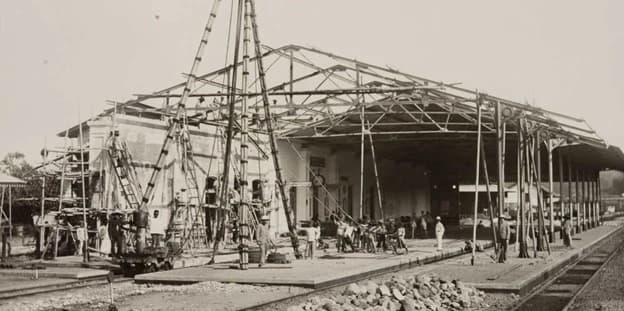
Image 4: The construction process of Padalarang Station. (Source: Collectie.wereldculturen.nl)
Following Indonesia's independence, the railway systems in Java and Sumatra were taken over by the Indonesian nation. Subsequently, the Djawatan Kereta Api Republik Indonesia (DKARI)—the precursor to PT Kereta Api Indonesia (Persero)—was formed. To improve station infrastructure by systematically defining facilities and transport capacity requirements, the Indonesian Railway Bureau (Djawatan Kereta Api or DKA) issued a regulation regarding station classifications via the DKA Decree No. 20493/BB/54 on March 16, 1954. Stations were categorized into several tiers: Large Station, Class I, Class II, Class III A/B, Class III C, Class IV, and Class V.
Under this 1954 decree, the stations along the Cibatu–Padalarang line were classified as follows: Padalarang Station was designated as a Class I station, while Cipatat Station and Tagogapu Station were classified as Class IV stations.
Table 2. Passenger and Freight Data for the Cipatat–Padalarang Line (1950–1952)
Station | Departing Passengers (1950) | Departing Passengers (1951) | Departing Passengers (1952) | Shipped Freight in Tons (1950) | Shipped Freight in Tons (1951) | Shipped Freight in Tons (1952) |
|---|---|---|---|---|---|---|
| Cipatat | 46,802 | 46,907 | 42,572 | 2,531 | 2,910 | 1,317 |
| Tagogapu | 48,167 | 59,664 | 47,467 | 33,361 | 28,577 | 22,777 |
| Padalarang | 388,195 | 495,961 | 535,153 | 18,776 | 27,376 | 26,636 |
(Source: Djawatan Kereta Api di Indonesia Statistik Tahunan 1950-1951-1952)
However, around 2013, operations on the Cipatat–Padalarang line ground to a halt. This followed the suspension of the Kereta Cianjuran (Cianjur Train) service which served the Cianjur–Padalarang route. The primary reason for the line's closure was the lack of compatible locomotives for the route. The BB-class diesel locomotives that previously operated on the line suffered mechanical failures, and sourcing spare parts became increasingly difficult. Furthermore, supporting infrastructure, such as the signaling system, was no longer adequate to support safe operations.
Sources:
Collectie.wereldculturen.nl
Djawatan Kereta Api di Indonesia Statistik Tahunan 1950-1951-1952
Michiel van Ballegoijen de Jong, Spoorwegstations op Java, Amsterdam: De Bataafsche Leeuw, 1993
Officieele Reisgids der Spoor- en Tramwegen en Aansluitende Automobieldiensten op Java en Madoera, January 1, 1900
Maps.library.leiden.edu
Mulyana, Agus, “Melintasi Pegunungan, Pedataran, Hingga Rawa-rawa: Pembangunan Jalan Kereta Api di Priangan 1878-1924”, Doctoral Dissertation, Department of History, Universitas Indonesia (UI), 2005
S. A. Reitsma, Korte Geschiedenis der Nederlandsch-Indische Spoor- en Tramwegen, Weltevreden: G. Kolff & Co, 1928
Tim Telaga Bakti Nusantara, Sejarah Perkeretaapian Indonesia Jilid II, Bandung: Penerbit Angkasa, 1997