
An Overview of the Tulungagung–Trenggalek–Tugu Tramway Network
The state-owned railway company, Staatsspoorwegen (SS), began the construction of its first railway network in Indonesia in 1875, specifically in the eastern region. The initial route successfully completed was the 63-kilometer Surabaya–Pasuruan line on May 16, 1878, utilizing a track gauge of 1,067 mm. This was later extended to Malang, which was completed in 1879. This railway network served as the primary main line connecting major cities for economic and military interests.
As a state enterprise, SS also held an obligation to open up isolated inland areas to foster public welfare. In 1905, SS began constructing branch lines from the main routes into the hinterlands in the form of tramways.
Trams possessed several distinct characteristics compared to conventional trains, including smaller locomotives and carriages, lower operational speeds, smaller transport capacities, and shorter travel distances. Furthermore, the opening of a tramway network only required a decision from the local government head (the Resident), unlike main railway lines which required approval from the central government (the Governor-General) in either The Hague or Batavia (Jakarta).

Image 1: A tram crossing a bridge in 1920. It is observable that the dimensions of the tram locomotive and carriages are smaller than those of a standard train. (Source: Tropenmuseum.nl)
The first tramway built by SS connected Madiun and Ponorogo. Following this, SS constructed various other tram lines, such as the Krian–Gempolkerep, Krian–Ploso, the tramways in Bandung, and the Tulungagung–Trenggalek–Tugu line. The construction of the Tulungagung–Trenggalek–Tugu route was authorized under the Law of June 6, 1919, published in Staatsblad (State Gazette) number 312.
The 48-kilometer line was built in three distinct phases. The first phase, spanning 14 kilometers from Tulungagung to Campurdarat, was completed on July 15, 1921. The next phase, a 25-kilometer stretch from Campurdarat to Trenggalek, was finished on July 1, 1922. Finally, on January 3, 1923, the entire line became fully operational with the completion of the 9-kilometer Trenggalek–Tugu section.

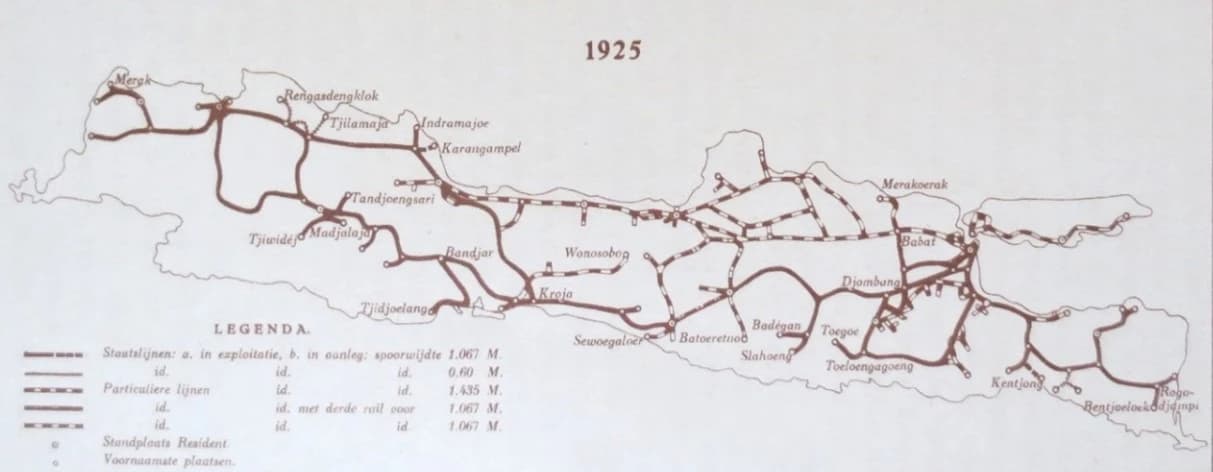
Image 2: A railway network map from 1925; the Tulungagung–Trenggalek–Tugu line is marked with a red circle. (Source: Boekoe Peringatan Dari Staatsspoor- en Tramwegen in Nederlandsch-Indië 1875–1925)

Image 3: Construction of the tram line in 1920, showing the tracks beginning to be laid. (Source: Tropenmuseum.nl)

Image 4: Bridge construction work in 1919. The iron and steel structures were transported using the tramway. (Source: Tropenmuseum.nl)
To serve as stopping points for boarding and discharging passengers and cargo, several stations and halts were built. Running sequentially from Tulungagung, these stops were Jepun, Beji, Boyolangu, Pojok, Pelem, Campurdarat, Duwet, Bandung, Bandung Pasar, Bulus, Kedunglurah, Bendo, Ngetal, Ngepoh, Trenggalek, Nglongsor, Winong, and Tugu.
In 1926, there were three daily round-trip train services between Tulungagung and Trenggalek. Between Trenggalek and Tugu, one round-trip service was recorded. Meanwhile, direct trains running the full Tulungagung–Tugu route operated twice a day per round trip. Traveling from Tulungagung to Trenggalek took approximately two hours, while the Trenggalek–Tugu leg took roughly half an hour.
During its operational years, the tram in the Trenggalek region was utilized for both passenger and freight transport. Passenger carriages were divided into three classes: Class 2, Class 3, and Class I. Class 2 was intended for East Asian and Middle Eastern foreigners (such as Chinese and Arab populations) as well as indigenous officials; Class 3 was for mixed use; while Class I was specifically designated for the general indigenous population. Passenger distribution at that time was indeed strictly based on social class hierarchy.
The cargo transported consisted mostly of estate commodities intended for export, namely sugar, rubber, tea, and cinchona (quinine). Agricultural and garden produce such as rice and cassava were also transported by train. In addition, local handicrafts from Trenggalek—including batik, horn and bone crafts, gold and silver thread embroidery, and earthenware pottery—are believed to have been distributed using this rail network.
Train Timetable for the Tulungagung–Tugu Line (1926)
No | Train Number | Route | Carriage Classes |
|---|---|---|---|
| 1 | 200 | Trenggalek - Tulungagung | 2, 3, and I |
| 2 | 201 | Tulungagung - Trenggalek | 2, 3, and I |
| 3 | 202 | Tugu - Tulungagung | 2, 3, and I |
| 4 | 203 | Tulungagung - Tugu | 2, 3, and I |
| 5 | 204 | Trenggalek - Tulungagung | 2, 3, and I |
| 6 | 205 | Tulungagung - Trenggalek | 2, 3, and I |
| 7 | 206 | Tugu - Tulungagung | 2, 3, and I |
| 8 | 207 | Tulungagung - Tugu | 2, 3, and I |
| 9 | 208 | Trenggalek - Tulungagung | 2, 3, and I |
| 10 | 209 | Tulungagung - Trenggalek | 2, 3, and I |
| 11 | 210 | Tugu - Trenggalek | 2, 3, and I |
| 12 | 211 | Trenggalek - Tugu | 2, 3, and I |
(Source: Adapted from Officieele Reisgids der Spoor- en Tramwegen en Aansluitende Automobieldiensten op Java en Madoera, May 1, 1926)
The existence of the Tulungagung–Trenggalek–Tugu tramway was short-lived. This premature closure is thought to be the effect of the Great Depression (malaise) that began in 1930. Before deciding to close the operations of the Tulungagung–Trenggalek–Tugu tram, SS had already conducted an economic significance study regarding the transport of goods and passengers from this line to the main junction in Tulungagung. In November 1932, SS officially halted all tram operations along the Tulungagung–Trenggalek–Tugu line.

Image 5: The closure of the Tulungagung–Trenggalek–Tugu tramway starting in November 1932, as reported in the print media of that era. (Source: Bataviaasch Nieuwsblad, Wednesday, October 19, 1932)
Source:
Bataviaasch Nieuwsblad, Wednesday, October 19, 1932.
Boekoe Peringatan Dari Staatsspoor- en Tramwegen in Nederlandsch-Indië 1875–1925.
Memori Asisten Residen Blitar (G. H. Barro), August 30, 1932.
Mulyana, Agus, “Melintasi Pegunungan, Pedataran, Hingga Rawa-rawa: Pembangunan Jalan Kereta Api di Priangan 1878–1924”, Doctoral Dissertation, Universitas Indonesia (UI), 2005.
Officieele Reisgids der Spoor- en Tramwegen en Aansluitende Automobieldiensten op Java en Madoera, May 1, 1926.
Soerabaiasch Handelsblad, Wednesday, March 9, 1932.
Subarkah, Imam, Sekilas 125 Tahun Kereta Api Kita 1867–1992.
Tropenmuseum.nl.