
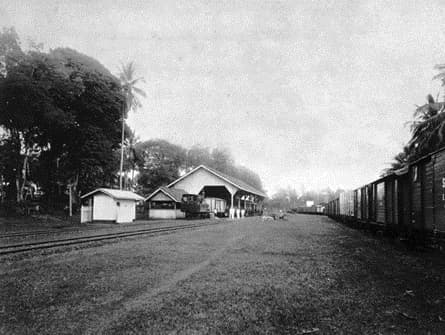
The Purwokerto-Sokaraja Railway Line
Purwokerto and Sokaraja were two neighboring districts in the Banyumas Regency that came under Dutch colonial rule in 1830. Initially, Banyumas was an isolated inland region. In his end-of-term memorandum (Memorie van Overgave), J.J. Helsdingen described the geographical constraints of Banyumas: it was traversed by the Serayu River, lacked inter-regional roads, and was surrounded by hills, leaving the regency completely cut off. Before the era of modern transportation, the Serayu River served as the primary transport route to carry agricultural yields from Banyumas to the port of Cilacap.
In 1879, the state-owned railway company Staatsspoorwegen (SS) constructed a railway line connecting Yogyakarta and Cilacap. Developing a rail network to Cilacap was deemed essential because the town possessed a potential port for coffee and sugar plantations in southern Java and Yogyakarta. The 187.283-km Yogyakarta-Cilacap railway network was completed in 1887. Shortly thereafter, the idea emerged to extend the line into the Banyumas interior, specifically targeting Purwokerto and Sokaraja. This proposal was driven by a growing plantation industry and the presence of sugar mills in both districts. The initiative was pushed forward by private sugar entrepreneurs in Banyumas, notably from the Purwokerto Sugar Mill and the Kalibagor Sugar Mill. Trains were considered an efficient means of transport to move industrial products into and out of Banyumas.
In 1895, the Dutch colonial government signed a memorandum of agreement with a private company, Serajoedal Stoomtram Maatschappij (SDS), to build a short-distance light rail (tram) network in the Banyumas interior. The development was led by Amsterdam-based directors Mr. F. S. Van Nierop, Voorz A. Van Hobeken, and Van Cortgene, alongside the chief of operations, J.D. Ruys, who resided in Purwokerto. The construction of the tram network in inland Banyumas spanned from Maos to Banjarnegara and was completed in several phases. The first phase connected Maos to Purwokerto, followed by the Purwokerto-Sokaraja line, with the Sokaraja-Purwareja section built in the final phase.
The second phase of development—the 8.6-km Purwokerto-Sokaraja line—was officially inaugurated on December 5, 1896. Built across residential areas, the project was completed rapidly due to a massive workforce. Workers were brought in from Purwokerto, Sokaraja, and as far as the Bagelen and Kedu regions, and were paid either on a daily basis or per job completion.
Two stations and two halts were built along the Purwokerto-Sokaraja route: East Purwokerto Station, Pasar Purwokerto Halt, Sangkalputung Halt, and Sokaraja Station. Since the primary objective of the Purwokerto-Sokaraja line was to transport sugar, the tracks were laid close to the sugar mills. Purwokerto Station was built behind the Purwokerto Sugar Mill, which had been operating since 1893. Meanwhile, Sokaraja Station was built to the north (about 500 meters) of the Kalibagor Sugar Mill, which had been active since 1838. To ease the logistics, both sugar mills built narrow-gauge plantation tracks (lori) connecting the sugarcane fields directly to the stations. Sugar produced at the Kalibagor Sugar Mill was hauled via these plantation tracks to Sokaraja Station, and likewise for the Purwokerto Sugar Mill to Purwokerto Station. From there, the sugar was transported using the SDS steam tram to Cilacap Port, where it was shipped to Europe.
The SDS railway line in inland Banyumas did not only handle export commodities; it was also used to transport sugar mill supplies coming from outside Banyumas, and even from abroad, such as seeds, fertilizers, limestone, machinery, fuel, and sugar packaging materials. Except for the short haul from the plantations to the mill, the entire output of the Kalibagor Sugar Mill was transported from this station via the tram. Outbound cargo bound for export consisted of sugar and cane syrup. Inbound cargo delivered to the mills included industrial supplies like stone, limestone, machinery, metal, fuel, and sugar sacks, alongside agricultural supplies like seeds and fertilizers.
In addition to freight logistics, the SDS tram on the Purwokerto-Sokaraja line was highly utilized for passenger travel. Locals used the SDS trains for daily commuting, such as visiting relatives, going to local markets, trading, and other purposes. Passenger data for the SDS train along the Purwokerto-Sokaraja line can be seen in the table below:
Passenger Volume per Stop (1920–1924)
| Station / Halt | 1920 | 1921 | 1922 | 1923 | 1924 |
|---|---|---|---|---|---|
| Purwokerto Station | 617,010 | 568,170 | 456,236 | 370,813 | 322,235 |
| Pasar Purwokerto Halt | 180,133 | 166,371 | 128,681 | 99,529 | 77,289 |
| Sangkalputung Halt | 11,690 | 12,437 | 12,692 | 9,330 | 6,654 |
| Sokaraja Station | 663,945 | 581,698 | 446,130 | 353,081 | 300,867 |
(Source: Purnawan Basundoro, “Transportasi dan Ekonomi di Karesidenan Banyumas Tahun 1830-1940,” Postgraduate Thesis, Department of History, Faculty of Cultural Sciences, UGM, 1999)
The opening of the rail network in inland Banyumas brought substantial profits to SDS. In 1929, SDS recorded a net profit of 813,736.39 guilders. In the subsequent years of 1930, 1931, and 1932, the profits stood at 522,832.22 guilders, 370,717.90 guilders, and 427,583.44 guilders respectively. This decline in revenue was caused by the Great Depression (malaise) that hit in the early 1930s, causing sugar prices in the market to plummet drastically. In 1933, both the Purwokerto Sugar Mill and the Kalibagor Sugar Mill were forced to close down. This severely impacted the profits of the SDS railway, given that sugar was the single largest commodity transported by the company. The Kalibagor Sugar Mill eventually reopened later in 1936.
The presence of the SDS tram line connecting Purwokerto and Sokaraja had a highly positive impact on the development of both areas, particularly in the economic sector. The SDS tram significantly accelerated the shipment of industrial goods to Cilacap Port and simplified passenger mobilization across Banyumas. Furthermore, the tram line sparked regional growth through the construction of train stations, which quickly transformed into bustling hubs of high-intensity activity. Sokaraja and Purwokerto were no longer isolated backwaters. In fact, due to this rapid development, an SS Inspector named J.K. Kempees proposed that the capital of Banyumas be moved to Sokaraja. Ultimately, the capital of Banyumas was indeed relocated in 1936—not to Sokaraja, but to Purwokerto.

Image 1: Map of the SDS tram line in the inland Banyumas region during the 1920s. The map illustrates that the SDS railway line was built in close proximity to sugar mills, including Purwokerto Station and Sokaraja Station. (Source: Banjoemas.com)

Image 2: Sokaraja Station between 1900 and 1905. Previously located east of the Sokaraja Market, this was the busiest station owned by SDS. The loading and unloading of goods for the Kalibagor Sugar Mill took place here. The Kalibagor Sugar Mill was the first and largest sugar factory in Banyumas. (Source: tropenmuseum.nl)

Image 3: East Purwokerto Station. Today, the building is used as a commercial storefront area on Jalan Stasiun Timur, located across from the PT KAI Daop 5 Purwokerto office. (Source: Banjoemas.com)

Image 4: The Purwokerto Sugar Mill, built in 1893. The company was managed by M. C. Brandes. (Source: Banjoemas.com)

Image 5: A steam locomotive ready to haul sugar in front of the Kalibagor Sugar Mill in 1905. (Source: tropenmuseum.nl)
Sources:
J. J Helsdingen, “Memori Residen Banyumas, 14 Mei 1928” Memori Serah Jabatan 1921-1930 (Jawa Tengah), Jakarta: National Archives of the Republic of Indonesia, 1977, p. CV.
M. J. van der Pauwert, “Memori Residen Banyumas, 24 Oktober 1925” Memori Serah Jabatan 1921-1930 (Jawa Tengah), Jakarta: National Archives of the Republic of Indonesia, 1977, p. XCIX.
Nurahmi, Prima Mulyasari, “Modernisasi dan Tata Ruang Kota Purwokerto 1900-1935” in Patrawidya Journal Volume 15, December 2014.
Purnawan Basundoro, “Transportasi dan Ekonomi di Karesidenan Banyumas Tahun 1830-1940,” Postgraduate Thesis, Department of History, Faculty of Cultural Sciences, UGM, 1999.
Tim Telaga Bakti Nusantara, Sejarah Perkeretaapian Indonesia, (Bandung: Percetakan Angkasa, 1997).
Banjoemas.com
Kitlv.nl
Tropenmuseum.nl