
The Construction of the Karawang-Rengasdengklok Tram Line
The Krawang Residency was located to the east of the Batavia (Jakarta) Residency. During the Dutch colonial administration, the Krawang Residency consisted of eight districts (currently equivalent to regencies): Purwakarta, Cikampek, Karawang, Rengasdengklok, Subang, Segalaherang, Pegaden, and Pamanukan. The Karawang Residency was a fertile region where most of the land was utilized for plantations and agriculture. The majority of plantation production was rubber or tea, which was managed by 48 plantation companies. The agricultural products yielded included rice, vegetables, and fruits. Both plantation and agricultural goods were sent to the Tanjung Priok Port in Jakarta using horse-drawn carts (known as cikar). At that time, this mode of transport had limited cargo capacity and required long travel times. As plantation productivity increased alongside the need for rapid transportation, a more modern transport facility was built connecting Jakarta to Karawang: the railway.
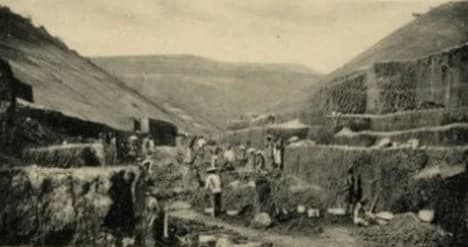
The construction of the 63 km Jakarta-Karawang railway line was carried out by a private railway company, Bataviasche Ooster Spoorweg Maatschappij (BOS), using a 1,067 mm track gauge. The construction was done in stages and successfully reached Karawang on March 20, 1898. However, during the process, BOS experienced a shortage of capital and requested assistance from the Dutch government. BOS managed to secure an injection of funds on the condition that once the railway line was completed, they had to hand over its management to the government. After the railway line was finished up to Karawang, it was purchased by the government railway company, Staatsspoorwegen (SS).

Image 1. Railway line construction in Karawang around 1898. (Source: kitlv.nl)
Stages of the Jakarta-Karawang Railway Construction
| Railway Section | Length (km) | Inauguration Date |
|---|---|---|
| Jakarta-Bekasi | 27 | March 31, 1887 |
| Bekasi-Cikarang | 17 | August 14, 1890 |
| Cikarang-Kedunggede | 13 | June 21, 1891 |
| Kedunggede-Karawang | 6 | March 20, 1898 |
(Source: Iman Subarkah, Sekilas 125 tahun Kereta Api Kita)
Staatsspoorwegen (SS) facilitated the transportation of processed rubber from Karawang to the Tanjung Priok Port, which was subsequently shipped to the United States. The processed rubber was eventually sold to tire factories in the US. At that time, rubber processing in Karawang was already utilizing methods standard to American tire factories.
To further expand transportation reach, branch lines in the form of trams with a 600 mm track gauge were constructed to several areas considered to have high potential. This aimed to accelerate the transport process from production centers, some of which were located in the hinterlands, far from the newly built main railway lines. Furthermore, as a government entity, SS had an obligation to open transportation access to facilitate public mobility. Among the areas where branch lines were built was Karawang, covering the Cikampek-Wadas, Karawang-Wadas, and Karawang-Rengasdengklok routes.

Image 2. Map of the Karawang-Rengasdengklok tram line marked in red, 1922. (Source: kitlv.nl)
Tram Line Operations and Characteristics
The characteristics of a tram differ from those of a traditional train. Trams have smaller locomotives and carriages, lower speeds, smaller transport capacities, and operate over shorter distances. Additionally, the decision to open a tram line could simply be made by the local government head (Resident), unlike railway lines which had to be authorized by the central government, either in The Hague or Jakarta.
The 36 km Karawang-Rengasdengklok tram line was inaugurated on June 15, 1919. To serve as boarding and loading points for passengers and freight, SS built stops at Karawang, Tjinango, Lamaran, Tegalsawah, Rawagedeh, Kobakkarim, Pataruman, Babakndjati, and Rengasdengklok. According to a report by the Resident of Karawang, Poliver, in October 1928, the construction of the Karawang-Rengasdengklok tram was primarily intended to expedite the transportation of rice to Karawang. The Rengasdengklok, Karawang, and Cikampek areas possessed the highest number of rice mills in the Karawang Residency, totaling 70 mills, all of which were owned by Chinese businessmen.
On the Karawang tram line, the locomotives utilized were TC10 type steam locomotives made by the Hartman factory in Germany, and TD10 types manufactured by Werkspoor in the Netherlands. These two locomotives differed in their wheel arrangements, wheel diameters, and cylinder sizes. Today, we can still find these two types of locomotives. There are three remaining TC10 steam locomotives: TC1008, TC1011, and TC1015. Locomotive TC1008 serves as a monument in front of Bandung Station, TC1011 is part of the TMII museum collection, and TC1015 is displayed as a monument inside the Manggarai Railway Workshop. There is only one remaining TD10 steam locomotive, TD1002, which is displayed as a monument in front of the Head Office of PT Kereta Api Indonesia (Persero).

Image 3. Locomotive TC1008 in front of Bandung Station. (Source: heritage.kereta-api.co.id)

Image 4. Steam locomotive TD1002 as a monument in front of the PT Kereta Api Indonesia Head Office. (Source: heritage.kereta-api.co.id)
Japanese Occupation and the Struggle for Independence
During the Japanese occupation (1942-1945), all railways in Indonesia were controlled by the Japanese, leading to the formation of the Rikuyu Sokyoku (Railway Service). The railway line in Karawang fell under the Seibu Kyoku (Western Exploitation) division, headquartered at Jakarta Kota Station. Following Indonesia's proclamation of independence on August 17, 1945, the spirit of freedom spread across the regions. Indonesian fighters took action to seize important institutions from Japanese hands, including the railways. The railway in the Western Exploitation division was successfully captured by the fighters on September 4, 1945, when they occupied Jakarta Kota Station.
The Indonesian railway company, Djawatan Kereta Api Republik Indonesia (DKARI), was established after the takeover of the Railway Head Office in Bandung on September 28, 1945. However, this victory was short-lived, as the Dutch returned to Indonesia and established the Dutch railway service, Staatsspoorwegen/Vereenigde Spoorwegbedrijf (SS/VS). DKARI's operational territories became increasingly threatened by the presence of SS/VS. Nevertheless, DKARI, supported by the Indonesian National Armed Forces (TNI), constantly strove to defend its operational areas.
There was a notable incident during the effort to defend the Karawang area. DKARI and the TNI attempted to repel the advancing Dutch troops during the First Dutch Military Aggression, which was launched on July 21, 1947. The Indonesian side devised a strategy to halt the Dutch army's movement by attempting to blow up the Tanjungpura railway bridge in Karawang using explosives. However, the strategy failed when DKARI and TNI forces were showered with bullets by Dutch Mustang aircraft just as they were about to plant the explosives on the bridge.
This failure did not cause the Indonesian forces to surrender. In another attempt to repel the Dutch troops, DKARI and the TNI dispatched an empty C2847 series locomotive from Karawang Station towards Kedunggedeh. At high speed, the locomotive collided with a series of SS/VS trains, creating a thunderous roar. Unfortunately, this effort did not result in any casualties on the Dutch side, as the Dutch troops had already disembarked from the train. Despite failing once again, the strategy employed by DKARI and the TNI illustrated the immense persistence of DKARI workers and TNI troops in defending Indonesia's independence.

Image 5. The condition of the Tanjungpura Bridge in 1946. (Source: "Kisah Jembatan KA Tanjungpura", Kontak Magazine, December 2016)

Image 6. The aftermath of the steam locomotive collision on the east side of the Tanjungpura Bridge, Karawang, on July 21, 1947. (Source: "Kisah Jembatan KA Tanjungpura", Kontak Magazine, December 2016)
Decline and Current State
Around the 1970s, the tram lines in Karawang began to cease operations. The trams in Karawang could not compete with automobiles, which were becoming increasingly prevalent, causing PJKA (the state railway company) to suffer financial losses. Despite this, remnants of the Karawang-Rengasdengklok tram line can still be found today, including former bridge foundations, bridges, and railway tracks. Surviving structures, such as sturdy iron bridges, are now utilized by local residents as pedestrian crossings.

Image 7. Remains of the Karawang-Rengasdengklok tram bridge foundation structure. (Source: semboyan35.com)

Image 8. The remains of the tram track starting to be covered by soil. (Source: semboyan35.com)

Image 9. Former tram bridge on the Rawagedeh-Tegalsawah section. (Source: semboyan35.com)

Image 10. A railway bridge converted into a highway bridge. This bridge was inaugurated in 1984 under the name Kalang Surya Bridge by the Karawang Regency government. (Source: semboyan35.com)
Sources:
ANRI, Memori Serah Jabatan 1921-1930 (Jawa Barat), Jakarta, 1976
APP, "Kisah Jembatan KA Tanjungpura", in Kontak Magazine, December 2016
DKA, Buku Djarak Untuk Djawa dan Madura, Bandung, 1950
Hatmawan, Adhitya, "Perkembangan Transportasi Kereta Api di Batavia 1870-1925", Undergraduate Thesis at the University of Indonesia, 2002
Iman Subarkah, Sekilas 125 tahun Kereta Api Kita, Bandung, 1992
Kitlv.nl
Marihandono, Djoko, et al., Dari Konsensi ke Nasionalisasi: Sejarah Kereta Api Cirebon-Semarang, Bandung, 2016
Susatya, Rachmat, Pengaruh Perkeretaapian di Jawa Barat Pada Masa Kolonial, Bandung, 2008