
Construction of the Bogor-Sukabumi Railway Line
The Bogor-Sukabumi railway line was part of the development of the Bogor-Bandung-Cicalengka line, which was the first railway network leading into the Priangan region. This construction stemmed from the government's desire to connect Priangan with Batavia (Jakarta) in an effective and efficient manner. Connecting these two regions was essential for economic interests. Prior to this, a private railway company, Nederlandsch Indische Spoorweg Maatschappij (NISM), had inaugurated the Jakarta-Bogor railway network on January 31, 1873.
The construction of the Bogor-Sukabumi railway line was authorized under the Law of June 6, 1878, published in the State Gazette (Staatsblad) Number 201. The initial step taken was surveying and mapping, which began in 1878. This work was supervised by European, Chinese, and native foremen. The scope of the surveying and mapping was divided into five sections, with the Bogor-Sukabumi line falling into the first section, which spanned 33.68 km from Bogor to Parungkuda.
Following the mapping phase, land acquisition was carried out by the Ministry of Public Works (Burgerlijk Openbare Werken). This was followed by excavation, embankment, and masonry work. The excavation and embankment of the ground commenced from the direction of Bogor. Masonry and cementing works were executed to construct various structures, such as bridge pier foundations, stations, official residential quarters, and other facilities. The required raw materials were supplied from other regions; lime was transported from Parungkuda or Bogor, while bricks were obtained from Depok.
The next step involved laying the tracks and iron components. Before the rails were installed, wooden sleepers made of teak wood were laid down. This timber was sourced from a contracting company owned by Dijkman, located in the Jepara region. Meanwhile, heavy iron materials were imported from Europe.
The completion of the Bogor-Bandung-Cicalengka railway line was carried out in stages. The 27-km Bogor-Cicurug section was completed on October 5, 1881. Subsequently, the 31-km stretch from Cicurug to Sukabumi was opened to the public on March 21, 1882.
In 1899, records show that there were four daily train trips from Bogor to Sukabumi, as well as five daily trips on the Garut-Cibatu route. Trains running between Bogor and Sukabumi were divided into three service classes: 1st Class, 2nd Class, and 3rd Class. This class division was based on social status, reflecting the strict social stratification in place at the time. 1st Class was designated for Europeans, 2nd Class for Foreign Orientals (such as Chinese and Arabs), and 3rd Class was reserved specifically for the native population (pribumi).
The differences in train classes also determined the ticket pricing. For instance, a ticket for the Bogor-Sukabumi route cost 3.5 guilders for a 1st Class passenger, 2.25 guilders for 2nd Class, and 0.87 guilders for 3rd Class. Meanwhile, the baggage fee was set at a flat rate of 0.17 guilders per 10 kg.

Image 1: The Bogor-Sukabumi railway line is marked with a red line, 1896 map. (Source: Kitlv.nl)

Image 2: Front view of Bogor Station around 1900. (Source: KITLV 106157)

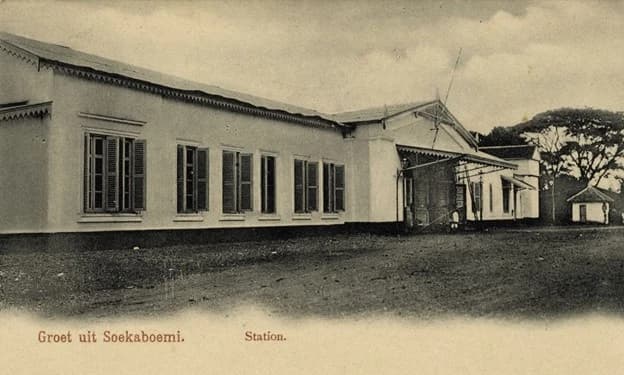
Image 3: The atmosphere of Sukabumi Station between 1895 and 1908. (Source: Kitlv.nl)
Sources:
Mulyana, Agus, Melintasi Pegunungan, Pedataran, Hingga Rawa-rawa: Pembangunan Jalan Kereta Api di Priangan 1878-1924
Officieele Reisgids voor Spoor en Tramwegen op Java 4e Uitgave 1 December 1898
Reitsma, Korte Geschiedenis der Nederlandsch Indische Spoor en Tramwegen