
Tourism in the Dutch East Indies Era: Taking the Train from Batavia to Garut
TABLE OF CONTENTS
Europa in de Tropen
Since the Dutch colonial era, the Priangan region has been renowned for its natural beauty and exotic landscapes. The specific areas in Priangan included Bandung, Cianjur, Sukabumi, Tasikmalaya, and Garut. The Priangan Residency earned numerous nicknames, such as Europa in de Tropen (Europe in the Tropics), Parijs van Java, Geneve van Java, Montpellier of Java, and Switzerland van Java. M.A.W. Brouwer, a Dutchman who once lived in the region, famously remarked that "the land of Pasundan was created when God was smiling."
The Charm and Appeal of Garut
The sprawling mountainous terrain of Garut offers breathtaking panoramic views. During the colonial period, Garut was a prominent tourist destination in Priangan. The area features several mountains, including Cikuray, Sadakeling, Papandayan, Guntur, Haruman, and Kaledong. The soil throughout this region is highly fertile, heavily planted with coffee, tea, and cinchona, alongside large areas dedicated to agriculture.

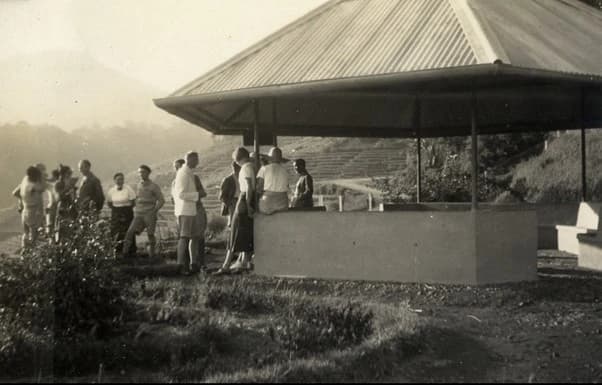
Image: A group of Europeans enjoying a leisure trip amidst the beautiful scenery of the Priangan region in 1937. (Source: KITLV)
Iron Roads Reach Garut
Despite its fertile land and captivating views, Garut's mountainous geography initially left the region isolated. The steep, winding roads cutting through the mountains made transport by horse carts difficult and time-consuming. To solve these transportation issues, the state-owned railway company Staatsspoorwegen (SS) constructed a railway network extending into Garut.
The construction of the railway line to Garut began from Cicalengka in 1887 as part of the broader Priangan–Cilacap railway development project. On August 14, 1889, the 51-kilometer Cicalengka–Garut railway line was officially opened to the public. The Governor-General of the Dutch East Indies inaugurated the route with a grand celebration. Later on, the line was extended further to Cikajang in 1921.

Map: The Cicalengka–Garut railway line is marked by the red-and-black line on this 1913 map. Built sequentially as stopping points were Nagreg Stop, Lebakjero Stop, Leles Stop, Leuwigong Stop, Cibatu Station, Cikoan Stop (Stooplats), Pasirjengkol Stop, Citameng Stop (Stooplats), Wanaraja Stop, Tungilis Stop (Stooplats), Cimurah Stop, Sukarame Stop (Stooplats), and Garut Station. (Source: KITLV)
Traveling to Mount Cikuray
An European traveler named H.M. Tomlinson recounted his journey to Garut by train from Batavia. He departed from Kemayoran Station toward Cibatu Station, before transferring to a train bound for Garut Station. At the time, the train was the preferred mode of transportation, offering passengers a thrilling and pleasant experience. Travelers were treated to views of sweeping mountains and valleys, alongside the unforgettable experience of crossing high, long bridges and passing through deep tunnels.
Upon arriving in Garut, Tomlinson continued his journey the next morning to visit Mount Cikuray, passing through a well-preserved small village. From the peak of Mount Cikuray, the lush green expanse of the Garut valley unfolded below—a landscape he noted could likely never be found in Europe or America. Impressed by the panoramic beauty, Tomlinson described Garut as a "Garden of Eden."

Image: A panoramic view of the beautiful rice fields in Garut in 1920, with Mount Cikuray towering majestically in the background. (Source: KITLV)
Charlie Chaplin’s Holiday in Garut
The legendary English comedian Charlie Chaplin is famously said to have visited Garut. Chaplin arrived in Garut on March 30, 1932, after touring Batavia and Bandung. Although he only stayed for a single night at a local hotel, Chaplin had a delightful experience that sparked numerous ideas for his comedy films.
It is highly probable that Chaplin traveled to Garut by train. This theory is supported by a photograph of Chaplin published in the January 15, 1995 edition of Moesen magazine, captioned "Charlie Chaplin op het perron van station Garoet, 1932" (Charlie Chaplin on the platform of Garut station, 1932). The photograph belongs to the collection of Ernst Drissen, who is known to have lived in Garut.

Image: A photograph from the Ernst Drissen collection captioned "Charlie Chaplin in front of the platform of Garut Station, 1932." The text "Chaplin at Garoet" is scribbled across the photo. (Source: Naratesgaroet.net)
Reactivation of the Garut Railway Line
The Cibatu–Garut railway line was closed on February 9, 1983, as passengers shifted to other forms of land transport, such as cars, buses, and trucks. During its operational years, traveling the 19-kilometer stretch between Cibatu and Garut took about 50 minutes, with a station or stop located roughly every four kilometers. In 1926, records show there were six daily train trips from Cibatu to Garut, as well as six returning trips. The trains on this line were pulled by the "Si Gombar" locomotive, a legendary and exceptionally powerful steam engine iconic to Garut.

Image: The atmosphere at Garut Station around 1910. (Source: KITLV)
Today, the tracks and railway bridges heading toward Garut are still visible. Station buildings like Pasirjengkol, Wanaraja, and Garut remain standing, though they have undergone several structural modifications. After being inactive for 45 years, the Cibatu–Garut route is planned for reactivation in 2018 through a collaborative effort between the Central Government, the West Java Provincial Government, and PT KAI.

Image: The state of Garut Station in 2018 during the Cibatu–Garut–Cikajang historical trail event. (Source: APA Collection)
Sources:
Andika, Ariwibowo, "Wisata Alam di Karesidenan Priangan Pada Periode Akhir Kolonial (1830-1942)"
Mulyana, "Melintasi Pegunungan, Pedataran, Hingga Rawa-rawa: Pembangunan Jalan Kereta Api di Priangan 1878-1924"
Naratesgaroet.net
Official Tourist Bureau Batavia, "Java The Wonderland"
PPK No: 11