
Railways in Madura
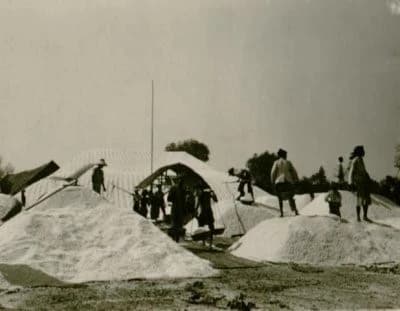
In the 17th century, the primary trade commodities in Java were rice, tobacco, and salt. One of the regions producing exceptionally high-quality salt was Madura. Since the era of local governance, salt had already become a crucial commodity on the island. It was distributed from Madura via the Parindiuan Port located in the south to various ports along the Madura Strait, such as Surabaya and Gresik.
Salt production was initially dominated by Chinese entrepreneurs. After the Dutch government took control of Madura at the beginning of the 20th century, they took over salt production from the Chinese and monopolized it. This salt monopoly policy successfully boosted production, establishing Madura Island as a major salt producer. This success was deeply tied to the efficiency of salt transportation across the island. Salt logistics were handled by the Dutch shipping company Koninklijke Paketvaart Maatschappij (KPM), the salt factory transport fleet Oost-Java Zeetransport (OJZ), and the private railway company Madoera-stoomtram Maatschappij (MSM).

Image 1: Salt processing in Sumenep, 1920. (Source: media.kitlv.nl)
MSM was a private railway company that operated in Madura under the Royal Decree (Koninklijk Besluit) No. 48, dated July 19, 1897. Prior to this, a concession for building a railway in Madura had been proposed on September 26, 1896, by E. M. Collard. The establishment of this company was closely linked to the distribution of Madura's export commodities, particularly salt.
The construction of the railway network in Madura by MSM began in 1897 and was completed in 1913. At the start of its development, MSM secured an initial capital of ƒ3,000,000 from investors. By 1901, the railway line connected the eastern and western sides of Madura, stretching from Kalianget to Kamal. The construction of this line was also a strategic effort to optimize Kalianget Port and Kamal Port. Kamal itself was an important small town in Western Madura that served as a transit point for passengers looking to cross over to Surabaya.

Image 2: Map of the Railway Network in Madura, 1922. (Source: media.kitlv.nl)
Details of the Railway Line Construction in Madura:
| No | Route Section | Distance (km) | Opening Date |
|---|---|---|---|
| 1 | Kamal – Bangkalan | 18 | December 8, 1898 |
| 2 | Bangkalan – Tunjung | 5 | March 15, 1899 |
| 3 | Tunjung – Kwanyar | 22 | February 26, 1900 |
| 4 | Tunjung – Kapedi | 45 | September 20, 1900 |
| 5 | Kapedi – Tambangan | 24 | January 21, 1900 |
| 6 | Tambangan – Kalianget | 20 | February 17, 1900 |
| 7 | Kwanyar – Balega | 33 | March 11, 1901 |
| 8 | Tanjung – Sampang | 15 | March 11, 1901 |
| 9 | Balega - Sampang | 26 | July 1, 1901 |
| 10 | Kamal – Kwanyar | 16 | September 1, 1913 |
(Source: Iman Subarkah, Sekilas 125 Tahun Kereta Api Kita 1867-1992)
During that era, a journey from Sumenep to Kamal to cross over to Surabaya could be completed within a single day. MSM operated multiple routes daily: Surabaya–Kamal (5 times), Kamal–Bangkalan (5 times), Kwanyar–Kamal (4 times), Balega–Kamal (3 times), Pamekasan–Kamal–Surabaya (2 times), and Maringan–Kamal–Surabaya (1 time).
Aside from serving passengers—many of whom had a strong culture of migration—MSM held a transportation contract with the government to haul salt. Between 1902 and 1908, MSM secured the exclusive monopoly rights for salt transportation across the Madura and East Java regions.

Image 3: Salt Industry in Krampon around 1914, showing the narrow-gauge tracks used for salt distribution. (Source: Tropenmuseum.nl)
As MSM's transportation business grew, the private railway company expanded its services. In 1922, MSM introduced road freight transport, followed by the launch of a bus service in 1928, starting with a fleet of 13 buses. These bus services operated through southern Madura, covering routes such as Kamal–Bangkalan, Balega–Pamekasan, Pamekasan–Kalianget, Sumenep–Tenbaru, and Kamal–Kwanyar. By 1930, MSM managed 224 km of railway track, operating 33 steam locomotives and 367 train cars. Additionally, the company operated 23 buses, 4 steamships, and 17 boats.

Image 4: MSM railway bridge over the Sampang River, Madura. (Source: Tropenmuseum.nl)
Sources:
Kitlv.nl
Kuntowijoyo, “Social Change In An Agrarian Society: Madura 1850-1940”, UGM Dissertation
Masykur, M. Ismail, “Kereta Api di Madura Tahun 1896-1929”, Universitas Airlangga Thesis
National Archief, Inventaris van het archief van de NV Madoera Stoomtrammatschappij, (1896) 1897-1973
Subarkah, Iman, Sekilas 125 Tahun Kereta Api Kita, Bandung, 1992
Syafi’i, Imam, “Persaingan Pengangkutan Garam di Selat Madura Tahun 1924-1957”, in UNM Historical Journal
Tropenmuseum.nl