
The Solo–Semarang Sugar Industry Railway Line
TABLE OF CONTENTS
An Overview of Sugarcane Plantation Development in the Vorstenlanden
The Cultivation System (Cultuurstelsel), which was introduced in Java in 1830, was not applied to the Vorstenlanden (Yogyakarta and Solo) regions. Instead, a land-lease system was practiced in these two areas. Under this system, land tenants—mostly Europeans and Chinese—leased land from aristocrats who had been granted the land by the king as a form of salary.
By the mid-19th century, land leasing experienced a significant increase in both the Mangkunegaran and Kasunanan regions of Solo. Initially, most of the leased land was dedicated to coffee cultivation. Alongside coffee, tobacco and sugarcane began to emerge as widely grown export commodities. Between 1846 and 1850, sugarcane exports grew rapidly enough to rival coffee.
Sugar Companies in Solo (1863)
| District | Number of Companies | Area (ha) | Number of Workers | Production (tons) |
|---|---|---|---|---|
| Sragen | 18 | 10,145 | 3,661 | 815 |
| Boyolali | 11 | 6,135 | 4,527 | 1,358 |
| Klaten | 9 | 8,674 | 6,523 | 2,515 |
| Kartasura | 3 | 1,943 | 1,575 | 741 |
(Source: Waskito Widi Wardojo, Spoor Masa Kolonial)
The Semarang–Solo Railway
Following the implementation of the Cultivation System in Java, sugar production expanded, especially after the enactment of the Agrarian Law of 1870. Sugar had to be transported from inland production centers to ports to be shipped to Europe. Until the mid-20th century, sugar transport in Java relied heavily on animal-drawn carts (cikar) pulled by cows or horses along public roads. Even before the sugar industry emerged in Solo, the Solo–Semarang route was already connected by a main highway. This road was vital as it linked inland production to maritime transport at the Port of Semarang. In some areas, small riverboats (gethek) were also utilized.
To optimize transport efficiency, the Dutch government repaired and paved existing roads and opened new ones. However, these policies were still deemed insufficient because transporting goods via horse carts or riverboats was limited by load capacity and slow speeds. At the time, a cart pulled by two animals could only carry between 300 to 425 kg at a speed of 15 to 18 km per hour. Meanwhile, human porters could only carry loads of 31 to 62 kg and cover a maximum distance of 18 to 24 km in a single day. Consequently, shipping goods from Solo to Semarang took up to 6 days by cart and 4 days by human porters. Therefore, a modern transportation infrastructure capable of moving large volumes of cargo in a shorter time was urgently needed: the railway.
Although the idea of building a railway line in Java first emerged in 1840, it could not be realized immediately. Driven by the urgent need for efficient transport, private entrepreneurs in Semarang petitioned the Dutch East Indies government to build a railway line connecting Semarang, Solo, and Yogyakarta. Finally, in 1864, construction began on the very first railway line in the Dutch East Indies. The project was executed by a private company, the Nederlandsch-Indische Spoorweg Maatschappij (NISM), through a concession granted by the Dutch East Indies government via Government Decree No. 1 on August 28, 1862.
The concession authorized NISM to open a railway line from Semarang to Yogyakarta via Solo. NISM appointed J.P. Bordes, a military engineer and NISM commissioner, to lead the construction. The project utilized wage laborers recruited from Blora, Rembang, Jepara, Grobogan, and Salatiga. Additionally, carpenters and blacksmiths were employed to manufacture sleepers and fabricate rails; most of these skilled workers came from Singen Kidul, Manggar, Grobogan, Purwodadi, Wirasari, Kragenan, and Salatiga.
On August 10, 1867, the 25-km Semarang–Tanggung railway line was officially inaugurated. The railway construction successfully reached Solo on February 10, 1870, and Yogyakarta on January 1, 1873. To facilitate passenger boarding and cargo loading, NISM built stops and stations. A "stop" (halte) was a minor station consisting of only one or two rooms with a very simple architectural design. In contrast, a "station" (stasiun) featured more comprehensive facilities than a stop, with multiple rooms dedicated to serving passengers and train operations. Station buildings were designed with architectural aesthetics in mind and utilized more durable materials suited to withstand the tropical climate.
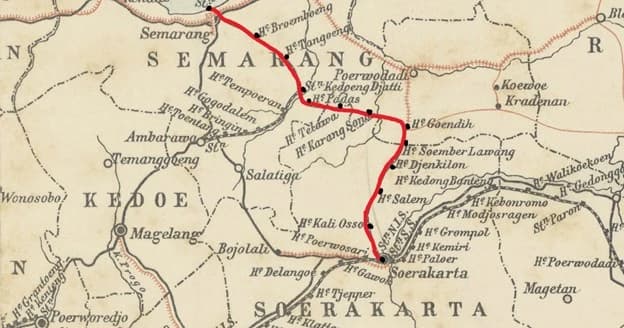
By 1872, the stops and stations operating along the Semarang–Solo line included Samarang Station, Brumbung Stop, Tanggung Stop, Kedungjati Station, Padas Stop, Telawa Stop, Salem Stop, Kalioso Stop, and Solo Station (Solo Balapan).
Construction of the Semarang–Solo Railway Line
| Section | Length (km) | Inauguration Date |
|---|---|---|
| Semarang–Tanggung | 25 | August 10, 1867 |
| Tanggung–Kedungjati | 9 | July 19, 1868 |
| Semarang–Port | 2 | July 20, 1868 |
| Kedungjati–Solo | 74 | February 10, 1870 |
(Source: Imam Subarkah, Sekilas 125 Tahun Kereta Api Kita 1867-1992)

Map: The Semarang–Solo railway line in 1896. (Source: media.kitlv.nl)
In 1870, the volume of sugar transported from Solo to the Port of Semarang reached 9,039 tons. Other primary export commodities transported included 3,248 tons of coffee and 83 tons of indigo. In terms of passenger services, NISM successfully sold 844 1st-class tickets, 10,206 2nd-class tickets, and 153,809 3rd-class tickets in that same year.
On June 10, 1872, NISM issued a new train timetable for the Semarang–Solo–Yogyakarta route. Based on this schedule, the journey between Semarang and Solo took approximately 4 hours. Trains departed from Semarang twice a day at 08:20 and 13:30 (with the afternoon slot prioritized for freight transport). Similarly, returning trains from Solo to Semarang departed twice a day at 06:50 (prioritized for freight transport) and 13:10.
NISM Passenger Fares
| Class | Cost per km (Guilders) | Total Fare in 1867 (Guilders) | Total Fare in 1906 (Guilders) | Total Fare in 1920 (Guilders) |
|---|---|---|---|---|
| 1st Class | 0.2 | — | 6 | 10 |
| 2nd Class | 0.15 | — | 3 | 6 |
| 3rd Class | 0.07 | — | 1.5 | 4 |
(Source: Compiled from G. Ambar Wulan, "Peranan dan Perkembangan Kereta Api di Jalur Semarang – Solo Pada Tahun 1864-1870" and Waskito Widi Wardojo, "Spoor Masa Kolonial")
NISM Freight Tariffs (1906)
| Class | Cost per 100 kg (Guilders) |
|---|---|
| Class 1 | 1.4 |
| Class 2 | 1.2 |
| Class 3 | 1.0 |
| Class 4 | 0.75 |
| Class 5 | 0.50 |
(Source: Waskito Widi Wardojo, Spoor Masa Kolonial)
Sources:
Ambar, G. Wulan, "Peranan dan Perkembangan Kereta Api di Jalur Semarang – Solo Pada Tahun 1864-1870", Undergraduate Thesis, Universitas Indonesia, 1985
Kitlv.nl
Subarkah, Imam, Sekilas 125 Tahun Kereta Api Kita 1867-1992, Bandung, 1992
Sulistyani, Harmilyanti, "Karakteristik Tata Ruang Dalam Bangunan Stasiun Kereta Api di Jalur Semarang-Vorstenlanden Periode 1864-1930", Master's Thesis in Architectural Engineering, Universitas Gadjah Mada, 2010
Widi, Waskito Wardojo, Spoor Masa Kolonial: Dinamika Sosial Ekonomi Masyarakat Vorstenlanden 1864-1930, Solo: Bukutujju, 2013
Tim Telaga Bakti, Sejarah Perkeretaapian Indonesia Jilid I, Bandung: Angkasa, 1997