
History of the Batavia–Bandung Railway Line via Karawang
TABLE OF CONTENTS
The Batavia–Karawang Railway Line
During the Dutch East Indies administration, several government and private railway companies operated in Batavia (Jakarta). The private company Nederlandsch-Indische Spoorweg Maatschappij (NISM) was the very first to build a railway line in Jakarta, opening the Jakarta–Bogor route (central line) in 1873. Staatsspoorwegen (SS), the state-owned railway company, operated the western line, which included the Jakarta–Tanjung Priok route inaugurated in 1886 and the Jakarta–Anyer line with a Duri–Tangerang branch line in 1899. Meanwhile, the Bataviasche Ooster Spoorweg Maatschappij (BOS) opened the eastern line connecting Jakarta, Bekasi, and Karawang. All of these lines used a 1,067 mm track gauge.
Based on the Law of June 9, 1898 (Staatsblad 222), BOS obtained the concession rights to construct a railway network in Jakarta. The construction was divided into four stages: Jakarta–Bekasi, Bekasi–Cikarang, Cikarang–Kedunggede, and Kedunggede–Karawang.
Construction Stages of the Batavia–Karawang Railway Line
| No. | Section | Inauguration Date | Distance (km) |
|---|---|---|---|
| 1 | Jakarta–Bekasi | March 31, 1887 | 27 |
| 2 | Bekasi–Cikarang | August 14, 1890 | 17 |
| 3 | Cikarang–Kedunggede | June 21, 1891 | 13 |
| 4 | Kedunggede–Karawang | March 20, 1898 | 6 |
(Source: DKA Magazine, June 1957)
The initial stage was successfully completed up to Bekasi on March 31, 1887. Initially, operations were managed by BOS. However, during the construction phase toward Karawang, BOS faced financial difficulties and poor management. As a result, BOS requested financial assistance from the Dutch East Indies government. The government agreed on the condition that once the work was completed, the Batavia–Karawang line would be taken over by SS. SS eventually poured 5 million guilders f 5 million into purchasing the Jakarta–Karawang line from BOS.
At that time, train fares were determined by passenger class. In 1900, for a trip from Jakarta to Karawang, a 1st-class ticket (for Europeans) cost f 4.7. For the same route, 2nd-class passengers (Foreign Orientals: Chinese, Arabs) paid f 2, 3rd-class passengers (mixed and natives) paid f 1.2, while inlanders (indigenous people) paid a special fare of just $f\ 0.66$. Meanwhile, the freight tariff was f 0.20 per 10 kg.

Map: The railway network in Jakarta in 1908. The red-and-white lines belonged to SS, while the black-and-white lines belonged to NIS. (Source: Kitlv.nl)

Timetable: The Jakarta–Karawang train schedule from the year 1900. (Source: Officieele Reisgids der Spoor- en Tramwegen en Aansluitende Automobildiensten op Java Madoera 1900)
Construction of the Karawang–Padalarang Railway Line
In 1901, SS continued the railway construction from Karawang to Padalarang. This project aimed to give SS full control over the railway line connecting Jakarta to the Priangan region. There were two primary interests driving this line: economic and military.
From an economic standpoint, the railway facilitated the transport of agricultural and plantation products for export to the ports in Jakarta, where they were shipped to Europe. Additionally, imported goods could be distributed to the inland areas of Priangan via train.
The military interest was closely tied to establishing a defensive line between the port in Batavia and the Priangan hinterland. Priangan's mountainous geography was highly strategic for defense, and the highlands were also considered a healthier environment.

Image: Railway line construction in Karawang around 1898. (Source: kitlv.nl)
The construction of the Karawang–Padalarang line sparked debates with pros and cons. Parliament members who opposed the project argued that it required a massive budget of around 12 million guilders f 12million. Furthermore, the areas traversed by the Karawang–Padalarang line were very sparsely populated, making it seem economically unprofitable and suggesting that military interests were overly dominant. Instead, they proposed that SS construct a double-track line from Jakarta to Bogor, and if necessary, extend it to Bandung.
On the other hand, the parliament members who supported the Karawang–Padalarang line put forward three main reasons:
The Karawang–Padalarang route would shorten the Jakarta–Bandung distance by about 36 km compared to the Jakarta–Bandung route via Bogor–Cianjur–Padalarang, thereby reducing travel times.
The presence of the railway would boost the economic potential of the communities in Southern Karawang and Northern Priangan, aligning with SS’s goal of improving public welfare.
The geographic structure of the Karawang–Padalarang route was deemed relatively safer than the Jakarta–Bogor–Bandung route, which passed through mountainous regions prone to earthquakes and landslides during the rainy season.
During construction, SS set up a semi-permanent office in Karawang. They also built warehouses and workshops to store iron and wood imported from Europe via the port in Batavia.
Surveying and measuring began earlier in 1898. Construction commenced from Karawang Station toward Padalarang Station, which was already part of the Bogor–Bandung–Cicalengka line. The 96-km-long construction project was divided into four sections. Track laying from Karawang to Purwakarta (a distance of 40.5 km) was successfully completed in November 1902. A month later, on December 27, SS officially opened the Karawang–Purwakarta section. By 1904, SS finished laying tracks in Ciganea. Ultimately, SS completed the entire Purwakarta–Padalarang line and opened it to the public on May 2, 1906.

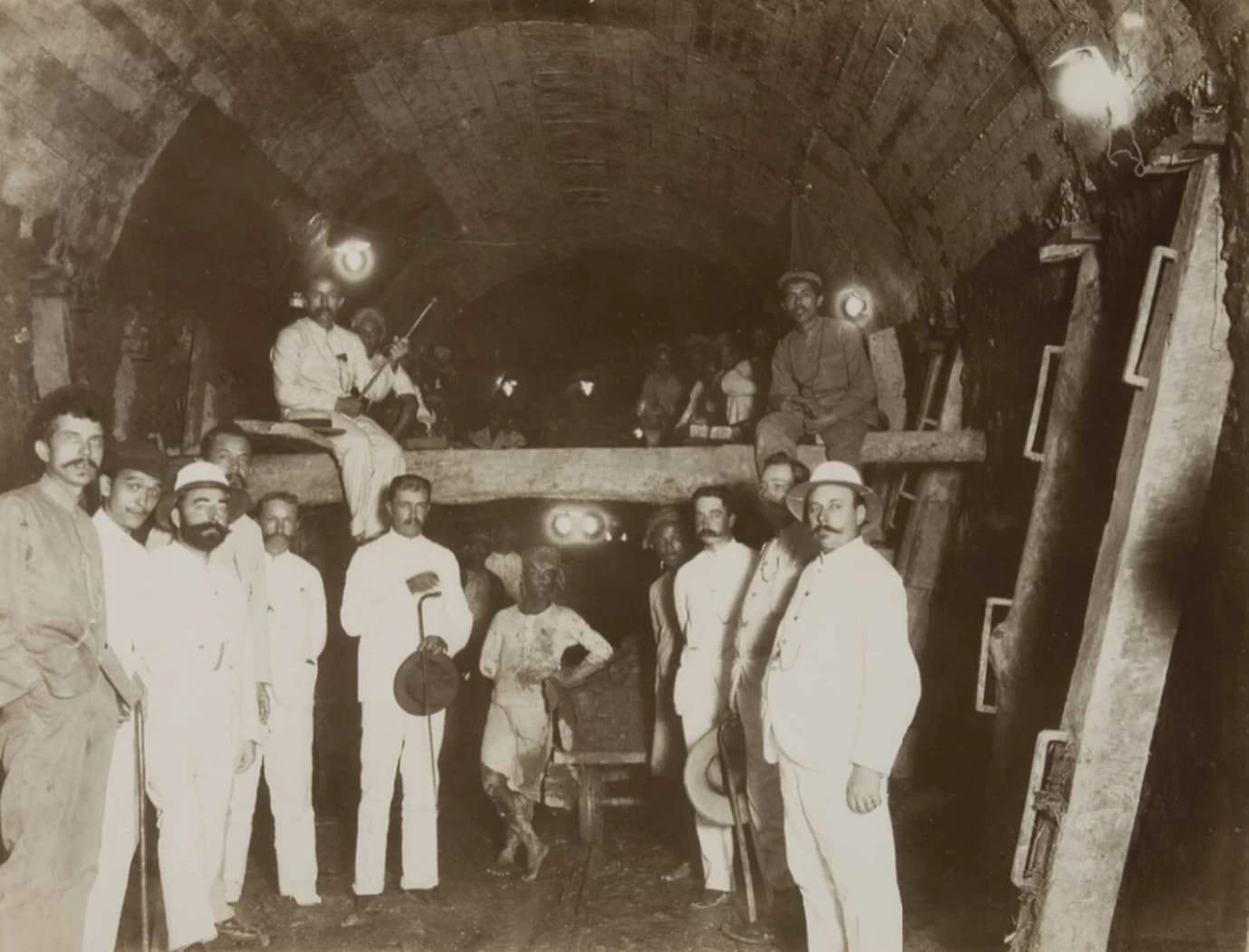
Image: A portrait of workers inside the Sasaksaat Tunnel, showing both European and indigenous laborers. This tunnel was built between 1902 and 1903. (Source: Tropenmuseum.nl)
Various classes of laborers were involved in building the Karawang–Padalarang line. Indigenous people and Chinese laborers mostly worked as coolies (manual laborers). Meanwhile, Europeans worked as branch heads, foremen, contractors, or technicians. Track laying in mountainous terrain required skilled labor. In areas with high levels of difficulty, military engineers (combat engineers) were deployed to lay tracks. For instance, from May 30 to October 21, 1904, 80 military engineers were deployed under the supervision of two lieutenants. These soldiers were tasked with helping lay tracks across Ciganea, Bendul, Plered, Cisomang, and Cilame. A barracks was built near Ciganea to serve as their rest quarters.
Expansion of the Tram Network in Priangan
To expand its transportation reach, SS built branch lines in the form of trams to several areas considered to have high potential. This aimed to accelerate transport from production centers, many of which were located inland and far from the newly constructed main railway lines. Furthermore, as a state company, SS had an obligation to open up transportation access to facilitate public mobility and enhance community welfare. One of the areas where these branch lines were built was Karawang, utilizing a 600 mm track gauge to cover the Cikampek–Wadas, Lamaran–Wadas, and Karawang–Rengasdengklok routes.
Tram Lines in Karawang
| No. | Section | Inauguration Date | Distance (km) |
|---|---|---|---|
| 1 | Cikampek–Cilamaya | July 1, 1909 | 28 |
| 2 | Cikampek–Wadas | June 15, 1912 | 16 |
| 3 | Karawang–Rengasdengklok | June 15, 1919 | 21 |
| 4 | Lamaran–Wadas | February 9, 1920 | 15 |
(Source: DKA Magazine, June 1957)
Tram Lines in Bandung
| No. | Section | Inauguration Date | Distance (km) |
|---|---|---|---|
| 1 | Rancaekek–Jatinangor | February 13, 1921 | 12 |
| 2 | Bandung–Soreang | February 13, 1921 | 29 |
| Soreang–Ciwidey | June 17, 1924 | 12 | |
| 3 | Dayeuhkolot–Majalaya | March 3, 1922 | 18 |
(Source: DKA Magazine, June 1957)
The characteristics of a tram differed from those of a standard train. Trams featured smaller locomotives and carriages, operated at lower speeds, had smaller carrying capacities, and traveled shorter distances. Furthermore, opening a tram line only required a decision from the local government head (the Resident), unlike railway lines which had to be authorized by the central government in either The Hague or Jakarta.
For perspective, the 36-km Karawang–Rengasdengklok tram line was inaugurated on June 15, 1919. To facilitate the boarding and unloading of passengers and goods, SS built stops at Karawang, Tjinango, Lamaran, Tegalsawah, Rawagedeh, Kobakkarim, Pataruman, Babakandjati, and Rengasdengklok. According to an October 1928 report by the Resident of Karawang, Poliver, the construction of the Karawang–Rengasdengklok tram was primarily intended to smooth out the transportation of rice to Karawang. The Rengasdengklok, Karawang, and Cikampek areas held the highest number of rice mills in the Karawang Residency, totaling 70 mills, all of which were owned by Chinese entrepreneurs.

Map: Railway and tram network map from 1922. (Source: Kitlv.nl)
The DD50 Steam Locomotive
It is not yet known with absolute certainty which locomotives operated along the entire Jakarta–Bandung line via Karawang. However, one of the locomotives used to haul trains on this route was the SS 1201 series steam locomotive. This is verified by archival video footage of train journeys on the Purwakarta–Padalarang line from around the 1920s. The SS 1200 series steam locomotive, also known as the DD50, was manufactured by the ALCO Locomotive Works in the USA. Eight units were imported in 1916.

Diagram: Technical drawing of the DD50 Steam Locomotive. (Source: J. J.G. Oegema, De Stoomtractie op Java en Sumatra)

Image: The SS 1201 (DD5001) steam locomotive captured in a video snippet of a train journey along the Purwakarta–Padalarang route. (Source: eyefilm.nl)
This particular locomotive was specifically deployed to pull long, heavy freight trains across mountainous areas. A surge in freight transport demands meant that train configurations grew increasingly longer. Thanks to its immense power, this locomotive was incredibly helpful and made operations more efficient. The pulling power of a single DD50 steam locomotive was equivalent to two smaller-capacity locomotives, which were commonly used at the time to pull freight trains up steep inclines. However, despite its incredible power, this locomotive was known to be a heavy fuel consumer.
Sources:
125 Tahun Kereta Api Kita: 1867-1992
ANRI, Memori Serah Jabatan 1921-1930 (Jawa Barat), Jakarta, 1976
Eyefilm.nl
J. J.G. Oegema, De Stoomtractie op Java en Sumatra
Kitlv.nl
Majalah DKA, June 1957
Maps.library.leiden.nl
Marihandono, Djoko, et al., Dari Konsensi ke Nasionalisasi: Sejarah Kereta Api Cirebon-Semarang
Michiel van Ballegoijen de Jong, Spoorwegstation op Java
Mulyana, Agus, Melintasi Pegunungan, Pedataran, hingga Rawa-rawa: Pembangunan Jalan Kereta Api di Priangan 1878-1924
Officieele Reisgids der Spoor en Tramwegen en Aansluitende Automobildiensten op Java Madoera 1900
Perkembangan Transportasi Kereta Api di Batavia 1870-1925