
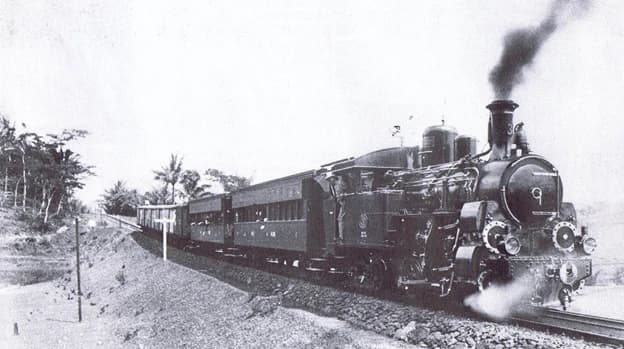
B25 Steam Locomotive
The B25 steam locomotive, manufactured by the Esslingen factory in Germany, first entered service in 1902. The railway company NIS (Nederlandsch-Indische Spoorweg Maatschappij) purchased five units of these locomotives, which initially carried the registration numbers NISM 231-235. These trains were specifically deployed for military transport and to navigate the steep rack railway sections along the Ambarawa–Secang route. The entire railway line from Ambarawa to Secang—which included an iconic 6.5-kilometer rack railway stretch spanning Jambu, Bedono, and Gemawang—officially opened for public operation on February 1, 1905.
One of the most unique features of the B25 steam locomotive is its specialized cogwheel or gear system. This cogwheel functions by interlocking directly with the toothed rack rail running underneath the train. Without this mechanism, the train would be completely unable to climb the steep mountainous tracks. The cogwheel is mounted dead center, positioned directly between the train’s normal outer wheels. This mechanism is absolutely vital; it allows the locomotive to successfully climb steep inclines of up to 65% at a slow, controlled speed of 10 km/h. Conversely, when the train heads downhill, the cogwheel engages to act as a brake system to manage and restrain the train's descent speed.

Image: The rack railway tracks inside the Bedono Station yard. (Source: De Stoomtractie op Java en Sumatra)

Image: Structural dimensions of the B25 Steam Locomotive. (Source: De Stoomtractie op Java en Sumatra)
Technical Specifications & Dimensions
Based on the historical technical drawings, the primary specifications of the NISM 231-235 (B25 series) are structured as follows:
| Parameter | Specification |
|---|---|
| Total Locomotive Length | 8,180 mm |
| Maximum Height | 3,650 mm |
| Coupler Height | 450 mm |
| Distance Between Driver Wheels | 1,900 mm |
| Main Driving Wheel Diameter | 853 mm |
| Rear Wheel Diameter | 768 mm |
To boil water and drive its heavy pistons, the B25 steam locomotive relies completely on high-quality teak wood as fuel. The engine features a unique four-cylinder setup, where two of the cylinders are dedicated exclusively to driving the central cogwheel mechanism. The teak wood fire is used to heat 2,850 liters of water inside the boiler, generating the pressurized steam required for propulsion.
Before the train can depart, the boiler requires a lengthy pre-heating process that takes more than three hours. This extended heating period ensures that the furnace reaches its peak operational temperature of approximately 235 degrees Celsius, which is necessary to move the wheels. Operating at this high temperature, the four-cylinder locomotive can produce a working pressure of 4–5 kg/cm² on flat tracks, which increases to 6–9 kg/cm² when crawling up steep mountain inclines.

Image: A B25 Steam Locomotive hauling a train carriage around the Bedono area. (Source: De Stoomtractie op Java en Sumatra)

Image: B2502 and B2503 Steam Locomotives resting inside the Ambarawa Locomotive Depot. (Source: KAI)

Image: An interior view looking out toward the B2502 Steam Locomotive. (Source: Ikhsan Prabowo)
Today, only three units of the historic B25 steam locomotive series survive. Two of them, locomotives B2502 and B2503, remain fully operational and are used to pull popular heritage tourist trains along the scenic Ambarawa–Bedono route. Meanwhile, the third surviving unit, locomotive B2501, is preserved as a static monument at the Ambarawa Palagan Monument, serving as a historic symbol of local heroism and struggle.
Source:
Lokomotif Uap B25: Lokomotif Bergerigi di Jawa