
Steam Locomotive B 5112
Thirty years after passenger steam locomotives first began operating in 1867, the railway network on the island of Java expanded rapidly. By 1894, the railway line connecting Batavia (Jakarta) and Surabaya was completed and officially opened for service. As the rail network grew, more steam locomotives were needed to haul train sets. However, 19th-century technology limited train speeds in Java to under 60 kilometers per hour. This was primarily because steam locomotives used for express passenger services at the time featured a 1B wheel arrangement—a configuration consisting of a single leading axle (pair of wheels) in front and two driving wheels behind. Under these conditions, the locomotive became unstable when running at high speeds. Meanwhile, railway experts predicted that passenger traffic would continue to grow at the turn of the 20th century. This surge in passenger numbers naturally demanded improved train services, most notably boosting average train speeds to around 60 kilometers per hour.
To meet this demand, the state railway enterprise Staatsspoorwegen (SS), a major player in the Dutch East Indies rail industry, required a locomotive type that was heavier and more powerful than previous models. SS entrusted the railway equipment manufacturer Hanomag to design and assemble the new locomotive. Located in Hanover, Kingdom of Prussia (Germany), the manufacturer adopted a design already used by the German railway authority, Preußische Staatseisenbahnen (Prussian State Railways).
According to technical specifications, the B51 locomotive measured over 14 meters long, 2.5 meters wide, and 3.7 meters high. Given these dimensions, the builder installed a boiler with a capacity of up to nine cubic meters of water. To generate the required steam pressure, it utilized a firebox measuring 700 millimeters in diameter and nearly two meters in length. This long, narrow firebox design was a signature characteristic of German engineering since the early days of steam locomotive development. Meanwhile, the 20-ton tender, which stored fuel (coal and firewood), was built separately from the locomotive.
The locomotive was equipped with two steam cylinders and pistons—one on each side—to turn the driving wheels. The circulation of steam pressure generated by boiling water inside the boiler drove the reciprocating movement of the pistons, which was converted into rotational motion on the driving wheels. Each driving wheel had a larger diameter, reaching over one and a half meters. Larger wheels provided several advantages: for a single revolution, a larger wheel distance covered a greater distance than a smaller wheel using the same piston stroke. In other words, it generated better power momentum than smaller wheels. The delivered steam pressure was also more efficient and stable for maintaining speed.
While earlier SS B-type locomotives (with two driving axles) had only a single leading axle, this new locomotive design featured a two-axle leading bogie (underframe). In total, four axles were installed on this 2B-type locomotive: two leading axles at the front and two driving axles at the rear. Thanks to this construction, the locomotive could run on flat tracks at a maximum speed of 80 kilometers per hour while remaining stable without dangerous vibrations. For deceleration, the 31-ton locomotive was fitted with a vacuum brake system (which uses air pressure for braking), a hand brake, and a Riggenbach counter-pressure brake. The braking system invented by Niklaus Riggenbach was quite effective on steep and rack railway lines such as those in Ambarawa–Bedono and the Anai Valley, as it utilized the train's own momentum and weight to brake the train set. However, because the 2B-type locomotives operated mostly on flat terrain, the Riggenbach brakes were eventually removed as they were not particularly useful.

B51 locomotive during the colonial era numbered SS 600. (Source: De Stoomtractie op Java en Sumatra)
In addition to Hanomag, SS also ordered locomotives of the same type and design from railway manufacturers Richard Hartmann and Werkspoor. In 1900, the first batch of seven units of this state-of-the-art locomotive generation arrived at the Port of Tanjung Priok. From then until 1909, brand-new B51 locomotives were delivered to SS in stages. Initially, these 2B-type locomotives entered service under older series numbers: SS 284 to SS 291, SS 300 to SS 311, SS 317 to SS 328, SS 337 to SS 340, SS 345–SS 346, and SS 351 to SS 366. The numbering system used by SS at the time was based solely on order sequence numbers without distinguishing between locomotive types. In 1912, two years after SS was reorganized and renamed Staatsspoor en Tramwegen (SS & Tr), an administrative overhaul of locomotive class numbers was implemented. From that point on, inventory series numbers were assigned based on locomotive type. Under this system, the 2B steam locomotives (B51) were categorized into the SS 600 class. Consequently, old numbers starting from SS 284 were renumbered from SS 601 to SS 644.
That same year, five SS 600 units—SS 633 and SS 639 through SS 642—were dispatched to South Sumatra. One locomotive became non-operational due to boiler damage. During their first twenty years in Java following their arrival at the turn of the 20th century, SS 600 locomotives earned a reputation as "workhorses" known for their reliability on flat lines and infrequent breakdowns. However, during the Great Depression (1929–1934), most SS 600 locomotives remained stored in depots. Following the global economic downturn, their role as fast express passenger locomotives was largely replaced by newer SS 700 and SS 1700 series locomotives. The SS 600 series locomotives were subsequently reassigned to operate local branch lines on flat terrain across West Java and East Java. Under SS regulations, the maximum service life of a locomotive was forty years, meaning this class was already considered "aging". By June 1941, SS 600 locomotives had accumulated an average mileage of over 1 million kilometers.
Very little data exists regarding the role of SS 600 locomotives during the Japanese military occupation. One key development occurred when the Japanese military administration consolidated railway management across Indonesia and renumbered all locomotives, passenger cars, and freight wagons from the Dutch era. Under this renumbering scheme, the SS 600 class was officially designated as the B51 class.

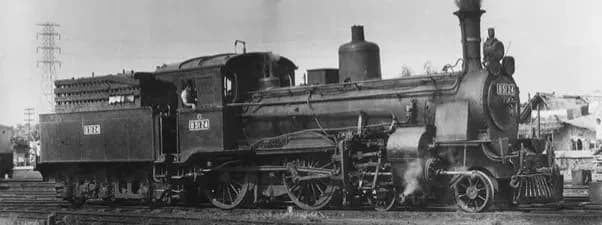
B5124 Steam Locomotive in Tanah Abang. (Source: Lokomotip Uap)
During a post-conflict re-inventory carried out by the Department of Railways (Djawatan Kereta Api or DKA) in early 1950 following the 1945–1949 Indonesian-Dutch conflict, 39 units of the B51 locomotive remained (B5101 through B5139). The fate of the five units sent to South Sumatra in 1912 remained unknown. As the diesel locomotive era took off in 1952, steam locomotives were gradually phased out. Cannibalization among steam locomotives became increasingly common to keep operations running. The B51 locomotives faced the same fate, having received no new spare parts since 1940.
Nearly eighty years after their initial debut, a small number of B51 locomotives remained in service on the Rangkasbitung–Labuhan and Merak lines in 1978. Meanwhile, locomotive B5112 was retired to a museum in 1976. However, B5112 proved more fortunate: after decades of dormancy, it was successfully restored to working condition and became the sole operating B51 locomotive, serving as a tourist train locomotive in Ambarawa.

Steam Locomotive B5112 hauling a Tourist Train in Ambarawa. (Source: Andre Dwi Apriliyanto)
Technical Specifications of Locomotive B5112
Manufacturer : Hanomag – Hanover, Germany
Wheel Arrangement : 4-4-0
Track Gauge : 1,067 mm
Dimensions (L / W / H) : 14,282 mm / 2,500 mm / 3,700 mm
Locomotive Operational Weight : 31.2 tons
Tender Operational Weight : 20 tons
Water Capacity : 9 m³
Axle Load : 9 tons
Maximum Speed : 80 km/h
Tractive Effort : 4,200 kg
Sources:
Oegema, J.J.G. De Stoomtractie op Java en Sumatra. Deventer-Antwerpen: Kluwer Technische Boeken, 1982
Perusahaan Negara Kereta Api. Sekilas Lintas 25 Tahun Perkereta-apian 1945-1970. Jakarta: PNKA, 1970
Reitsma, S.A. Gedenkboek der Staatsspoor- en Tramwegen in Nederlandsch-Indië, 1875-1925. Weltevreden: Topografische Inrichting, 1925