
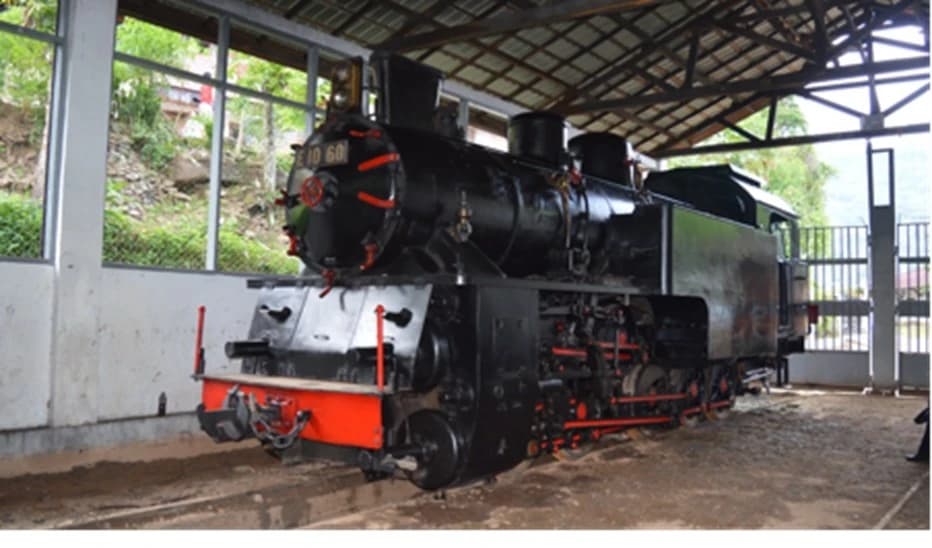
Mak Itam Locomotive
The construction of the railway network in West Sumatra was closely linked to "black gold"—coal. It was H. W. de Greve, a geologist who discovered coal deposits in Ombilin, Sawahlunto around 1868. Subsequently, according to research conducted by Verbeek in 1875, it was estimated that there were approximately 200 million tons of coal in the area.
Following the discovery of the coal reserves, J. L. Cluysenar led a research team to study cost-effective ways to transport the coal to the west coast of Sumatra. The results of his study were published in 1875. Cluysenar proposed building a railway line from Muaro Kalaban to Padang via Solok, cutting through the Bukit Barisan mountain range.
Cluysenar's initial proposal was rejected due to the difficulty of the proposed route and its high construction costs. Three years later, Cluysenar suggested an alternative route passing through the Anai Valley using a rack railway line.
Much like railway development in Java, a debate arose regarding who should build the network: the government or private enterprises. It was ultimately agreed that the project would be undertaken by the government through its state railway company, Staatsspoorwegen ter Sumatra’s Westkust (SSS).
To haul the train sets, one of the locomotive types acquired by SSS was the Type E10 steam locomotive. Between 1921 and 1928, 22 Type E10 locomotives (numbered 4–25) were brought in from the Esslingen and SLM factories. Later, between 1964 and 1966, an additional 20 E10 locomotives were imported from the Esslingen factory. In 1967, seven more units of the same type were purchased from Japan's Nippon Sharyo.
One of the surviving Type E10 locomotives is the E1060 Steam Locomotive. Affectionately known as "Mak Itam," this locomotive was manufactured by the Esslingen factory in Germany and brought to Indonesia in 1966. It features specialized cogwheels designed to mesh with rack rails.

Dimensions of the Type E10 Steam Locomotive. (Source: De Stoomtractie Op Java En Sumatra)
After the steam locomotive era came to an end in 1981, steam locomotives were gradually replaced by diesel locomotives between 1981 and 1984. From then on, Mak Itam ended its service pulling regular passenger and freight trains, and was mostly utilized for rack railway tourist trains on the Kayutanam–Padangpanjang–Tabal route.
In 1998, Mak Itam was relocated in a damaged condition to the Ambarawa Railway Museum in Central Java. Following repairs, the 750-horsepower locomotive served the Ambarawa–Jambu tourist train line. However, it did not run on the cog railway line toward Bedono because the cogwheels on its undercarriage did not match the rack rail layout on that route.
In December 2008, the Mak Itam steam locomotive returned home to Sawahlunto at the request of the Sawahlunto City Government. There, it was operated as a tourist train on the 7 km Sawahlunto–Muara Kalaban route, complementing local mining heritage and old-town tourism.
In 2017, the Mak Itam Locomotive was officially designated a cultural heritage object under the Sawahlunto Mayor Decree No. 188.45/327/WAKO-SWL/2017.
Currently, Mak Itam is housed at the Sawahlunto Depot and remains operational within the yard of the Sawahlunto Rail and Train Museum.

An E60 type locomotive passing around the Waterfall area. (Source: Lokomotip Uap 1988)

The Mak Itam Locomotive at the Sawahlunto Depot in 2017. (Source: KAI)