
CC 200 Locomotive
TABLE OF CONTENTS
The Shift from Steam to Diesel
Following independence, one of the biggest challenges for the Indonesian State Railway (Djawatan Kereta Api or DKA) was restoring heavily damaged rail infrastructure and rolling stock. To address immediate transportation shortages, the government imported 100 units of the D52 steam locomotive from West Germany's Krupp factory in 1950.
While waiting for the D52 orders to arrive, DKA officials decided to purchase diesel locomotives, which offered superior efficiency and performance. The long-term strategy was to phase out steam power entirely in favor of diesel. This sparked an internal debate within DKA regarding whether to adopt diesel-hydraulic or diesel-electric technology. After careful evaluation, DKA Director General Ir. Moh. Effendi Saleh and Head of Traction Ir. Otong Kosasih decided to procure 27 units of diesel-electric locomotives from General Electric (GE) in the United States, officially kicking off Indonesia's railway dieselization program.

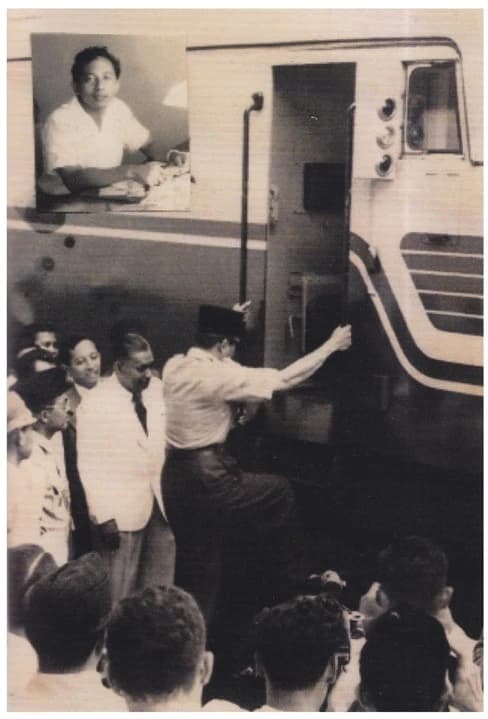
Image: President Soekarno boarding the driver's cab of the CC 200 02 locomotive at Gambir Station during the official inauguration ceremony. (Source: Memoir Book of Ruby Kiyoka Yamamoto Soejoto & Djoko Soejoto)
Timeline of the CC 200 Dieselization Project
| Date / Period | Milestone Event DOCX |
|---|---|
| Early 1950 | DKA orders D52 steam locomotives and plans the transition to diesel power. |
| June 1952 | Ir. Djoko Soejoto is tasked with leading the dieselization program; engineers are sent to the US and West Germany. |
| Mid-1952 | The first railway diesel training school opens inside the Manggarai Workshop complex. |
| Late Sept 1952 | The first GE/Alco CC 200 diesel-electric locomotive arrives at Tanjung Priok Port. |
| October 2, 1952 | The CC 200 completes its first successful test run along the Manggarai–Tanah Abang route. |
| November 22, 1953 | Official inauguration of the CC 200 diesel locomotive, attended by President Soekarno. |
Building Technical Expertise from Scratch
Because DKA management had no prior experience with diesel technology, the agency dispatched several railway experts to General Electric's plant in the United States to study diesel-electric systems. They also visited Krupp’s diesel-hydraulic locomotive factory in West Germany to gain a comprehensive understanding of the technology.
In June 1952, Ir. Effendi Saleh appointed Ir. Djoko Soejoto—an electrical engineer and Head of Traction at the Manggarai Workshop (Balai Yasa Manggarai)—to spearhead the program. Ir. Djoko was granted broad authority to prepare for the arrival of the new CC 200 fleet. Upon returning from the US, Ali Noor Luddin, one of the trained railway experts, teamed up with Ir. Djoko to open Indonesia's first diesel training school within the Manggarai Workshop complex.
The school operated out of an official residence in Manggarai, while students lived in nine smaller nearby houses converted into dormitories. The curriculum was divided into mechanical and electrical engineering tracks, with Ali teaching mechanics and Djoko handling electrical systems. The student body consisted of shop technicians from the Manggarai Workshop, alongside drivers and assistant drivers scouted from various locomotive depots. The training courses lasted two months and one week, depending on the focus level. Kurdi Wangsa, a driver from the Jatinegara Depot, became the school's very first graduate and was appointed senior driver by Djoko due to his age and seasoned field experience.

Image: Ir. Djoko Soejoto accompanying the President inside the driver's cab of the CC 200 02. (Source: Memoir Book of Ruby Kiyoka Yamamoto Soejoto & Djoko Soejoto)
Arrival and Trial Runs
The first diesel locomotive arrived at Tanjung Priok Port in late September 1952, welcomed by Ali, Djoko, and a DKA delegation. A floating crane named Gadjah Laoet hoisted the 1,600-horsepower, green-and-yellow GE/Alco CC 200 locomotive from the ship onto the harbor tracks. From there, a steam engine towed the new locomotive to the Manggarai Workshop, where shop crews spent the first few days translating and studying the technical manuals.
On October 2, 1952, the diesel locomotive made its historic first run outside the workshop grounds. Three men served as the inaugural crew: Ali Noor Luddin drove the engine from the workshop to Manggarai Station; Ir. Djoko Soejoto took over the controls from Manggarai to Tanah Abang Station; and Kurdi Wangsa drove the locomotive back to Manggarai. This successful round trip marked the completion of Indonesia's first diesel railway run. Out of the three, only Kurdi and Djoko held official driver's licenses.

Image: The CC 200 locomotive parked at the Manggarai Workshop. (Source: Memoir Book of Ruby Kiyoka Yamamoto Soejoto & Djoko Soejoto)
Subsequent trials involved pulling passenger and freight cars, gradually increasing the load to test the engine's maximum pulling power and braking systems at top speeds of up to 90 km/h. The DKA crews mastered the diesel locomotives quickly. Beyond the fact that diesel engines were far easier to operate than steam locomotives, Ir. Djoko Soejoto intentionally staffed the diesel division with young DKA recruits who had no experience with steam technology. This strategy ensured that the team could learn fast without having to unlearn old steam-operating habits.

Image: Front page of the driver's logbook tracking the official inauguration run of the CC 200 diesel locomotive.

Image: Back page of the driver's logbook tracking the official inauguration run of the CC 200 diesel locomotive.
Source:
Lokomotif CC 200: Awal Dieselisasi Lokomotif Indonesia