
KRD Kuda Putih
TABLE OF CONTENTS
A Diesel Railcar, locally known as KRD (Kereta Rel Diesel), is a specialized passenger rail vehicle powered by its own onboard diesel engine, which is mounted either beneath or above the passenger cabin floor.
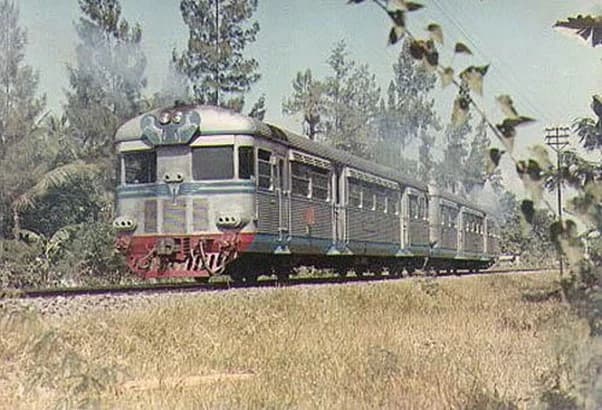
The state-owned railway company, Perusahaan Kereta Api Negara (now known as PT KAI), operated the country's very first diesel railcar, the MCDW 300, in 1963. A total of seven trainsets were imported from the Glossing und Scholer GmbH factory in Dortmund, Germany. The designation "MCDW 300" carried a specific meaning: M signified a diesel-engine-powered car, C denoted third-class (economy) passenger seating, D indicated the capacity to carry baggage, 3 stood for hydraulic transmission, and 00 marked it as the first generation of its kind. Each trainset consisted of two cars, with each car featuring a dedicated cabin for the train driver. This railcar was affectionately dubbed the "Kuda Putih" (White Horse) due to a distinctive logo depicting two white horses on the upper front portion of the train. Because its design closely resembled a road bus, it was also categorized as a railbus.

Image: The Kuda Putih diesel railcar passing through as it travels from Solo Balapan Station to Purwosari Station. The two white horse logos are visible on the upper front section of the train.
Connecting Yogyakarta and Solo
The Kuda Putih served the Yogyakarta–Solo route and vice versa. Operating five round trips daily, it quickly became a vital transport link. Local residents relied heavily on this railcar, whether they were traveling to markets for trade or simply commuting for leisure. A single car could comfortably accommodate 50 seated passengers and 10 standing passengers, alongside a cargo section capable of holding up to 3.5 tons of luggage. The entire journey took about one and a half hours. To make the trip even more pleasant, passengers could enjoy music played through an audio system installed in every car.
Becoming a Public Favorite
Powered by a 215 HP engine, the railcar could reach speeds of up to 90 km/h, making it the backbone of transportation between Yogyakarta and Solo. It quickly became the public's top choice because it offered a far more comfortable ride than local buses. On top of that, traveling by the Kuda Putih was more affordable. In the early 1970s, a bus ticket between Yogyakarta and Solo cost Rp 100, whereas the Kuda Putih fare was only Rp 80. Over time, riding the Kuda Putih even came to be seen as a prestigious way to travel in Surakarta and Yogyakarta.
Throughout its golden years, the Kuda Putih was regularly maintained at the locomotive depots in Yogyakarta and Solo. However, toward the late 1970s, its condition began to decline from its original prime. The primary issue was the extreme difficulty in sourcing spare parts from the manufacturer in Germany. Out of the seven original trainsets, several became severely damaged and could no longer run on their own engine power.
Consequently, the Kuda Putih was officially retired from service in 1980. Following its retirement, the Yogyakarta–Solo line was left without a dedicated connecting train for years. This void lasted until 1994, when a new commuter service emerged, known today as the Prameks (Prambanan Ekspres).
Of the seven historic trainsets brought to Indonesia, only one remains today at the Solo Locomotive Depot, though it is in a poorly maintained state. Recognizing its immense historical value as the pioneer of diesel railcar in Indonesia, PT KAI initiated a conservation project in 2011 to rescue and preserve the vehicle. Today, the legendary Kuda Putih stands preserved as a static monument at Lempuyangan Station.
Technical Specifications of the Kuda Putih
| Category | Parameter | Specification |
|---|---|---|
| Dimensions | Track Gauge | 1067 mm |
| Body Length | 18690 mm | |
| Coupler-to-Coupler Distance | 19640 mm | |
| Body Width | 2900 mm | |
| Maximum Height | 3550 mm | |
| Wheelbase | 2060 mm | |
| Pivot-to-Pivot Distance | 11350 mm | |
| Driving Wheel Diameter | 784 mm | |
| Idle Wheel Diameter | 784 mm | |
| Coupler Height | 760 mm | |
| Weight | Empty Weight | 32 tons |
| Ready-to-Run Weight (Fully Loaded) | 42 tons | |
| Adhesion Weight | 21 tons | |
| Diesel Engine | Type | General Motors 8V – 71 |
| Cycle Type | 2-Stroke | |
| Engine Power | 215 HP | |
| Power to Converter | 200 HP | |
| Transmission | Torque Converter Quantity | 1 unit |
| Torque Converter Type | Voith Diwabus U + S | |
| Performance | Maximum Speed | 90 km/h |
| Minimum Curve Radius | 80 meters | |
| Capacity | Seated Passengers | 50 people |
| Standing Passengers | 10 people | |
| Total Passenger Capacity | 60 people | |
| Baggage Capacity | 3.5 tons | |
| Miscellaneous | Brake System | Compressed Air Brake |
Kuda Putih Train Timetable (1974)
Solo to Yogyakarta | Yogyakarta to Solo | |||||
|---|---|---|---|---|---|---|
| Train No. | Departure | Arrival | Train No. | Departure | Arrival | |
| R 80 | 06.30 | 07.02 | R 81 | 04.46 | 06.34 | |
| R 82 | 07.34 | 09.03 | R 83 | 07.16 | 08.36 | |
| R 84 | 10.53 | 12.25 | R 85 | 10.50 | 12.15 | |
| R 88 | 13.51 | 15.19 | R 89 | 14.24 | 16.14 | |
| R 90 | 16.29 | 17.40 | R 91 | 15.58 | 17.40 | |
Source:
Mohtar, Omar, Peranan Kereta Rel Diesel Kuda Putih Bagi Kehidupan Sosial-Ekonomi Masyarakat Yogyakarta-Surakarta 1963-1980
Hartono, Lokomotif & Kereta Rel Diesel di Indonesia Edisi 3
Laporan Konservasi KRD MCDW 300 001-003 (Kuda Putih)