
Trams in the Land of Rencong
TABLE OF CONTENTS
The first railway line in Indonesia was opened in 1867 in Semarang by a private railway company, Nederlandsch-Indische Spoorweg Maatschappij (NISM). The purpose of that railway line was primarily economic, specifically for transporting export commodities like sugar. However, the situation in Sumatra was entirely different. The first railway line in Sumatra, located in Aceh, was not built for economic reasons, but rather for security and defense purposes to mobilize military troops and war equipment. This railway line in Aceh was developed by the Dutch colonial government using funding allocated from the Ministry of War (Departement van Oorlog).
The Aceh War Breaks Out
In 1873, the Dutch government declared war on the Aceh Sultanate. In the same year, the Dutch government brought in troops from Batavia to attack Aceh. However, the conquest was far from simple; sporadic resistance from the Acehnese people left the Dutch forces overwhelmed.
On March 26, 1873, the Aceh War officially erupted. During the first military aggression, the Dutch government successfully captured the palace of Sultan Mahmud Syah. Even so, fierce resistance from the Acehnese forces and citizens continued, ultimately resulting in the death of Major General Johan Harmen Rudolf Kohler, the commander of the Dutch army.
Reflecting on this failure, the Dutch government proposed building a mass transportation system as the primary backbone for military operations to mobilize troops rapidly. To secure and streamline control over the region, a Dutch military officer named Johanes Ludovicius Jacobus Hubertus Pel suggested constructing a railway line in Aceh for effective and efficient military mobilization. Officer Pel's proposal was given the green light by Governor-General James Loudon.
The planning of the railway network, designed in the form of a tramway, was carried out by the Ministry of War (Departement van Oorlog). The first stone was laid on June 26, 1874, marking the beginning of railway construction in Aceh. Construction began from Olee Lheue Port toward the administrative center in Kotaraja, utilizing a track gauge of 1,067 mm. Materials for this four-kilometer track were brought in from Java, and convict laborers were deployed to construct it.
From Olee Lheue Port to Kota Raja (Banda Aceh)
Two years later, the Olee Lheue-Kotaraja railway line was officially inaugurated on November 12, 1876. Although it was initially intended solely for military mobilization, many local civilians began utilizing the train services. After four months of operation, Governor-General van Lansberge visited Aceh to personally inspect the progress of the military operations.

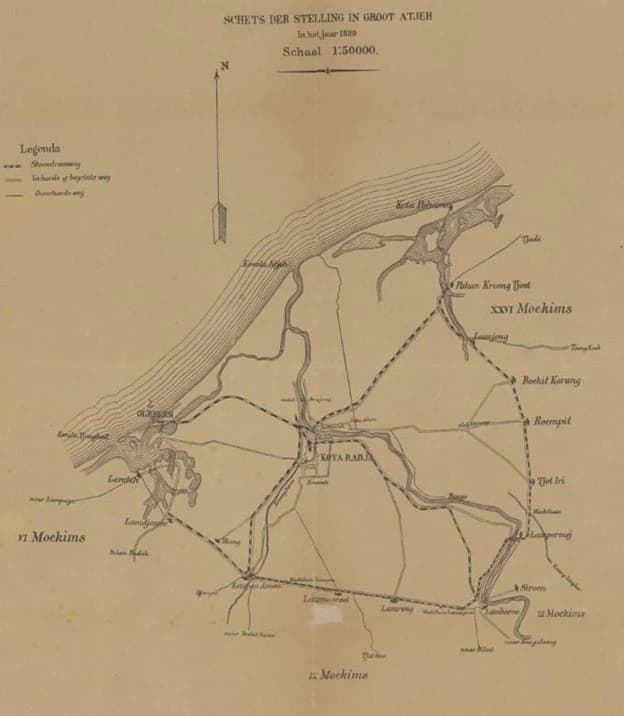
Image 1: The railway network in Kotaraja in 1889. (Source: KITLV)
As the network expanded outward from Kotaraja, the 34 km Lambaru-Seulimeum tram line was built under the Law of May 2, 1897 (State Gazette No. 199). This was followed by the 61 km Sigli-Lhokseumawe line authorized by the Law of December 30, 1899 (State Gazette 1900 No. 4). Furthermore, under the Law of December 29, 1900 (State Gazette 1901 No. 4), a 98 km tram line was built from Lhokseumawe to Idi, while the 65 km Idi-Langsa line was constructed according to the Law of December 31, 1902 (State Gazette 1903 No. 13)

Image 2: A train passing through Kota Raja in 1895. (Source: KITLV)

Image 3: Kota Raja Station in 1920. (Source: Stations en Spoorbruggen op Sumatra 1876-1941)
The Lhokseumawe - Langsa Tram Line
While the railway line in Aceh was initially focused on serving military interests, its presence proved to have a massive and strategic impact on the pacification process of Aceh. In addition, the railway network stimulated economic growth and prosperity, particularly along the northern coast, which was a major, high-producing pepper region.
The line even attracted private investors who wished to exploit the railway for mining transport. One interested investor was Karel Frederick van Swieten, a Dutch plantation businessman based in Batavia. He proposed building a railway line and branches stretching from Langsa Bay (or Bayan) all the way to Pangkalan Brandan. However, his proposal was rejected, as the colonial government decided to handle the development themselves, opening the railway line across Kotaraja-Sigli-Lhokseumawe-Langsa.

Image 4: Tramline construction supervised by the military. (Source: Stations en Spoorbruggen op Sumatra 1876-1941)
Unlike the initial line which used a 1,067 mm track gauge, the subsequent expansions in Aceh used a narrower 750 mm gauge. The tracks built were also designated as trams rather than standard railways. Trams have distinctly different characteristics compared to standard trains, utilizing smaller locomotives and carriages, operating at lower speeds, carrying smaller capacities, and covering shorter distances. Furthermore, the opening of a tram line only required the approval of the local resident (head of the local government), unlike a standard railway line which required a direct decision from the central government in either The Hague or Batavia.

Image 5: Tram stops along the Lhokseumawe-Langsa line. (Source: Stations en Spoorbruggen op Sumatra 1876-1941)
The construction of the tramway from Lhokseumawe to Langsa was divided into two phases. The first phase was the 98 km Lhokseumawe-Idi line, built based on the Law of December 29, 1900 (State Gazette 1901 No. 4). The second phase was the 65 km tram line from Idi to Langsa, which was authorized under the Law of December 31, 1902 (State Gazette 1903 No. 13). The entire route was successfully opened to the public on June 15, 1906.
Throughout the construction process, workers faced numerous disruptions from Acehnese freedom fighters. The fighters viewed the presence of the railway and tram lines as a direct threat that would weaken their tactical positions and strength. Consequently, it was a frequent occurrence for tracks laid during the day to be completely dismantled by Acehnese fighters under the cover of night.
When operations first began, the Acehnese people were reluctant and afraid to use the tram. They harbored deep suspicions toward a facility that had originally been prioritized for military purposes. To combat this, the government slashed ticket prices by half in 1902. The goal was to entice the public into using the tram service and to demonstrate the government's good intentions to develop Aceh. Additionally, the revenue generated from ticket sales was expected to cover daily operational costs.

Image 6: The Lhokseumawe Station area in 1920. (Source: KITLV)
After the Aceh War ended, the Dutch government drastically reduced its military budget, reallocation those funds to maintain general security. The military's role in daily life in Aceh began to wane, especially as administrative roles were increasingly filled by civil servants. Public services such as transportation, irrigation, and agricultural counseling quickly became dominated by civilian management. In 1916, management of the rail-based transportation network officially transitioned from military control to the state railway company, Staatsspoorwegen (SS), under the division name Atjehstaatsspoorwegen (ASS).

Image 7: Langsa Station in 1916. (Source: Stations en Spoorbruggen op Sumatra 1876-1941)

Image 8: Tram schedule from Lhokseumawe to Idi in 1931. (Source: Reisgids der Staatsspoorwegen in Atjeh)

Image 9: Tram schedule from Idi to Langsa in 1931. (Source: Reisgids der Staatsspoorwegen in Atjeh)
Sources:
Kitlv.nl
Marihandono, Joko et al., Jalan Besi di Tanah Rencong: Perkembangan Trem Aceh 1874-1950
Michiel van Ballegoijen de Jong, Station en Spoorbruggen op Sumatra 1876-1941
Reisgids der Staatsspoorwegen in Atjeh, July 1, 1931
Sejarah Perkeretaapian Indonesia Jilid I