
The Padang-Sawahlunto Railway
TABLE OF CONTENTS
An Overview of West Sumatra
The West Sumatra region, also famously known as the land of Minangkabau, is located in the west-central part of Sumatra Island. The landscape consists of highlands stretching across the central Bukit Barisan mountain range—which runs from north to south—and lowlands facing the Indian Ocean along the West Coast.
West Sumatra is a highly fertile region. Its economic potential lies heavily in agriculture and plantations, producing commodities like rice, coffee, cinnamon, gambier, tobacco, and copra. Originally, these commodities were transported using very simple means of transportation.
In the beginning, transport in West Sumatra relied entirely on human and horse power, using vehicles like traditional carriages (dokar) and carts (pedati). However, this was highly inefficient. At the time, traveling on foot from Agam to Padang took up to five or six days.
The Black Gold of Sawahlunto
The construction of the railway line in West Sumatra was closely tied to "black gold"—coal. In 1868, a geologist named H. W. de Greve discovered coal deposits in Ombilin, Sawahlunto. Later, a study by Verbeek in 1875 estimated that there were approximately 200 million tons of coal in the area.
Following this discovery, J. L. Cluysenar led a team to find an affordable way to transport the coal to Sumatra's west coast. Their report, published in 1875, proposed building a railway line from Muaro Kalaban to Padang via Solok, cutting straight through the Bukit Barisan mountains.
Cluysenar’s initial proposal was rejected due to the immense difficulty of the route and the high costs involved. Three years later, Cluysenar suggested an alternative route through the Anai Valley using a cog railway (rack railway) system.
Just like the railway development in Java, a debate arose over whether the project should be handled by the government or private companies. Ultimately, it was agreed that the government would take charge through its state-owned railway company, Staatsspoorwegen ter Sumatra’s Westkust (SSS).
The Padang-Bukittinggi Line
J. W. Ijzerman, a railway engineer staff member from Java, was appointed to lead the railway construction project in West Sumatra. The first route built was the Padang-Bukittinggi line, which was divided into four sections:
Bukit Putus to Duku
Duku to Kayu Tanam
Kayu Tanam to Padang Panjang
Padang Panjang to Bukittinggi
Starting from Kayu Tanam, cog rails were used because the track began to climb steeply. On July 1, 1891, the Padang-Padang Panjang line was completed. Before it opened to the public, Governor O. M. de Munnick and his entourage officially inaugurated the line by taking a train ride from Padang Station to Padang Panjang.
Four months later, on November 1, 1891, the 19 km Padang Panjang-Bukittinggi line was officially opened. The total cost for the entire Padang-Bukittinggi construction reached 18.3 million guilders.
Throughout the construction process, the project utilized paid laborers from various backgrounds, including Minangkabau, Nias, Javanese, and Chinese workers.

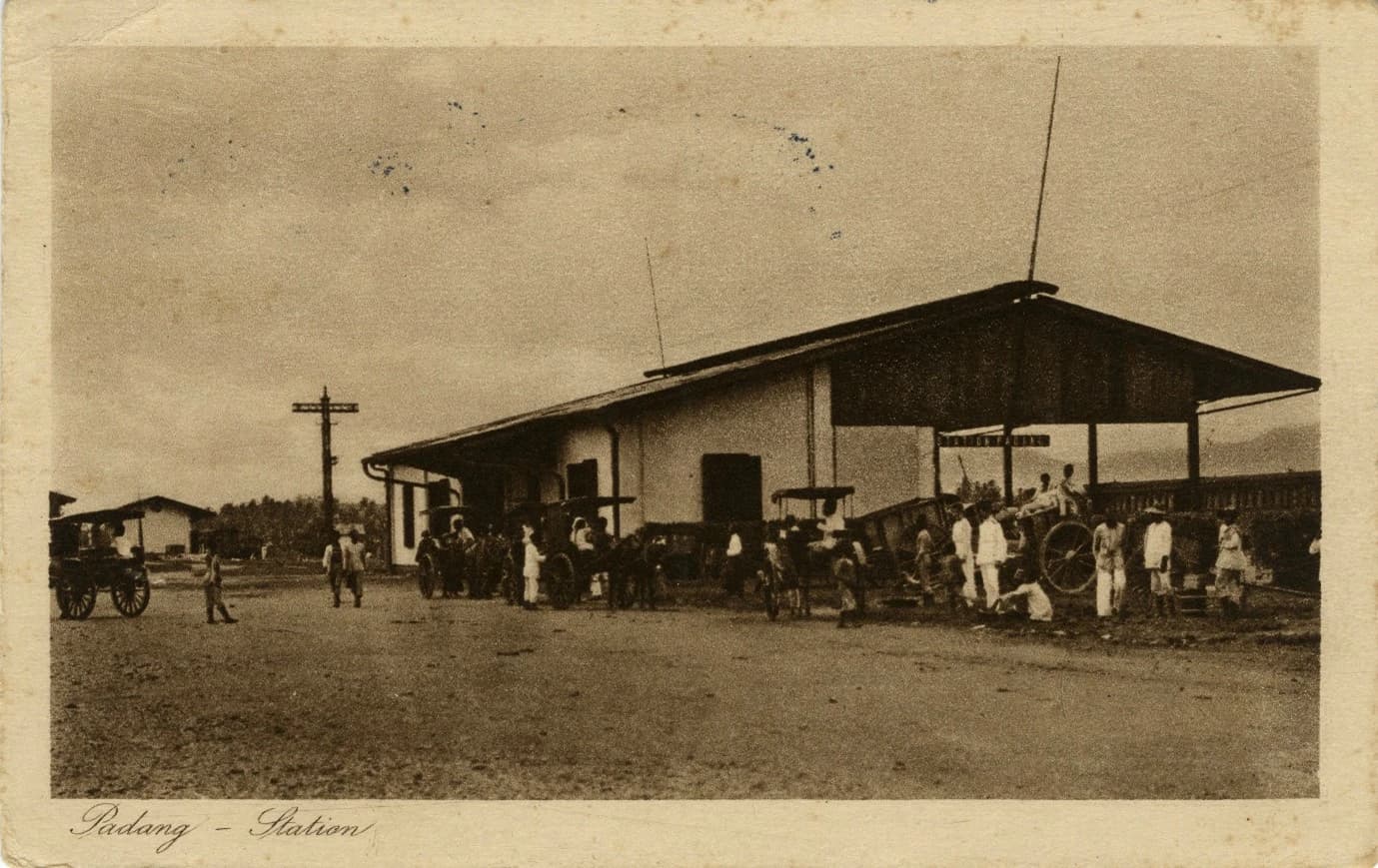
Image 1: The bustling activity at Padang Station around 1910. (Source: media-kitlv.nl)
The Padang Panjang-Muaro Kalaban Line
The next route tackled by SSS was from Padang Panjang to Muaro Kalaban. This line was divided into three sections: Padang Panjang-Kacang, Kacang-Solok, and Solok-Muaro Kalaban.
The 53 km Padang Panjang-Solok line was inaugurated on July 1, 1892. A cog railway system was also utilized between Kubu Puding and Batu Tabal. Meanwhile, the 23 km section from Solok to Muaro Kalaban was opened to the public on October 1, 1892.

Image 2: SSS employees posing at Padang Panjang Station around the 1890s. (Source: media-kitlv.nl)
The Muaro Kalaban-Sawahlunto Line
To finally reach the mining site in Sawahlunto, a 4 km extension was built from Muaro Kalaban to Sawahlunto. This line was officially inaugurated on January 1, 1894.

Image 3: A portrait of Sawahlunto Station around the 1890s (Source: media-kitlv.nl)
The "Mak Itam" Locomotive
To haul the trains, one of the train models purchased by SSS was the Type E10 Steam Locomotive. Between 1921 and 1928, 22 Type E10 locomotives (numbered 4 to 25) were imported from the Esslingen and SLM factories. Later, between 1964 and 1966, another 20 E10 locomotives were brought in from the Esslingen factory. In 1967, seven more units of the same type were purchased from the Nippon Sharyo factory in Japan.
One of the surviving Type E10 locomotives is the Steam Locomotive E1060. Affectionately nicknamed "Mak Itam" (Old Black), this locomotive was built by the Esslingen factory in Germany and arrived in 1966. It is equipped with a gear mechanism underneath designed to lock onto the cog rails.

Image 4: Dimensions of the Type E10 Steam Locomotive. (Source: De Stoomtractie Op Java En Sumatra)
After the steam era came to an end in 1881, steam locomotives were gradually replaced by diesel locomotives between 1981 and 1984. From that point on, Mak Itam retired from hauling regular passenger and freight trains. Instead, it was mostly used to power heritage tourist trains on the Kayutanam-Padangpanjang-Tabal cog railway route.
In 1998, Mak Itam was moved to the Ambarawa Railway Museum in Central Java in a damaged condition. After being repaired, the 750-horsepower locomotive operated tourist trains on the Ambarawa–Jambu route. However, it could not traverse the cog track toward Bedono because the gears on the bottom of the locomotive did not align with the rack rails on that specific track.
In December 2008, Mak Itam finally returned home to Sawahlunto at the request of the Sawahlunto City Government. There, it was used to pull heritage tourist trains along the 7 km Sawahlunto–Muara Kalaban route, boosting the city's mining and old town tourism.
In 2017, the Mak Itam locomotive was designated as a cultural heritage object under the Sawahlunto Mayor's Decree No. 188.45/327/WAKO-SWL/2017.
Today, Mak Itam is housed at the Sawahlunto Depot and can still run on the tracks inside the Sawahlunto Rail and Train Museum complex. However, the locomotive's boiler tubes currently have several leaks, meaning it requires maintenance and repairs before it can safely run at full capacity again.

Image 5: The "Mak Itam" locomotive passing through a steep incline in the Kayutanam area after returning from Padang Panjang to collect coal in Sawahlunto on January 24, 1978. (Source: Rob Dickinson Collection)

Image 6: The Mak Itam locomotive at the Sawahlunto Depot in 2017. (Source: PBA Collection)
The BB 204 Diesel Locomotive
To modernize transport in West Sumatra, the state railway company, Perusahaan Jawatan Kereta Api (PJKA), introduced the BB 204 Diesel Locomotive. Manufactured by Schweizerische Lokomotiv und Maschinenfabrik (SLM), this was the only European-made locomotive specifically engineered to operate on West Sumatra’s unique cog railway lines.
A total of 17 units of the BB 204 were brought in across three phases: 1981, 1982, and 1984. By the end of 2011, seven units were still operational. However, because the coal reserves in Sawahlunto ran out, the cog railway operations eventually ground to a halt.
Today, a couple of the remaining BB 204 diesel locomotives, namely BB 2049305 and BB 2049306, are stored at the former Solok Depot. In 2019, a proposal was made to send both locomotives to the Yogyakarta Locomotive Workshop (Balai Yasa Yogyakarta) for repairs so they could be repurposed to haul tourist trains in Ambarawa.

Image 7: Dimensions of the BB 204 Locomotive. (Source: Lokomotif & Kereta Rel Diesel di Indonesia)

Image 8: BB 2049305 and BB 2049306 locomotives at the former Solok Depot in 2017. (Source: PBA Collection)
Sawahlunto Rail and Train Museum
Toward the end of the year 2000, coal production in Sawahlunto drastically declined. This drop automatically brought railway activities in West Sumatra to a near standstill.
In an effort to preserve Sawahlunto Station, PT Kereta Api Indonesia (Persero) partnered with the Sawahlunto City Government to convert the historic station into a museum. The Sawahlunto Museum was officially opened on December 17, 2005, by Vice President Jusuf Kalla. One of its most famous centerpieces is the E1060 cog steam locomotive, better known as "Mak Itam."
The Sawahlunto Rail and Train Museum is included in Area A of the World Heritage Site (WBD) as part of UNESCO's Ombilin Coal Mining Heritage of Sawahlunto. The museum building, which originally served as a station, has also been designated as a cultural heritage building through Sawahlunto Mayor's Decree No. 188.45/59/WAKO-SWL/2019 and the Decree of the Minister of Education and Culture No. 345/M/2014.

Image 9: The atmosphere at the Sawahlunto Rail and Train Museum in 2017. (Source: PBA Collection)
Sources:
Abrar, Angkutan Kereta Api dan Perkembangan Ekonomi Sumatra Barat 1887-1940, Master's Thesis, Universitas Indonesia, 2001.
Hartono, Lokomotif & Kereta Rel Diesel di Indonesia, Depok: PT Ilalang Sakti Komunikasi, 2012.
J.J.G. Oegema, De Stoomtractie Op Java En Sumatra, Kluwer Technische Boeken B.V.-Deventer, 1982.
S. A. Reitsma, Korte Geschiedenis der Nederlandsch Indische Spoor en Tramwegen, Weltevreden: G. Kolff & Co, 1928.