
The Rp3,000 Fare That Powers Millions of Journeys: Rangkasbitung–Merak Local Train and the “Farmers and Traders Train” Connect Economic Activity Across Banten
Nearly 2 million customers used the Rangkasbitung–Merak Local Train from January to May 2026, while the Farmers and Traders Train recorded 25,023 customer journeys since it began operations.
When discussing the economic growth of a region, attention is often focused on investment, industrial estates, or large-scale infrastructure development. However, there is another factor embedded in people's daily lives that has a direct impact on productivity: the ability of communities to move easily, quickly, and affordably. This mobility enables economic activities to continue sustainably.
In Banten Province, this role is fulfilled by the Rangkasbitung–Merak Local Train. With a fare of just Rp3,000 per trip, the service connects residential areas, commercial centers, industrial estates, government offices, educational institutions, and Merak Port—one of the country's most important transportation hubs linking the islands of Java and Sumatra.
For many people, Rp3,000 may seem like a small amount. However, from the perspective of household economics, affordable transportation costs allow families to allocate more of their income to other essential needs such as education, household consumption, and business development. This is where public transportation serves not only as a means of travel but also as a driver of economic efficiency for the community.
The public's enthusiasm for the service is reflected in the continuous growth in customer numbers over recent years. In 2023, the Rangkasbitung–Merak Local Train served 3,617,478 customers. This figure increased to 4,269,154 customers in 2024 and rose again to 4,463,498 customers in 2025. From January to May 2026 alone, the service had already been used by 1,978,799 customers.
This growth demonstrates that rail transportation has become increasingly integrated into the daily lives of the people of Banten. More residents are relying on trains as their primary mode of transportation for work, education, business, and accessing public services. Connecting Rangkasbitung, Jambu Baru, Catang, Cikeusal, Walantaka, Serang, Karangantu, Tonjong Baru, Cilegon, Krenceng, and Merak stations, the service links key activity centers along the western Banten corridor.
Vice President of Corporate Communication KAI Anne Purba stated that the success of a public transportation service should be measured not only by the number of customers it serves but also by the benefits it provides to communities in carrying out their daily activities.
"Affordable public transportation generates broad economic benefits. It enables people to travel more efficiently, provides greater access to employment opportunities, and connects communities with economic centers that previously required higher travel costs."
This role becomes even more significant considering the characteristics of the regions served. The Rangkasbitung–Merak corridor connects Lebak Regency, Serang Regency, Serang City, Cilegon City, and the Merak Port area. According to Statistics Indonesia (BPS) data for 2024, Serang City has a population of approximately 756,000, while Cilegon City is home to around 465,000 residents. Both areas serve as economic growth centers supported by trade, services, manufacturing, and port activities.
Under these conditions, large-scale interregional mobility takes place every day. Rail transportation connects residential areas with productive economic zones, ensuring that distance is not a barrier for people seeking employment, running businesses, or accessing educational services. The easier it is for people to travel, the greater the economic opportunities available to them.
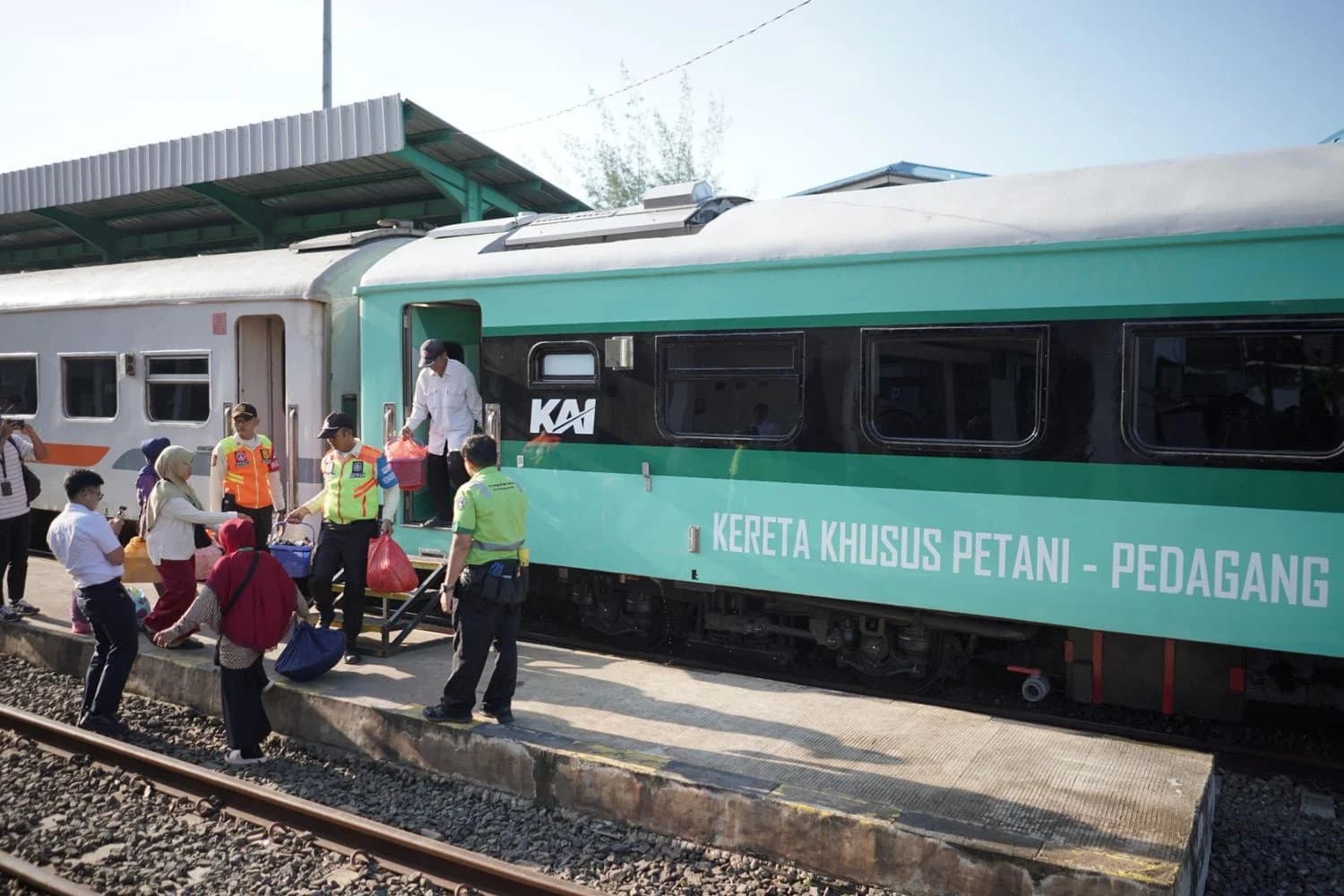
This economic contribution is further strengthened by the introduction of the Farmers and Traders Train, which began operations on 1 December 2025. The service was established to meet the needs of communities whose livelihoods depend on traditional markets, commercial centers, and agricultural areas along the Merak railway corridor.
From January to May 2026, the Farmers and Traders Train recorded 20,908 customer journeys. Since its launch on 1 December 2025 through the end of May 2026, the service has recorded a total of 25,023 customer journeys.
These figures reflect consistent economic mobility occurring day after day. Behind every recorded journey are continuous trading and distribution activities. Traders travel to purchase merchandise, farmers head to markets to sell their harvests, and micro-business owners use the train as an affordable and accessible mode of transportation.
For these communities, transportation cost efficiency has a direct impact on their income. The lower their travel expenses, the greater the opportunity to expand their businesses, reach broader markets, and increase profitability. Therefore, the benefits of this service extend far beyond the recorded travel data by supporting economic activities across the many locations connected by the railway network.
Anne added that the benefits of public transportation often create a chain reaction throughout society.
"When a trader can reduce transportation costs, the competitiveness of their business increases. When farmers can access markets more easily, they gain broader access to buyers. When people can travel at affordable costs, they also gain greater access to economic opportunities. This is where public transportation delivers benefits that go far beyond simply moving people from one place to another."
Many development studies identify connectivity as one of the key factors determining regional productivity. The better the connectivity available, the greater the opportunities for the exchange of goods, services, labor, and other economic activities. Therefore, every train journey contributes to maintaining the smooth movement of people and economic activities along the Rangkasbitung–Merak corridor.
The Rangkasbitung–Merak Local Train and the Farmers and Traders Train demonstrate how affordable transportation can strengthen community economic activity. The continuous growth in customer numbers year after year reflects that mobility has become increasingly essential as residential areas, commercial centers, industries, and service sectors continue to develop across Banten. Along the Rangkasbitung–Merak corridor, every recorded journey represents people traveling to work, trade, study, and build their businesses. Through this role, rail transportation helps maintain regional connectivity while expanding public access to a wide range of economic opportunities.
VP Corporate Communication KAI