
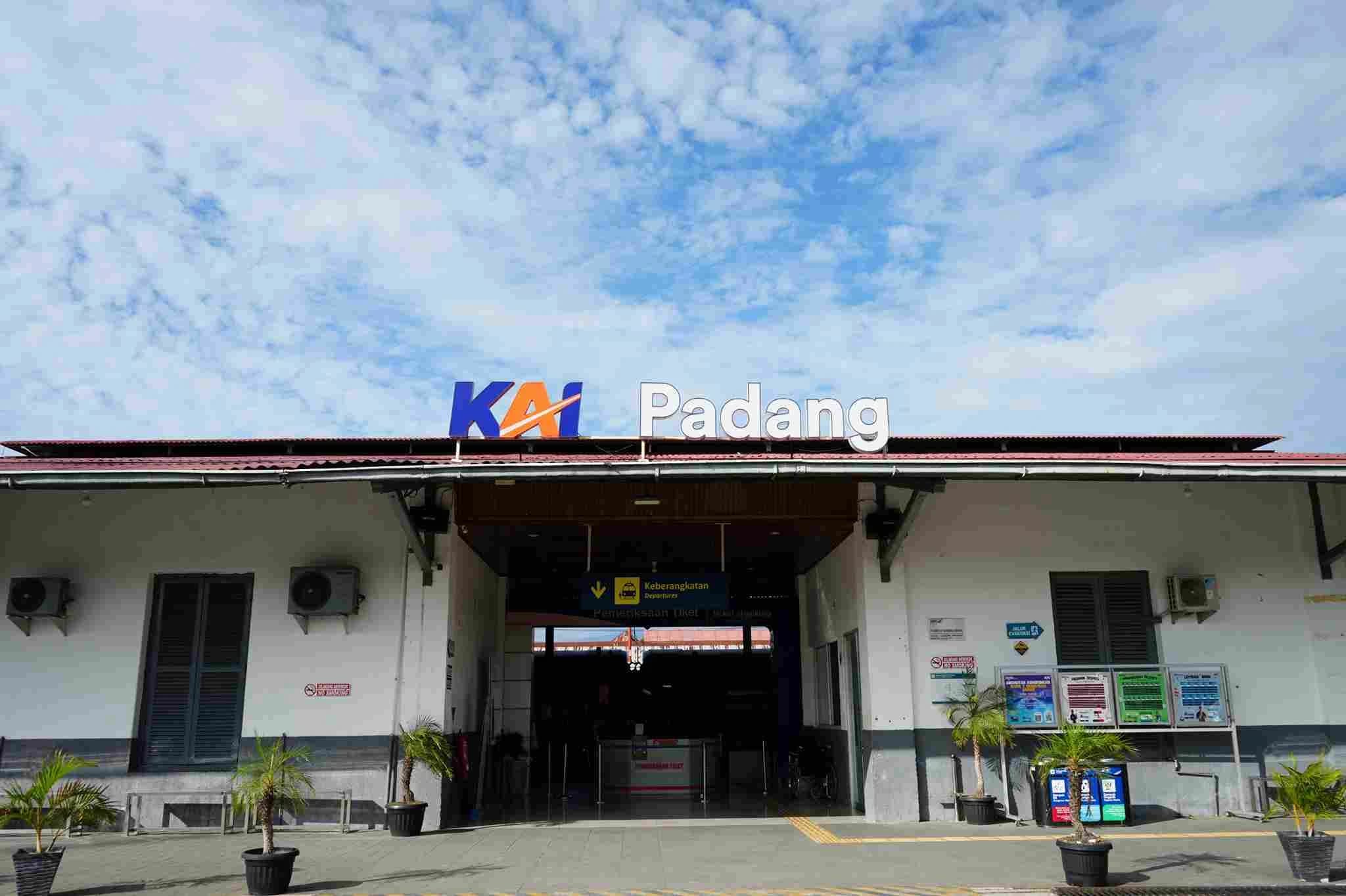
West Sumatra in the Grand Blueprint of Sumatra’s Rail Connectivity: Active Historic Tracks Continuously Serving the Community
In West Sumatra, railway tracks encapsulate the timeless narrative of Ombilin coal, the historic Emmahaven Port (now Teluk Bayur), the steep terrain of the Anai Valley, Sawahlunto, and Pariaman. Today, this rich history intersects with the daily realities of citizens commuting from their homes to schools, universities, workplaces, airports, and major tourist destinations.
This historical backdrop has now found a renewed strategic context within the overarching blueprint to reinforce rail connectivity across Sumatra Island. Under the directive of President Prabowo Subianto, the government is aggressively driving the development of an interconnected railway network spanning from Banda Aceh to Bandar Lampung. Within this grand vision, West Sumatra stands out as a critical node due to its expansive rail history, substantial infrastructure assets, and active services that directly sustain the grassroots economy.
West Sumatra serves as an essential lens through which to observe the long evolutionary journey of rail transit in Sumatra. Here, the tracks do not merely link origins and destinations; they preserve the industrial footprints of the Ombilin coal mines, Teluk Bayur Port, Sawahlunto, the Anai Valley, and Pariaman, while mirroring how public mobility has evolved across generations.
KAI’s Vice President of Corporate Communication, Anne Purba, stated that West Sumatra occupies a unique position in national railway history. The rail network in this region was born out of the necessity to interconnect mines, ports, cities, and communities. Throughout its development, these same corridors have evolved to accommodate daily commuting, leisure tourism, and industrial freight distribution.
"West Sumatra illustrates how railways have functioned from the very beginning as a vital economic conduit bridging cities, ports, and the public. This legacy remains highly relevant as we address Sumatra’s modern connectivity needs today,"
The history of West Sumatra’s railways dates back to the late 19th century, when the rail network was constructed to connect the Ombilin coal fields in Sawahlunto with the coastal port in Padang. Construction of Padang Station commenced on July 6, 1889, to streamline coal transport to Emmahaven Port. Pulau Air Station followed in 1891, built by the Staatsspoorwegen ter Sumatras Westkust (SSS) and officially inaugurated on October 1, 1892. From Padang, the rail network gradually branched out toward Kayu Tanam, Padang Panjang, Solok, Muaro Kalaban, Sawahlunto, Pariaman, and Naras.
During that era, West Sumatra's rail construction confronted formidable terrain, navigating steep hills, deep valleys, and sharp inclines. It was in this demanding landscape that the public came to know the cogwheel steam locomotives like Mak Itam, an enduring icon of Sawahlunto’s rail heritage deeply intertwined with the Ombilin mining history.
According to infrastructure assets data from Regional Division II (Divre II) West Sumatra, the aggregate length of the railway network in the region reaches 312.232 kmsp. Kmsp stands for kilometer spoor (track-kilometer), a standard technical metric used to calculate total physical track length. In other words, West Sumatra possesses roughly 312.2 kilometers of rail lines. Out of this total, 110.910 kmsp (approx. 110.9 km) constitutes active lines, while 201.322 kmsp (approx. 201.3 km) comprises inactive lines. The division also operates 20 passenger stations and shelters, alongside 4 dedicated freight stations.
Currently, active passenger services in West Sumatra include the KA Pariaman Ekspres (Pauh Lima–Padang–Naras route), the KA Minangkabau Ekspres (Pulau Air–Padang–Minangkabau International Airport airport rail link), the KA Lembah Anai (Kayu Tanam–Duku–Padang pioneer rail), and the KA Wisata Mak Itam (Muarokalaban–Sawahlunto heritage train), which operates dynamically to serve historical tourism demands. For freight logistics, KAI operates the Indarung–Bukit Putus route to support the mass distribution of bulk cement and clinker.
The operational performance of these routes reflects the enduring dependence of West Sumatra's population on rail transport. From January to May 2026, passenger services under Divre II West Sumatra carried 913,674 passengers. The monthly breakdown recorded 172,548 passengers in January; 151,768 passengers in February; 188,425 passengers in March; 202,282 passengers in April; and 198,651 passengers in May.
On the logistics front, KAI’s Divre II West Sumatra moved 492,220 tons of freight from January to May 2026. This volume consisted of 299,070 tons of cement and 193,150 tons of clinker. Rail-based logistics play a pivotal role in ensuring the seamless flow of industrial supply chains, mitigating the burden of heavy-duty vehicles on highways, and optimizing the transport link from production sites to key distribution nodes.
Performance metrics over the last five years indicate that a stable rail market has successfully formed in West Sumatra. Annual passenger volume in Divre II West Sumatra surged from approximately 1.09 million passengers in 2021 to 1,978,241 passengers in 2025. Within the 2021–2025 period, passenger ridership achieved a staggering 81 percent aggregate growth, averaging a steady 16 percent annual growth rate. This expanding metric proves that public preference for rail transit in West Sumatra continues to strengthen.
The KA Pariaman Ekspres stands out as a prime example of a service deeply aligned with grassroots needs. In 2025, ridership on the KA Pariaman Ekspres reached 1,615,996 passengers, rising 15.61 percent compared to the 1,399,691 passengers in 2024. This service effectively interlinks residential corridors, downtown Padang, university campuses, and scenic coastal tourism spots that draw heavy public traffic during weekends.
Similarly, the KA Lembah Anai has shown a highly positive market response following its recent route optimization. In January 2026, the service welcomed 24,607 passengers, a sharp increase from the 9,932 passengers recorded in January 2025. In February 2026, volume reached 22,136 passengers, up from 7,270 passengers in February 2025. By March 2026, ridership climbed to 28,515 passengers, compared to just 6,363 passengers in March 2025. This upward shift demonstrates that strategic service modifications can significantly expand accessibility and capture public interest.
Anne explained that the core strength of West Sumatra's rail network lies in its close integration with the socioeconomic spaces of the community. The KA Pariaman Ekspres accommodates commuters, students, and beachgoers. The KA Minangkabau Ekspres offers a direct transit connection between downtown Padang and Minangkabau International Airport. The KA Lembah Anai opens up access to Kayu Tanam and its surrounding buffers, while Mak Itam preserves the cultural memory of Sawahlunto as a historic mining town and a global heritage site.
"The railway in West Sumatra is deeply embedded within the public's daily lifestyle. It reliably serves daily commuters, airport travelers, and tourists, while simultaneously sustaining industrial freight distribution,"
West Sumatra’s immense potential is further mirrored in its thriving tourism sector. Data from BPS (Statistics Indonesia) of West Sumatra, analyzed within the state's railway reactivation studies, shows that domestic tourist trips escalated from 8.4 million trips in 2021 to 20.7 million trips in 2025. Several premier destinations—such as Jam Gadang (the historic clock tower), Lake Singkarak, Sawahlunto, Padang Panjang, and Bukittinggi—sit squarely within corridors that can be powerfully reinforced via expanded rail connectivity.
Sawahlunto holds a distinctive strategic value due to the Ombilin Coal Mining Heritage of Sawahlunto, which was inscribed as a UNESCO World Heritage Site in 2019. Within this zone, the tracks are viewed not merely as standard transit infrastructure, but as living history, educational toolkits, tourism assets, and an integral part of the community's collective memory.
From a regional transportation standpoint, data from the West Sumatra Northwest Transportation Agency indicates that road networks still dominate passenger and cargo distribution. The road modal share stands at roughly 96 percent for passenger transit and 87 percent for cargo distribution. Meanwhile, the railway's modal share for cargo sits around 8 percent. This composition highlights a massive room for growth for railways to expand their role, particularly in driving highly efficient bulk logistics and tourism transit.
West Sumatra’s potential is also reflected in its numerous inactive rail lines, which present lucrative reactivation opportunities. Several corridors earmarked within the potential reactivation assessment include the Naras–Sungai Limau, Kayu Tanam–Padang Panjang–Bukittinggi–Limbanang, Muarokalaban–Sawahlunto, Padang Panjang–Batubual, Batubual–Solok, and Solok–Muarokalaban lines. Once developed in phases, these tracks can significantly widen access to tourist attractions, educational hubs, economic centers, and key logistic hubs across the Minangkabau region.
One corridor possessing an exceptionally strong commercial outlook is the Kayu Tanam–Padang Panjang–Bukittinggi–Payakumbuh route, with a planned alignment spanning approximately 67.363 kmsp. This line is vital because it crosses highly strategic centers in West Sumatra, unlocks access to major tourist sights, and robustly supports public mobility and freight distribution. Furthermore, the proposed Padang–Solok shortcut project possesses high strategic value, as it could serve as a direct transit gateway linking toward Lubuk Linggau in South Sumatra.
Within the grand blueprint of the Trans-Sumatra rail connectivity network, expanded rail development is central to how the island aims to bridge regional distances, compress logistics overheads, unlock eco-tourism potentials, and reinforce mass public mobility. Reactivation impact studies note that when the Anai Valley road link suffers structural disruptions, logistical freight vehicles are forced to utilize significantly longer alternative routes. This detour inflates operational logistics costs by approximately 22 percent above normal baselines. This vulnerability underscores the critical need for a stable, highly efficient, and sustainable transport alternative.
"The history of West Sumatra’s tracks offers an invaluable lesson: rail connectivity is far more than a physical path—it is a gateway to accessibility, regional expansion, and equitable socio-economic opportunities for the entire community,"
VP of Corporate Communication KAI