
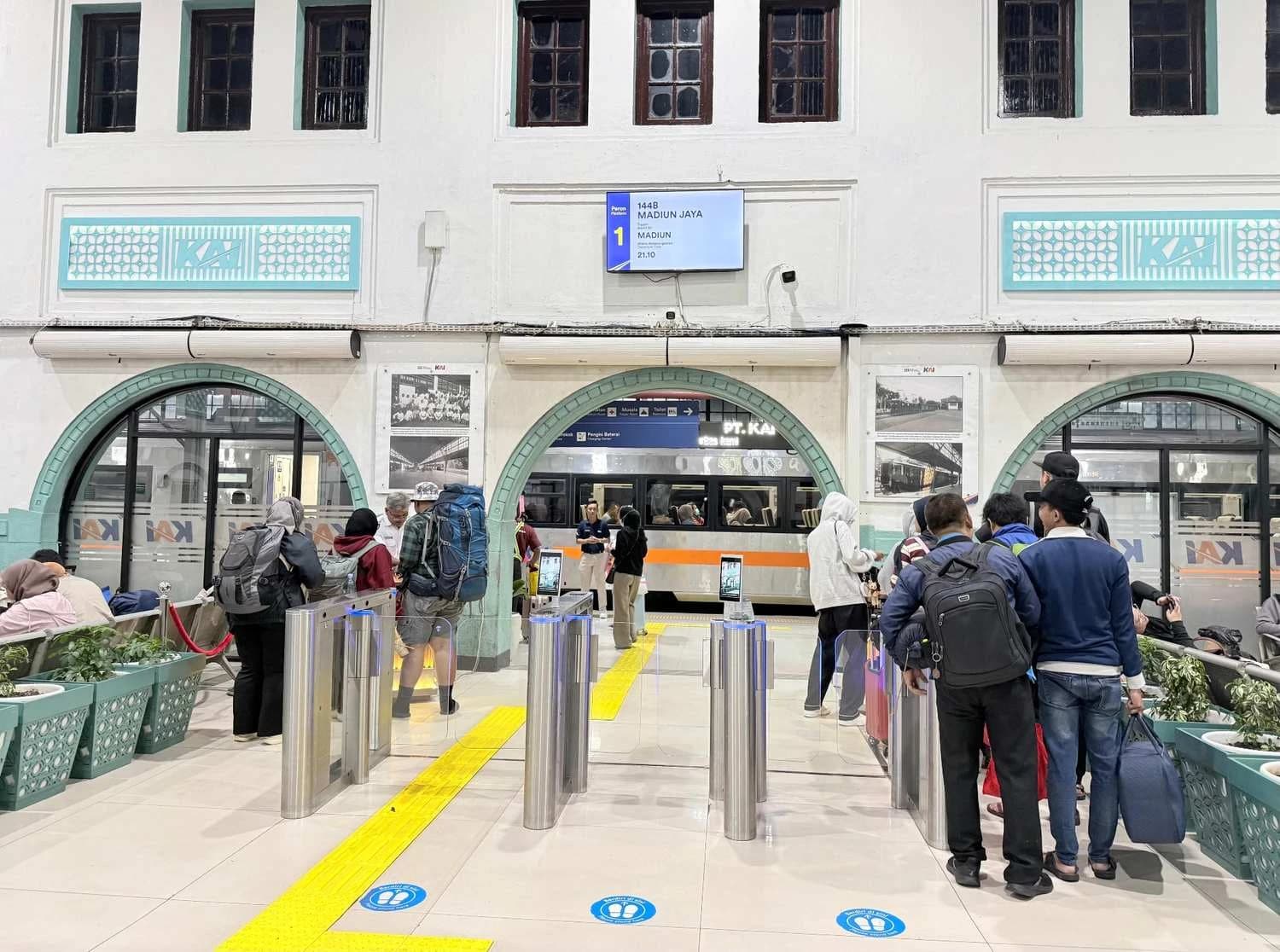
In the First Semester of 2026, 5.56 Million Customers Used Face Recognition, KAI Saved 13,888 Rolls of Paper
PT Kereta Api Indonesia (Persero) recorded a total of 5,555,034 long-distance train passengers using the Face Recognition Boarding Gate facility throughout the first semester of 2026. This figure increased by 53,978 customers compared to the same period in 2025, which recorded 5,501,056 users.
The high level of usage indicates that digital-based boarding processes have become part of customers’ travel habits across various stations. Customers who have completed registration simply need to direct their face to the scanning device to match their identity with their travel ticket data, without the need to print a boarding pass.
Behind this increasingly streamlined process, there are measurable environmental and operational efficiency benefits. From January to June 2026, the use of face recognition reduced the need for approximately 13,888 rolls of boarding pass paper, with estimated cost savings reaching IDR 203,800,310.
Assuming each roll of paper is approximately 72 meters long, the total paper saved would stretch nearly 1,000 kilometers. Based on a conservative simulation, this volume is equivalent to around 4.4 tons of paper or the raw material from approximately 75 trees.
KAI Vice President of Corporate Communication, Anne Purba, stated that the utilization of digital technology provides convenience for customers while also helping the company manage resources more efficiently.
“Face recognition makes the boarding process more practical, as customers only need to scan their faces. When used by millions of customers, reducing even a single printed sheet per journey can accumulate into significant savings in paper and costs,” said Anne.
These benefits become even more evident when calculated from the initial implementation of face recognition in January 2023. As of June 2026, this facility has been used by 26,964,584 long-distance train passengers.
During this period, KAI reduced the need for approximately 67,411 rolls of boarding pass paper, with estimated savings reaching IDR 989,263,176. If stretched out, the total length of the paper saved is estimated to exceed 4,853 kilometers.
Ecologically, this cumulative amount is estimated to be equivalent to approximately 21.36 tons of paper or raw materials from around 363 trees. This impact demonstrates that sustainability can be achieved through simple changes applied consistently on a large scale.
“Every customer who chooses digital boarding contributes to reducing material consumption. This efficiency also helps create a faster service flow, especially at stations with high passenger departure volumes,” Anne added.
Gambir Station recorded the highest number of Face Recognition Boarding Gate users during the first semester of 2026, reaching 927,658 customers. This was followed by Yogyakarta Station with 648,737 customers and Pasarsenen Station with 490,450 customers.
The following are the top 10 stations with the highest number of face recognition users in the first semester of 2026:
- Gambir Station: 927,658 customers
- Yogyakarta Station: 648,737 customers
- Pasarsenen Station: 490,450 customers
- Semarang Tawang Station: 401,361 customers
- Purwokerto Station: 341,514 customers
- Surabaya Pasar Turi Station: 327,434 customers
- Surabaya Gubeng Station: 269,552 customers
- Solo Balapan Station: 245,957 customers
- Bandung Station: 245,445 customers
- Semarang Poncol Station: 221,660 customers
These ten stations collectively recorded 4,119,768 users, or approximately 74.16 percent of total face recognition usage during the first semester of 2026. This means that nearly three out of four uses occurred at the top 10 highest-volume stations.
The concentration of usage at major stations reflects the strong demand for a more practical boarding process. This data also serves as part of KAI’s evaluation in managing service capacity, boarding gate equipment, and customer assistance at each station.
Currently, Face Recognition Boarding Gate facilities are available at 22 stations: Bandung, Bekasi, Cirebon, Cirebon Prujakan, Gambir, Jember, Kiaracondong, Kutoarjo, Lempuyangan, Medan, Malang, Madiun, Pekalongan, Pasarsenen, Purwokerto, Surabaya Pasar Turi, Surabaya Gubeng, Solo Balapan, Semarang Poncol, Semarang Tawang, Tegal, and Yogyakarta.
KAI will continue to evaluate the implementation of face recognition to ensure that the technology aligns with customer needs and the service characteristics of each station. The expansion of digital boarding habits is also part of efforts to create more efficient and paperless travel management.
“Millions of face scans generate dual benefits: a more practical boarding experience for customers and a sustainable reduction in paper consumption. This is the strategic value of digitalization when its benefits can be felt in every journey,” Anne concluded.
VP Corporate Communication KAI