
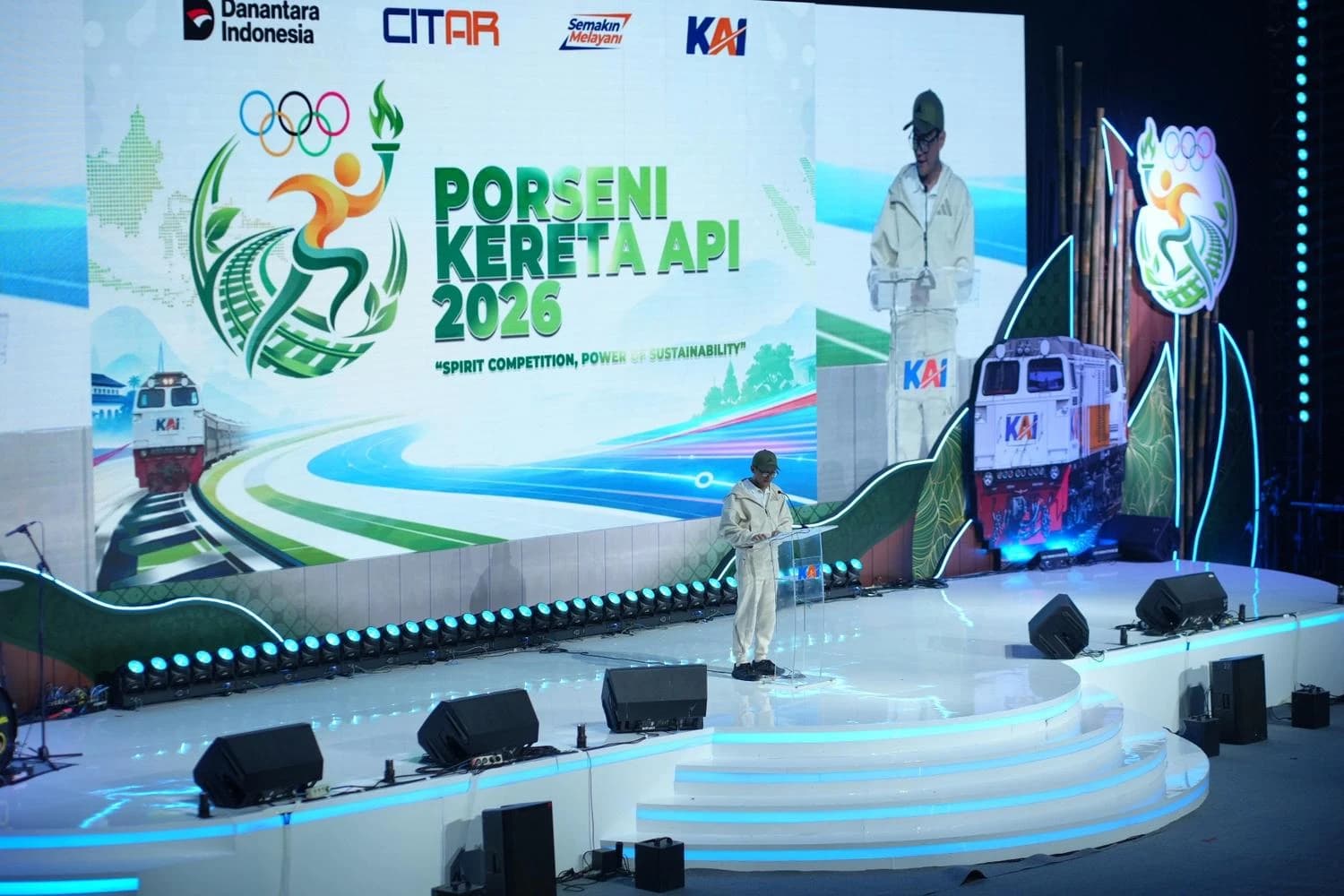
Railway Sports and Arts Week 2026 Opens in Yogyakarta, 1,632 Participants Unite the Spirit of Service and Sustainability
PT Kereta Api Indonesia (Persero) officially inaugurated the Railway Sports and Arts Week, or Porseni Kereta Api 2026, in Yogyakarta on Tuesday (14/7). Carrying the theme “Spirit of Competition, Power of Sustainability,” the event is participated in by 1,632 participants from 17 contingents across the KAI Group.
Participants come from various operational regions, regional divisions, work units, and KAI subsidiaries. They represent diverse geographical backgrounds, fields of work, and characteristics, yet gather with a shared spirit to strengthen unity and enhance service to the public.
Porseni Kereta Api 2026 features nine sports competitions, namely basketball, futsal, football, volleyball, table tennis, lawn tennis, badminton, chess, and e-sports (Mobile Legends). In the arts category, participants compete in band and traditional dance performances.
President Director of KAI, Bobby Rasyidin, stated that Porseni serves as a platform for employees to express their capabilities while building positive energy through healthy competition. The values of discipline, teamwork, creativity, sportsmanship, and mutual respect demonstrated during the event align with the professional character of railway personnel.
“Each region and work unit has its own characteristics and challenges. However, all KAI Group employees are united by the same responsibility: ensuring safety and delivering the best service to the public. Porseni serves as a platform to nurture this unity through sports and the arts,” said Bobby.
KAI Group is currently supported by approximately 36,053 employees. This figure includes around 29,585 employees of the parent company and those assigned to subsidiaries, as well as employees across all KAI subsidiaries.
They perform a wide range of roles, from train operations, customer service, rolling stock and infrastructure maintenance, information technology, and logistics, to corporate support functions. These diverse roles complement one another in ensuring smooth railway services across Java and Sumatra.
The contributions of these employees are reflected in KAI Group’s performance during the first semester of 2026. From January to June 2026, KAI Group served 258,993,359 customers, an increase of 7.55 percent compared to 240,805,920 customers in the same period of 2025.
During the same period, KAI transported 32.50 million tons of goods to support the distribution of energy, industrial, and national logistics commodities. This achievement was supported by improved safety, enhanced service capacity, digitalization, rolling stock maintenance, and the development of intermodal connectivity.
“Behind the journeys of hundreds of millions of customers and the distribution of millions of tons of goods are employees with diverse roles. They work at stations, onboard trains, in control centers, workshops, depots, along railway lines, and in various supporting units. All these roles are interconnected within a unified service system,” Bobby explained.
According to Bobby, Porseni serves as a momentum to appreciate employee dedication while also maintaining physical and mental well-being. Interactions among contingents also create opportunities to build connections, exchange experiences, and strengthen cross-regional and cross-unit collaboration.
This year’s event presents a more diverse range of competitions compared to the 2023 edition. Chess has been added to the sports category, while the arts category has been expanded to include band and traditional dance competitions.
This diversity provides broader opportunities for employees with varying interests and talents to participate. Each competition is conducted with adherence to rules, respect, and a spirit of camaraderie among contingents.
“In sports and the arts, everyone brings their own strengths. When these abilities come together in a spirit of unity, they create energy that strengthens KAI Group as one big family,” Bobby added.
In line with the event’s theme, sustainability is implemented through daily practices throughout the Porseni series. Participants are encouraged to bring reusable tumblers and utensils to help reduce single-use waste.
Each employee is also encouraged to collect one unused white R6 uniform. These uniforms will be repurposed into products with functional value as part of circular economy practices and textile waste reduction within the company.
Environmental initiatives have also been carried out through the planting of 25 productive trees at Balai Yasa Yogyakarta on Monday (13/7). The trees, with an average height of 2.5 to 3 meters, consist of 10 mango trees, 2 mundu trees, 5 duku trees, 5 jackfruit trees, and 3 velvet apple trees.
Cumulatively, KAI has planted 99,785 trees from 2022 to July 13, 2026. Of these, 4,540 trees were planted in 2026 across various operational areas, taking into account plant suitability and local environmental conditions.
This program complements various environmental initiatives implemented by KAI in its operations and customer services. KAI has operated 113 solar power units across 92 locations, with a total installed capacity of 4,430.65 kilowatt peak and the potential to reduce more than 5,000 tons of carbon dioxide emissions annually.
Since July 1, 2026, KAI has also gradually implemented B50 biodiesel fuel, taking into account fuel quality, infrastructure readiness, safety, and operational reliability.
Service digitalization has also contributed to reducing resource consumption. During the first semester of 2026, the Face Recognition Boarding Gate was used by 5,555,034 long-distance train passengers, reducing the need for approximately 13,888 rolls of boarding pass paper, with estimated cost efficiency reaching Rp203.80 million.
KAI also provides 124 free drinking water facilities at 58 stations to support the use of tumblers and reduce single-use plastic bottle consumption during travel.
Bobby emphasized that sustainability can begin from both corporate operational policies and consistent daily practices carried out by employees across all working areas.
“The spirit of sustainability must be reflected in how we work, use energy, manage materials, and serve customers. Although assigned to different regions and fields, all KAI Group employees play equally important roles in maintaining the company’s sustainability,” he said.
Bobby encouraged all contingents to compete with sportsmanship, prioritize safety, and respect one another. While achievements are part of the competition, unity, discipline, and collaboration are values that can be carried back into the workplace.
“Best of luck to all participants in competing and creating. Show your best abilities, build friendships across contingents, and make the diversity within KAI Group a strength to continue serving the public and advancing Indonesia’s railway sector,” Bobby concluded.
VP Corporate Communication KAI