
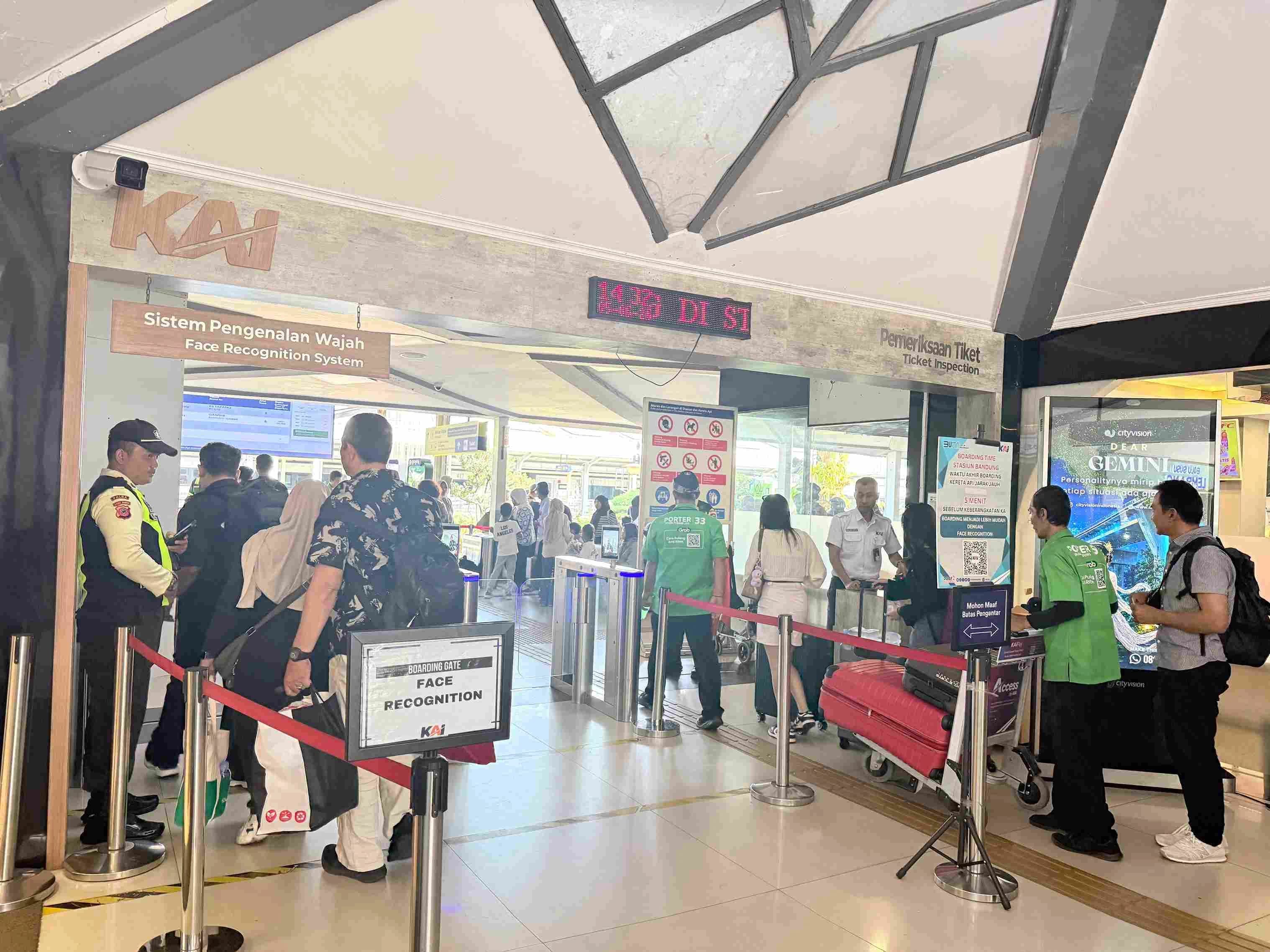
Expanding Options for Jakarta–Bandung Travel: KAI Strengthens Customer Connectivity to Key Stations in West Java
The Jakarta–Bandung corridor remains one of the most dynamic transit routes, characterized by highly fluid public mobility. Commutes for work, university, family visits, tourism, and onward travel to various stations across West Java have driven increasingly diverse demands for rail-based transportation along this line.
PT Kereta Api Indonesia (Persero) notes that passengers traveling from Jakarta to Bandung now enjoy an array of service options. In addition to the KA Parahyangan as the primary direct service for the Gambir–Bandung round-trip (PP) route, passengers can also utilize the KA Papandayan, KA Pangandaran, KA Cikuray, and KA Serayu, depending on their departure stations, final destinations, travel needs, and service preferences.
KAI’s Vice President of Corporate Communication, Anne Purba, stated that this diverse service portfolio offers unprecedented flexibility for Jakarta–Bandung travel. Passengers can seamlessly select long-distance trains, connected local transit links, or high-speed rail to match their specific mobility requirements.
"Jakarta–Bandung mobility is continuously evolving. In response, KAI presents a wide array of service options, allowing customers to tailor their journeys—whether they require direct travel to Bandung Station, access to Kiaracondong and Cimahi stations, or onward connectivity to Garut, Tasikmalaya, Ciamis, Banjar, and Purwokerto,"
The KA Parahyangan serves as the direct mainline link from Gambir to Bandung PP. This train remains the top choice for passengers traveling between Jakarta and Bandung for business, education, family commitments, or weekend getaways. By directly linking these two major hubs of activity, KA Parahyangan plays a pivotal role in anchoring mobility along the Jakarta–Bandung corridor.
From January to May 2026, KA Parahyangan served 475,072 passengers, representing a significant 38.57 percent increase compared to the 342,837 passengers recorded during the same period in 2025. This robust growth highlights the enduring demand for direct travel between Jakarta and Bandung.
Beyond the flagship mainline, passengers from Jakarta can opt for the KA Papandayan operating the Gambir–Garut PP route. This train makes a scheduled stop at Bandung Station, making it an excellent alternative for Jakarta passengers heading to Bandung while simultaneously catering to those continuing onward to Garut. The presence of KA Papandayan broadens the service matrix for customers requiring connectivity from Jakarta through to Bandung and Garut stations.
In January–May 2026, KA Papandayan carried 180,640 passengers, an 18.91 percent increase compared to the 151,919 passengers served in January–May 2025. This performance demonstrates that the Jakarta–Bandung–Garut transit arc is becoming increasingly relevant for passengers accessing key stations in both regions.
Another viable option is the KA Pangandaran on the Gambir–Banjar PP route. This train also calls at Bandung Station, serving as an additional alternative for the Jakarta–Bandung commute. Concurrently, KA Pangandaran reinforces vital downstream access from Bandung to key stations within the Eastern Priangan region, such as Tasikmalaya, Ciamis, and Banjar.
From January to May 2026, KA Pangandaran served 146,160 passengers, compared to 163,349 passengers during the same period in 2025. Despite a 10.52 percent correction in passenger volume during this timeframe, KA Pangandaran remains an essential asset in expanding multi-regional connectivity across Jakarta, Bandung, and Eastern Priangan.
For passengers departing from Pasarsenen Station, KAI operates the KA Cikuray serving the Pasarsenen–Garut PP route. This train stops at Bandung Station, providing a dependable Jakarta–Bandung transit option with onward access to Garut. This service is highly favored by passengers seeking cost-effective intercity travel options.
KA Cikuray served 266,993 passengers in January–May 2026, marking a 7.13 percent growth compared to the 249,218 passengers in January–May 2025. These figures demonstrate KA Cikuray's steady role in supporting affordable public mobility from Jakarta toward Bandung and Garut.
Meanwhile, the KA Serayu operating the Pasarsenen–Purwokerto PP route serves as an alternative for passengers from Jakarta heading to stations within the Greater Bandung area. While KA Serayu does not call at Bandung Station directly, it services strategic transit nodes such as Kiaracondong and Cimahi. Thus, the train remains highly relevant for commuters targeting the Bandung metropolitan area via these alternative gateways.
From January to May 2026, KA Serayu served 568,759 passengers, a 3.14 percent increase compared to the 551,465 passengers recorded during the corresponding period in 2025. This service cements reliable access from Jakarta to Kiaracondong, Cimahi, and other stations along the Pasarsenen–Purwokerto operational corridor.
In addition to long-distance intercity trains, customers can capitalize on a combined network of commuter rails and local services. From Jakarta, commuters can board the Cikarang Commuter Line to reach the Bekasi and Cikarang regions, subsequently transferring to local train services heading to Purwakarta and stations across Greater Bandung.
The Cikarang Commuter Line served 36,294,605 passengers from January to May 2026, an 8.28 percent increase compared to the 33,519,333 passengers in January–May 2025. This line functions as a vital artery for daily mobility within Jabodetabek while opening seamless gateway access to West Java’s local rail network.
From the Cikarang area and its surroundings, passengers can continue their journey via the KA Walahar (Cikarang–Purwakarta PP). From January to May 2026, KA Walahar served 1,807,649 passengers, a 7.85 percent increase compared to the 1,676,008 passengers recorded in January–May 2025.
Similarly, the KA Jatiluhur (Cikarang–Cikampek PP) forms another link in the local connectivity ecosystem across eastern Jabodetabek and West Java. KA Jatiluhur served 575,808 passengers in January–May 2026, marking a solid 28.20 percent surge compared to the 449,156 passengers in the same period of the previous year.
Upon entering the Greater Bandung network, passengers can connect to the Cibatuan or Garut Cibatuan local train services. This regional network interlinks stations across Greater Bandung with Garut, including the Cibatu–Garut PP shuttle services and broader local loops that sustain regional intercity movement in West Java.
From January to May 2026, the Cibatuan/Garut local train services carried 1,317,737 passengers, a 7.60 percent increase compared to the 1,224,630 passengers served in January–May 2025. This service remains a preferred daily mobility baseline for commuting, education, commerce, and family trips to numerous stations between Greater Bandung and Garut.
On the premium and high-speed rail segment, passengers also have the elite option of the Whoosh High-Speed Train service. In January–May 2026, Whoosh served 2,415,736 passengers, reflecting a 1.43 percent increase compared to the 2,381,619 passengers recorded in January–May 2025, adding a rapid transit dimension to the Jakarta–Bandung network.
Aggregated across all modes, long-distance lines, local trains, the Cikarang Commuter Line, and Whoosh services supporting Jakarta–Bandung mobility collectively moved 44,049,159 passengers from January to May 2026. This reflects an overall 8.20 percent growth compared to the 40,709,534 passengers served in January–May 2025.
Anne added that this diverse multi-tier service matrix empowers the public to select their travel based on precise origin points, destination stations, transit times, tariff structures, and specific trip profiles.
"Every service tier possesses its distinct operational character and market segment. Most importantly, the public now enjoys a wealth of choices to travel via a rail ecosystem that is safe, comfortable, efficient, and thoroughly interconnected across destination stations,"
KAI advises passengers to plan their journeys well in advance, verify that their chosen departure and arrival stations align with their travel itineraries, and cross-check train schedules through KAI’s official distribution channels. Long-distance train tickets can be booked seamlessly via the Access by KAI application, the official KAI website, and other certified corporate sales partners.
"KAI will continuously strengthen services, network connectivity, and travel accessibility to ensure that the railway remains the absolute primary choice for the public commuting from Jakarta to Bandung, Garut, Eastern Priangan, Purwokerto, and various other stations across West Java,"
VP of Corporate Communication KAI