
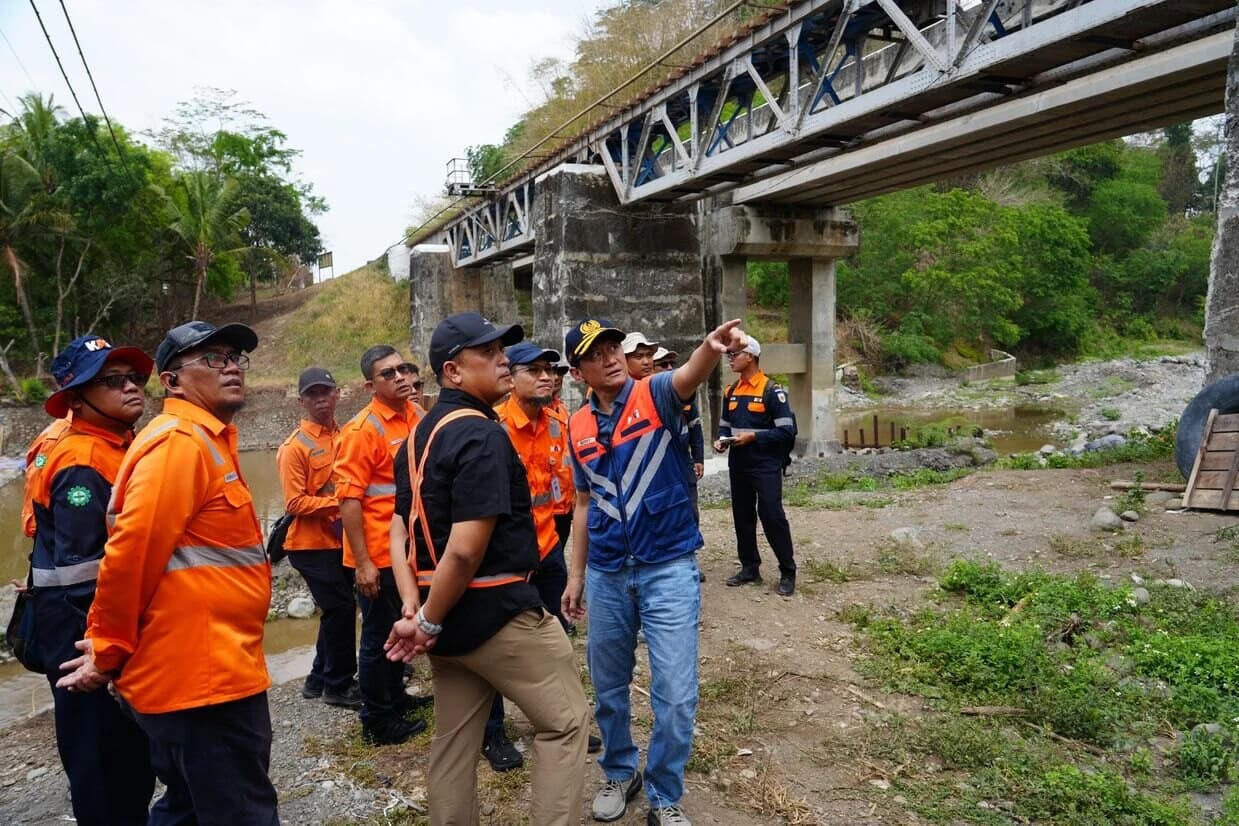
KAI President Inspects Railway Lines in Daop 5 Purwokerto Ahead of Nataru
PT Kereta Api Indonesia (Persero) President Director Bobby Rasyidin directly inspected several railway infrastructures in Central Java, ranging from railway bridges to level crossings. The inspection covered BH 1109 Bridge at KM 303+6/7 along the Prupuk–Linggapura line in Daop 5 Purwokerto, as well as two level crossing locations along the Tegal–Slawi line, namely KM 7+200 and JPL 16A KM 7+080.
During the visit, Bobby and the operational team observed infrastructure conditions and the progress of safety facility development in the field. The inspection covered track and bridge conditions, as well as the readiness of crossing facilities used by the public in their daily activities.
“Each railway line has different characteristics. We directly observed the conditions of bridges, tracks, and level crossings to ensure that the necessary measures are appropriate to the actual conditions in the field. We hope that train journeys and public activities around railway lines can continue to improve,” Bobby said.
The inspection is in line with KAI’s ongoing level crossing safety improvement program. The program includes the construction of 190 level crossing guard posts, complemented by the development of supporting facilities such as barrier gates and operational equipment for crossing attendants.
As of November 5, 2026, 24 level crossing locations have been operating with newly developed facilities in Daop 1 Jakarta, Daop 2 Bandung, Daop 3 Cirebon, Daop 4 Semarang, Daop 7 Madiun, and Daop 8 Surabaya. Work at other locations continues in stages, covering the completion of physical facilities and the readiness of operational equipment.
Bobby stated that progress at each region remains a priority for KAI, particularly at level crossings directly intersecting with public mobility.
“Level crossings are shared spaces used by train journeys and road users. We continue to complete their facilities gradually, while taking into account the readiness of personnel and equipment at each location. We want the results of this work to benefit people who pass through these crossings every day,” Bobby said.
In addition to facility development, KAI continues to evaluate level crossings together with regional governments and relevant stakeholders, according to the conditions at each location. These efforts include facility improvements, operational arrangements, and coordination in addressing locations requiring further attention.
Through inspections along the Prupuk–Linggapura and Tegal–Slawi lines, KAI continues its infrastructure evaluation and safety improvement programs across various regions.
“Developments in the field serve as evaluation material for determining our next steps. Most importantly, the facilities we build must function properly and support the safety of train journeys and the public,” Bobby concluded.
VP Corporate Communiation KAI