
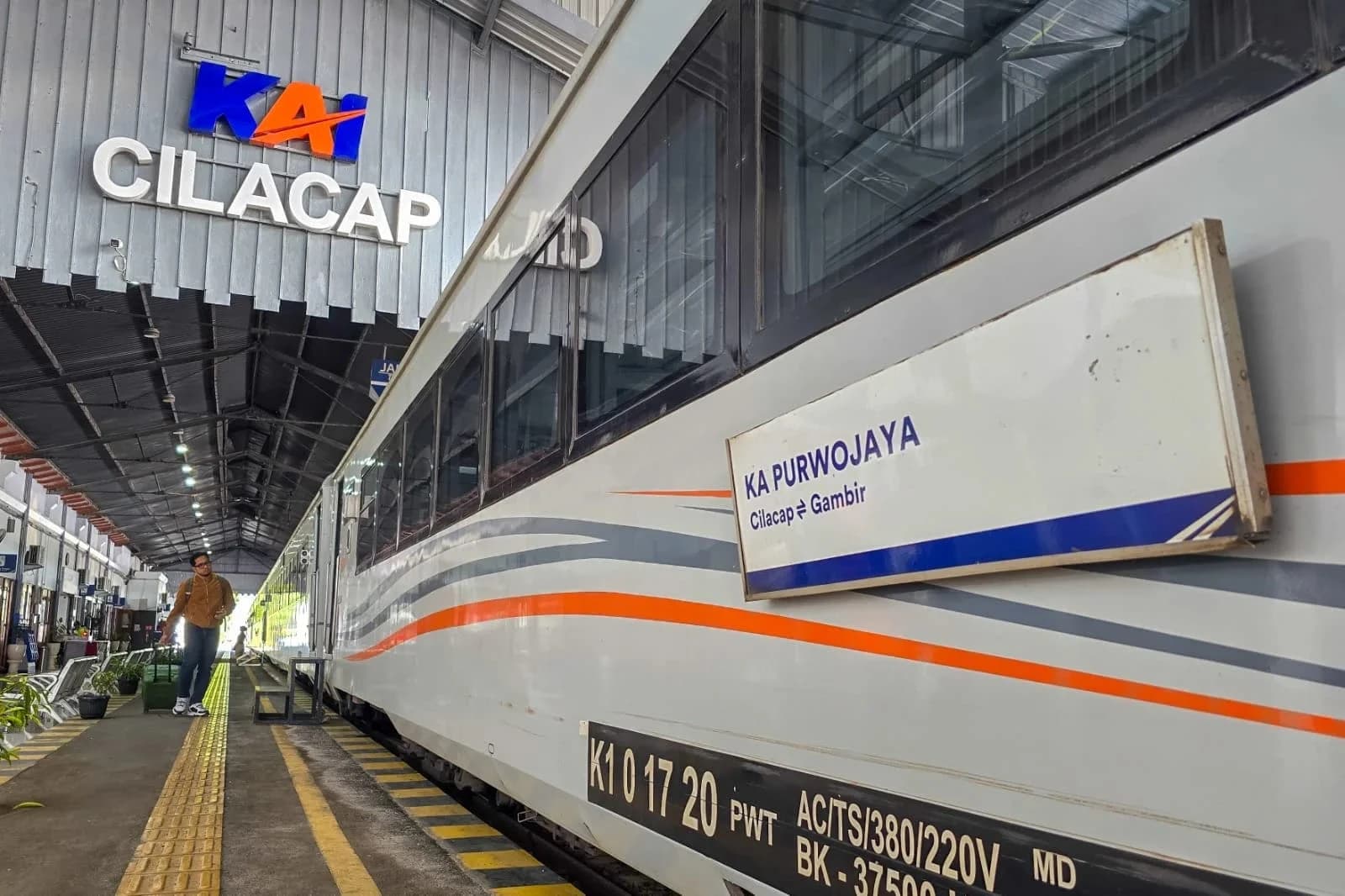
Purwojaya Train Customers Increase by 84.55 Percent, Cilacap–Jakarta Corridor Reaches 408 Thousand Customers
Intercity train travel growth throughout 2026 is also visible on the corridor connecting southern Java cities with Jakarta. The Purwojaya Train served 408,961 customers throughout January–September 2026, an increase of 84.55 percent compared to 221,601 customers in the same period of 2025. In terms of volume, there was an additional 187,360 customers in nine months.
The Purwojaya Train serves the Cilacap–Kroya–Gambir round-trip relation, connecting the Cilacap region and its surroundings with Jakarta via the southern Java network. This growth is interesting because it demonstrates that the increase in travel toward the capital also comes from secondary city corridors, rather than being concentrated solely on major intercity routes.
KAI Vice President Corporate Communication Anne Purba stated that each corridor has different demand patterns, and customer data serves as the basis for reading these changes.
“Purwojaya grew by more than 84 percent in nine months. This figure shows that travel demand to Jakarta is developing strongly from the Cilacap corridor and surrounding areas,” Anne said.
This movement takes place within the context of high community mobility in southern Central Java. BPS data shows that Cilacap Regency received approximately 3.16 million domestic tourist trips during January–July 2026, while Banyumas Regency recorded around 4.84 million trips in the same period.
In terms of travel origins, BPS also recorded that around 3.11 million domestic tourist trips originated from Cilacap Regency and approximately 3.10 million trips originated from Banyumas Regency during January–July 2026. This data provides an overview of the substantial movement of people from the southern region of Central Java, although not all of these trips used trains.
The growth of Purwojaya serves as an example of how the intercity train market develops in corridors with different economic and mobility characteristics. Customers use this travel service for work, education, business, family visits, and tourism activities, meaning the demand for schedules and capacity does not always align with other metropolitan corridors.
For KAI, changes in volume per train serve as an indicator to evaluate capacity, departure patterns, travel times, and service composition. This approach is important because high growth in one corridor does not necessarily generate the same needs in another.
“Data per train helps us view the market in greater detail. When a relation grows rapidly, we can evaluate customer needs based on travel patterns that actually occur in that corridor,” Anne said.
The growth of Purwojaya also indicates that the intercity train network has room to capture mobility from economic centers outside the largest cities. KAI will continue to use volume data, occupancy rates, and seasonal travel patterns to determine service steps for each relation.
“The intercity network must read the specific needs of each corridor. That is what enables capacity and services to adapt more accurately to changes in community mobility,” Anne concluded.
VP Corporate Communication KAI