
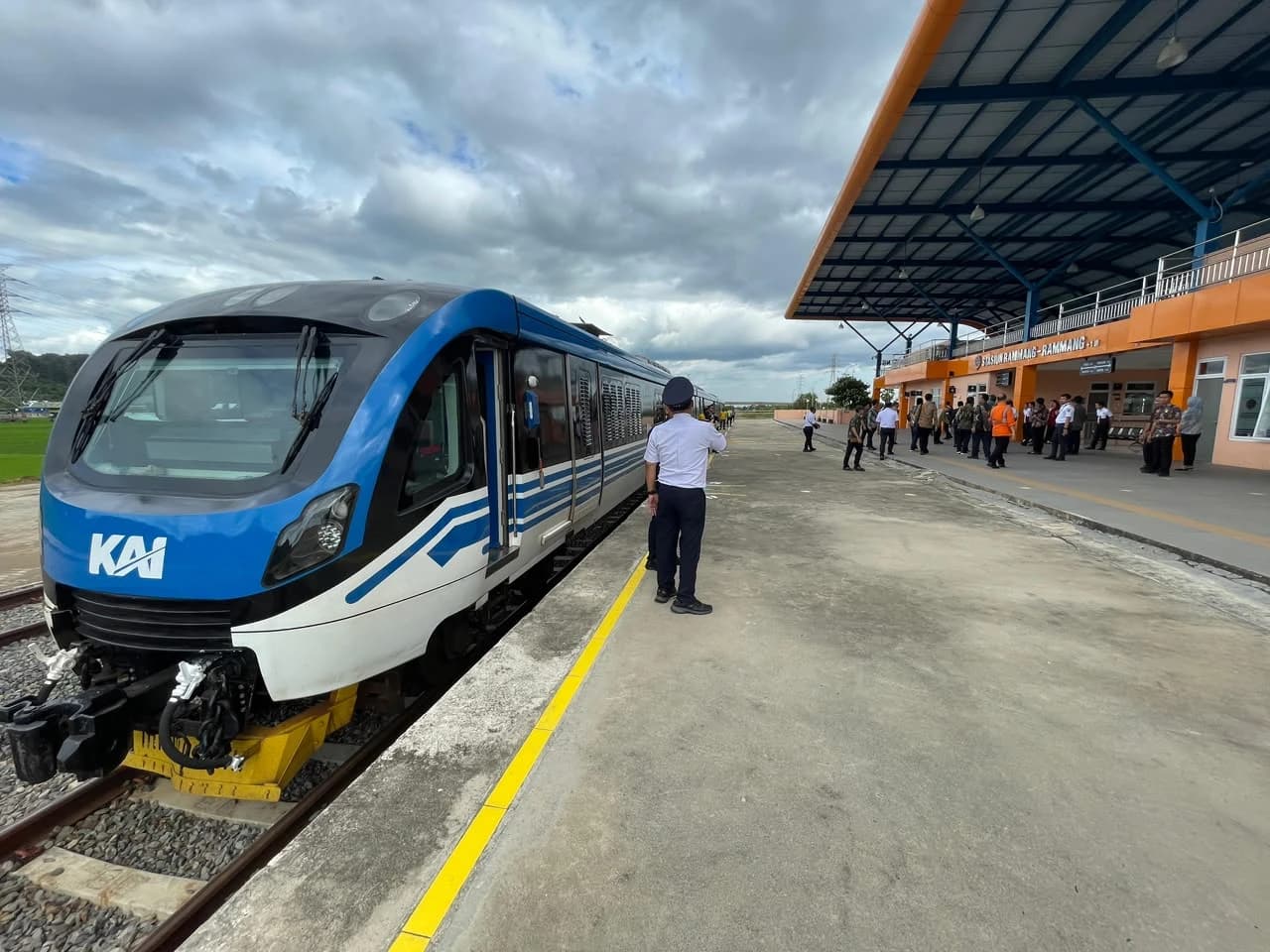
Makassar–Parepare Railway Passengers Increase by 13.62 Percent, KAI Expands Connectivity and Opportunities for the People of South Sulawesi
PT Kereta Api Indonesia (Persero) recorded positive growth in the Makassar–Parepare Railway service during the January–July 2026 period. During this period, the service transported 206,651 passengers, an increase of 13.62 percent compared to 181,876 passengers during the same period in 2025.
Cumulatively, since the commencement of operations through July 2026, the Makassar–Parepare Railway has served 1,032,163 passengers. Surpassing one million passengers reflects the growing demand among the people of South Sulawesi for public transportation that is safe, comfortable, affordable, and reliable.
KAI Vice President of Corporate Communication Anne Purba said that the growth in passenger numbers conveys a broader message about the importance of connectivity in regional development. A region has greater opportunities to grow when its people can more easily access education, employment, trade, public services, tourism, and various social activities.
"Indonesia has enormous potential spread across every region. Connectivity helps connect that potential with opportunities. When travel becomes more accessible, people have greater opportunities to pursue education, work, build businesses, reunite with family, and contribute to the development of their regions," Anne said.
The presence of railway services in South Sulawesi also expands mobility options beyond Java and Sumatra. The service forms part of the Sulawesi railway network development, which is designed to connect key activity centers and support regional development.
The role of connectivity has become increasingly strategic as South Sulawesi's economic potential continues to grow. The province's economy expanded by 6.88 percent year-on-year in the first quarter of 2026, reflecting stronger economic activity that requires reliable transportation support.
This economic growth is driven by activities across various sectors and regions. Therefore, the benefits of development can be further expanded when communities are able to reach activity centers with more predictable travel times and measurable transportation costs.
For workers, improved connectivity expands employment opportunities without necessarily requiring them to leave their hometowns. For students, easier travel provides greater access to schools, universities, training programs, and learning opportunities. For MSMEs, increased mobility creates opportunities to reach new customers and introduce local products to broader markets.
The tourism sector also benefits from improved connectivity. The Makassar–Parepare Railway passes through areas rich in natural attractions, cultural heritage, culinary destinations, and historical sites, including Maros, Pangkep, and Barru. As travel becomes easier, tourists can discover more destinations, while local communities gain opportunities through culinary businesses, accommodations, connecting transportation services, the creative economy, and sales of local products.
"Opportunities take many tangible forms. There are traders meeting new customers, young people pursuing education and training, workers reaching their workplaces, and families traveling more conveniently. Every journey can become the beginning of an opportunity that once seemed out of reach," Anne said.
From Parepare, the Nation's Talents Can Move Forward
Parepare holds a special place in Indonesia's national history. It is the birthplace of Bacharuddin Jusuf Habibie, the third President of the Republic of Indonesia, a renowned scientist, and a national technology figure. According to the Presidential Museum of the Republic of Indonesia, B.J. Habibie was born in Parepare on 25 June 1936 before embarking on an educational and professional journey that enabled him to make significant contributions to Indonesia.
His story carries an important message: outstanding talents can emerge from any city or region. One's birthplace does not determine how far one can aspire. However, every talent requires access to education, knowledge, experience, and opportunities to develop.
Connectivity creates opportunities for young people across the regions to access education and personal development. A child growing up in South Sulawesi can become a scientist, engineer, educator, artist, athlete, entrepreneur, leader, or someone who contributes great ideas to Indonesia when access to opportunities becomes more open.
"Parepare gave birth to B.J. Habibie, a figure who demonstrated that someone from a regional city could bring Indonesia's ideas to the world stage. We never know from which town or village the next great talent will emerge. Our shared responsibility is to provide access so every child has the opportunity to learn, grow, and move forward," Anne said.
Equal opportunity does not mean everyone must follow the same path in life. It means that where someone comes from, the distance they must travel, or limited accessibility should not become the main barriers to developing their potential.
In this context, railways closely reflect the journey of human life. Every train follows its designated track, passing through cities and regions while carrying passengers toward different destinations. Some travel to school, workplaces, business locations, tourist attractions, family homes, or places where new hopes begin.
Independence Means Everyone Has the Right to Move Forward
Ahead of the 81st Anniversary of the Independence of the Republic of Indonesia on 17 August 2026, the growth of the Makassar–Parepare Railway service represents part of the effort to expand the benefits of transportation development for the community.
Independence becomes even more meaningful when every citizen has the opportunity to determine their own future. Young people can pursue higher education, parents can build better livelihoods, entrepreneurs can expand their markets, and communities can travel safely and reliably to various centers of activity.
"Everyone has the right to move forward. They deserve the opportunity to pursue higher education, secure better jobs, build businesses, and contribute to the development of their regions. Railways continue moving forward, carrying people toward their destinations, just as Indonesia continues moving forward through the capabilities and aspirations of its people," Anne said.
Behind the figure of 1,032,163 passengers are more than one million journeys, each with a unique purpose. There are students pursuing their dreams, workers supporting their families, entrepreneurs sustaining their businesses, tourists discovering the richness of local destinations, and families traveling to reunite with loved ones.
The growth in passenger numbers encourages KAI to continue improving the quality of the Makassar–Parepare Railway service. KAI remains committed to maintaining safety, comfort, cleanliness, friendly service, and operational reliability so that the benefits of the service can reach even more people.
The development of the Sulawesi railway network also requires continuous collaboration among the Central Government, regional governments, KAI, local communities, and other stakeholders. Such collaboration is essential to strengthen intermodal integration, improve access to railway stations, develop surrounding areas, and ensure railway services meet the needs of the community.
"Indonesia is rich in potential. In every city, village, coastal area, and mountainous region, there are people with talent, courage, and aspirations. Connectivity opens the way for that potential to meet opportunity. As the people of South Sulawesi continue to move forward, the region will develop, and Indonesia will move forward as well," Anne concluded.
VP Corporate Communication KAI