
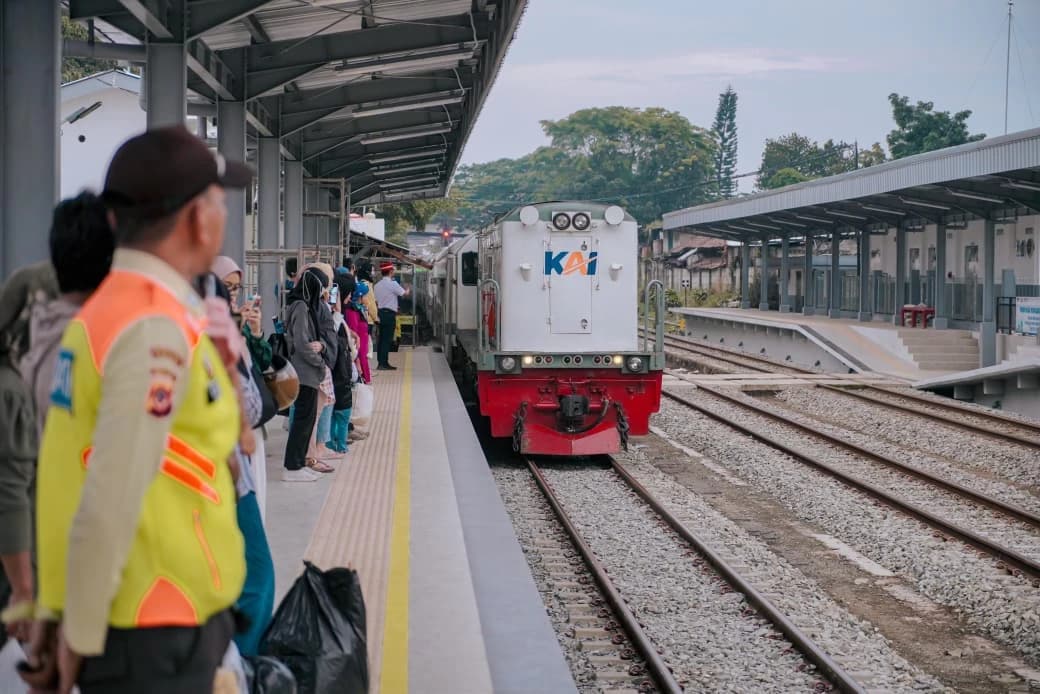
Bandung Raya Local Train Ridership Hits 11.87 Million; KAI Pushes for Needs-Based Infrastructure
The public transportation service provider PT Kereta Api Indonesia (Persero) recorded that public demand for rail services in the Greater Bandung area continued to grow. From January to July 2026, local train services in Greater Bandung served 11,872,273 passengers, an increase of 8.55 percent compared with 10,936,955 passengers during the same period in 2025.
Compared with January–July 2023, when the service carried 8,595,185 passengers, ridership during the same period this year has risen by 38.13 percent. The increase reflects a steadily strengthening mobility base across the Greater Bandung region.
The annual trend shows a similar pattern. Throughout 2023, Greater Bandung rail services recorded 14,720,252 passengers. The figure increased by 9.77 percent to 16,159,458 in 2024, before climbing another 15.89 percent to 18,727,224 in 2025. Over the past two years, total passenger volume has grown by approximately 27.22 percent.
KAI Vice President Corporate Communication Anne Purba said the data provides important insight into the relationship between regional development and the need for mass transportation infrastructure.
“Greater Bandung offers a clear example. As community activity increases and travel demand becomes more established, public transportation capacity must be prepared to keep pace. Passenger data is one of the key indicators in determining what needs to be strengthened and when those improvements are required,” Anne said.
Demand has also remained relatively consistent. Between January and July 2026, monthly passenger numbers for Greater Bandung local train services ranged from approximately 1.45 million to 1.84 million. Ridership reached around 1.84 million in March 2026 and approximately 1.77 million in July.
According to Anne, this pattern is an important consideration for both the government and operators when evaluating future capacity improvements. Infrastructure upgrades may include additional track capacity, signaling systems, station facilities, access integration, fleet readiness, and technological developments such as railway electrification.
“Electrification and capacity expansion are options that need to be assessed based on the specific requirements of each railway corridor. We need to consider passenger demand, travel patterns, service frequency, energy supply readiness, existing infrastructure conditions, investment costs, and the benefits delivered to the public. Infrastructure development must be supported by careful planning,” Anne explained.
This needs-based approach aligns with the Government’s strategy to expand Indonesia’s national railway network. The Government is promoting railway development beyond Java, including Sumatra, Kalimantan, and Sulawesi, to strengthen connectivity, improve logistics efficiency, and reduce transportation service disparities among regions. It also emphasizes integrating railway development with broader infrastructure projects and regional development plans.
KAI believes this agenda should be implemented gradually, systematically, and based on clear priorities. Each region has distinct mobility characteristics, geographical conditions, economic centers, passenger and freight potential, as well as different investment requirements.
National transportation data also reflects strong travel activity across various regions. According to Statistics Indonesia (BPS), railway services outside Java, covering Sumatra and Sulawesi, served 3.99 million passengers during January–June 2026, an increase of 9.22 percent compared with the same period in 2025.
For maritime transportation, passenger volumes during January–June 2026 reached 97,900 at Belawan Port, 271,000 at Makassar Port, and 267,200 at Balikpapan Port, representing year-on-year increases of 5.50 percent, 8.49 percent, and 12.79 percent, respectively. Meanwhile, domestic air travel recorded approximately 1.10 million passengers at Kualanamu International Airport and around 1.37 million passengers at Hasanuddin International Airport over the same period.
Anne said these figures provide an initial picture of national mobility trends. However, decisions regarding railway development must be supported by more comprehensive feasibility studies.
“The transportation needs of Sumatra differ from those of Kalimantan, Sulawesi, and Papua. Some regions have strong passenger potential, others have greater logistics demand, while some have the potential to serve both. Therefore, development priorities must be determined through data-driven assessments to ensure the greatest benefits for the public,” Anne said.
The same approach is being applied to preliminary discussions on railway development in Papua. In April 2026, the Papua Provincial Government and KAI initiated an initial survey to assess potential routes and field conditions. The provincial government stated that comprehensive technical studies are essential to ensure infrastructure development aligns with regional needs before moving to the next stage.
According to Anne, taking a prudent approach in determining development priorities is a key part of sound transportation investment governance. Railway infrastructure has a long service life, making it essential to consider not only present-day demand but also long-term regional development.
“The most important factor is the public benefit. When demand is evident, regions continue to develop, economic potential exists, and feasibility studies support the investment, service improvements can be implemented more effectively. Greater Bandung demonstrates how travel data can help us better understand those needs,” Anne concluded.
VP Corporate Communication KAI