
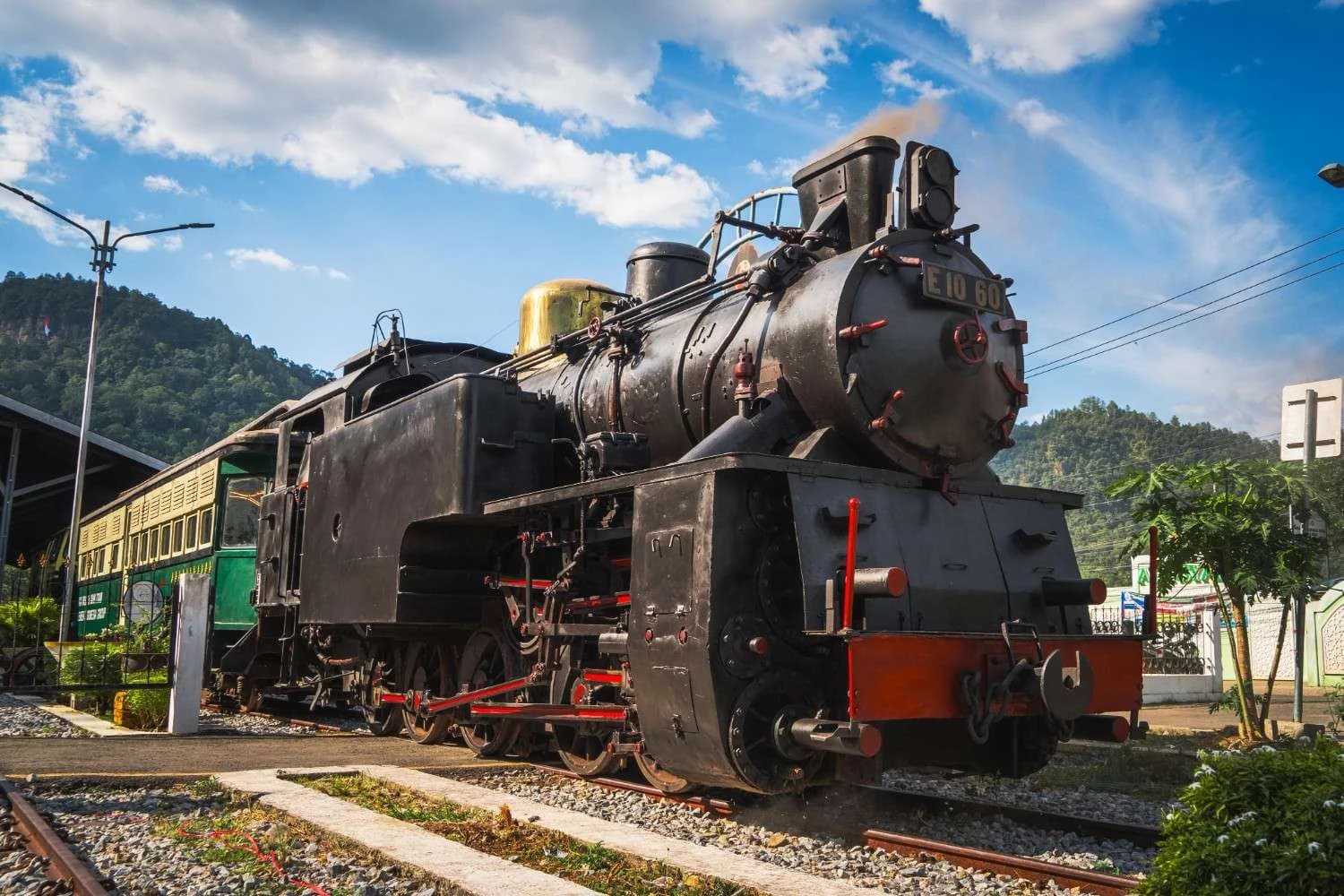
Mak Itam and Its Cogwheel, Old Technology That Conquered the Mountains of Sumatra
Long before high-speed trains raced at hundreds of kilometers per hour, railway engineers had faced a different challenge: how to take trains through mountainous areas with steep inclines. In West Sumatra, this challenge was related to the need to transport Ombilin coal from the interior to the port. One of the legacies that reminds us of that era is Mak Itam, a steam locomotive that holds stories of technology, industry, and changing times.
Mak Itam is the E1060 steam locomotive built by the Esslingen factory in Germany, which was brought to Indonesia in 1966. This 750-horsepower locomotive has a cogwheel underneath it. This technology is related to the cog railway system developed to handle uphill routes. However, Mak Itam’s cogwheel was not compatible with the configuration of the cog railway leading to Bedono, so the locomotive did not travel along that route when it was once used for tourist journeys in Central Java. This detail shows that railway technology is designed with specific specifications, not for use on every route.
The story behind Mak Itam began with the discovery of Ombilin coal around 1868 by geologist Willem Hendrik de Greve. The coal reserves in the Sawahlunto area had significant economic value, but the location was in the interior, surrounded by hilly terrain. The challenge did not stop at mining. The mined resources also had to be transported to the coast for distribution. The construction of a railway network then became part of a system connecting the mines, processing facilities, mountain routes, and ports.
The scale of this engineering effort extended beyond the interests of a single city. UNESCO recognizes the Ombilin Coal Mining Heritage of Sawahlunto as an integrated industrial system comprising mines, company settlements, coal storage facilities, ports, and a 155-kilometer mountain railway network. This system demonstrates the meeting of European engineering knowledge with local knowledge of the environment and geographical conditions. On July 6, 2019, UNESCO designated this industrial heritage area as a World Heritage Site. The recognition was granted to the entire Ombilin system, not to Mak Itam as an individual object.
Vice President Corporate Communication KAI Anne Purba said Mak Itam’s story helps the public understand that railway technology has developed through a long process of responding to the needs and conditions of its time. “Behind a locomotive, there is engineering knowledge and design decisions that emerged from real challenges. Mak Itam’s story invites us to see how transportation, industrial activities, and regional development are interconnected. This history is important to understand so that we can learn about the journey of Indonesian railway technology up to the present day,” said Anne.
The history of steam locomotives in West Sumatra spans several generations. The E10 locomotive family was delivered in several stages, including 22 units in 1921–1928, 20 units in 1964–1966, and seven units in 1967. As diesel technology developed, steam locomotives gradually left regular service in the early 1980s. Mak Itam then entered a new chapter as a tourist locomotive. In 1998, the locomotive was transferred to the Ambarawa Railway Museum in a damaged condition and, after repairs, briefly operated tourist journeys in Central Java. In December 2008, Mak Itam returned to Sawahlunto to support the development of railway heritage tourism.
This change in function reflects the challenges faced by industrial heritage around the world. When older technology is no longer the primary choice for operations, the value of an asset can shift from a production tool to a source of historical knowledge. However, this change in function requires careful management. Preservation needs to maintain the asset’s original characteristics, document its history, and ensure that its use complies with its technical condition and safety requirements.
Mak Itam was designated a cultural heritage object through Sawahlunto Mayor’s Decree Number 188.45/327/WAKO-SWL/2017. According to KAI data, the locomotive is located at Sawahlunto Depot and can still move within the Sawahlunto Rail and Train Museum yard. KAI also recorded leaks in several boiler fire tubes that require maintenance and repairs before the locomotive can operate optimally. This condition is a reminder that preserving technological heritage requires precise technical work, not merely maintaining its external appearance.
Anne explained that preserving historic railway assets requires combining technical precision with ways of presenting history that are easy for the public to understand.
“The value of a heritage asset does not stop at its age. It includes knowledge of how it works, the challenges it once faced, and the changes it experienced throughout its history. When all of this is properly preserved and accurately told, future generations can learn from past experiences,” said Anne.
For Indonesia, Mak Itam serves as a reminder that railway heritage is part of technological history as well as social and economic history. The Ombilin railway network was built to connect resources with markets, but today it also holds lessons about how infrastructure shapes the development of a region. The next challenge is to ensure that this value continues to be understood by the public through responsible preservation, accurate documentation, and use that is appropriate to the asset’s condition.
“From Mak Itam’s cogwheel, we learn that advances in transportation always leave behind knowledge worth preserving,” concluded Anne.
VP Corporate Communication KAI