
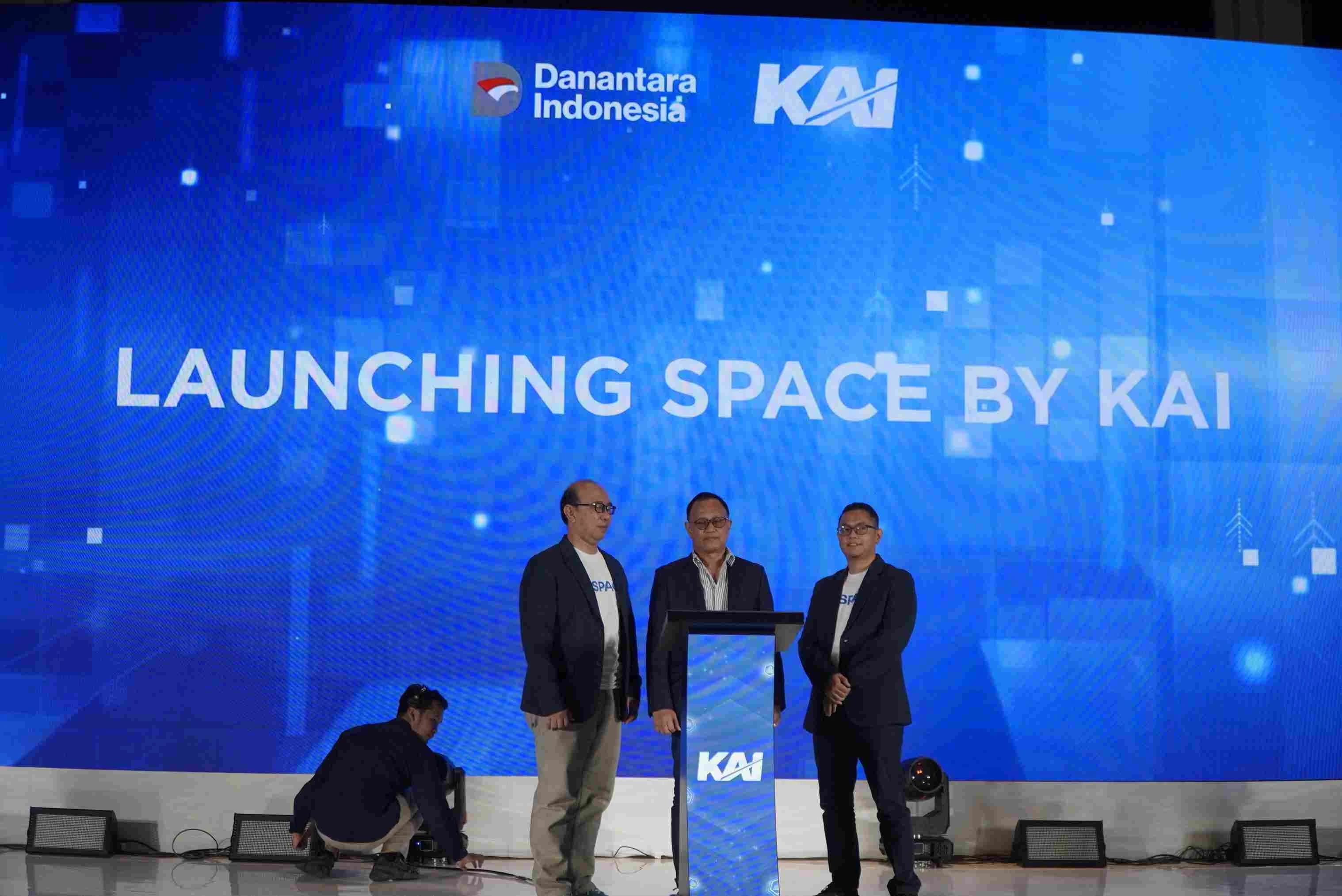
KAI Launches 'Space by KAI', an Official Platform Opening Business Opportunities Across KAI’s Strategic Assets
PT Kereta Api Indonesia (Persero) officially launched Space by KAI during an event held at the Raffles Hotel Jakarta on Wednesday (June 10). This official digital platform is designed to provide easier, more transparent, and informative access to KAI’s strategic assets spread across various regions in Indonesia, while simultaneously opening partnership opportunities for business players, investors, and prospective business partners.
This launch is part of KAI's transformation in corporate asset management. To date, KAI has managed a diverse portfolio of strategic assets located in high-value economic zones, ranging from stations, transit areas, strategic land, commercial spaces, and buildings, to other high-potential business areas. Through Space by KAI, the company introduces a new way to bridge these assets with the needs of the business community through a single, integrated digital platform.
Space by KAI was developed to meet the demand for more modern, transparent, fast, and efficient access to asset information. The platform also addresses the needs of business entities for clearer early-stage access when exploring business opportunities within KAI's ecosystem. Prospective partners can now obtain centralized asset details and understand available collaboration opportunities through one official channel.
KAI’s Director of Business and Corporate Development, Rafli Yandra, stated that the launch of Space by KAI is an integral part of the company's transformation to widen access to business partnership opportunities.
"We present Space by KAI as an official platform connecting KAI’s strategic assets with business opportunities in a more open, professional, and accessible manner. We aim to align the needs of the business sector with the potential of our assets spread across various regions, ensuring that collaborations can begin through a clearer and more structured process,"
KAI possesses assets scattered throughout various operational regions in Java and Sumatra, with a total land area reaching 327.8 million square meters, consisting of 189.6 million square meters across Operational Regions (Daerah Operasi/Daop) and 138.2 million square meters across Regional Divisions (Divisi Regional/Divre). Additionally, KAI manages 3,881 official operational buildings and 16,463 corporate housing units, which form part of the company's strategic asset portfolio. This portfolio spans various business segments, including station commercial areas, Right of Way (ROW), non-ROW assets, advertising, rolling stock and facilities, as well as tourist spots and museums.
As KAI’s official platform, Space by KAI provides centralized access to various asset utilization opportunities. The platform comes equipped with comprehensive asset information, practical search features, and a direct communication channel that enables prospective partners to easily initiate partnership discussions.
Executive Vice President of Sales at KAI, Zuhril Alim, explained that Space by KAI is engineered to assist businesses in finding opportunities that align with their needs and growth strategies.
"Through Space by KAI, businesses can more easily identify assets that suit their operational requirements. From retail, F&B, advertising, and activation, to regional development and various forms of long-term partnerships, everything can now be explored through a single, integrated platform,"
Alim added that the launch of Space by KAI arrives amidst evolving mobility patterns among urban communities. Currently, over 150 million Indonesians reside in urban areas, making public transportation a vital part of daily life. This condition creates high-value interaction nodes for various business and commercial activities.
According to Alim, KAI’s ecosystem offers unique market characteristics. Rail transport passengers spend roughly 40 to 90 minutes per day commuting, creating prolonged and daily recurring engagement windows. This situation unlocks opportunities for businesses to build brand affinity with consumers through various commercial activities, promotions, and brand collaborations.
Beyond station commercial zones, business players can explore asset utilization in Right of Way (ROW), advertising, station naming rights, transit-oriented development (TOD), non-ROW asset utilization, and various long-term partnerships integrated with KAI's transportation network. Space by KAI also showcases urban development opportunities surrounding stations that can be co-developed with strategic partners.
Currently, KAI has collaborated with more than 99 partners across strategic industries, spanning banking, retail, F&B, technology, energy, and real estate. This collaboration underscores the immense potential for business development that can thrive within KAI’s ecosystem.
"We view KAI’s assets as part of an ecosystem possessing immense traffic, connectivity, and growth potential. Through Space by KAI, we want to help businesses find opportunities that fit their corporate needs through simpler and integrated access,"
On the same occasion, KAI’s Vice President of Corporate Communication, Anne Purba, also explained that the primary appeal of KAI’s ecosystem for the business world lies in the massive daily public mobility across various rail-based transportation services managed by KAI Group.
From January to March 2026, KAI Group served 128,055,072 passengers, a 9.97% increase compared to the 116,451,006 passengers recorded during the same period in 2025. This figure equates to an average of over 1.4 million daily passengers engaging within KAI Group's transportation ecosystem.
"KAI Group served over 128 million passengers in just the first three months of 2026. This number reflects the massive daily public activity taking place within the railway ecosystem. This high level of mobility creates a substantial interaction space for various business activities and collaborations,"
Anne elaborated that the Commuter Line service remains the backbone of daily public mobility, recording a volume of 101,382,889 passengers in the first quarter of 2026. Meanwhile, Long-Distance and Local Trains served 14,515,350 passengers, Jabodebek LRT served 7,754,946 passengers, KAI Airport services recorded 1.755,275 passengers, South Sumatra LRT served 1,084,242 passengers, Whoosh (High-Speed Train) carried 1,408,815 passengers, the Makassar–Parepare Train served 75,421 passengers, and KAI Wisata recorded 78,134 passengers.
According to Anne, this high passenger volume indicates that KAI’s stations, transit hubs, and various assets are positioned at nodes that are central to the public's daily routines.
"Every day, millions of people use KAI Group's services to work, study, travel, or conduct business trips. These activities present a major opportunity for businesses to reach consumers through strategic locations within the KAI ecosystem,"
KAI also manages more than 330 stations spread across Java and Sumatra, located within economic growth centers, educational zones, central business districts, residential areas, and tourist destinations. This extensive network provides businesses the opportunity to tap into high-traffic markets across various regions.
"Space by KAI brings smoother access for business players to recognize various opportunities available within the KAI ecosystem. We hope this platform will expand collaborations and foster shared growth spaces across Indonesia,"
The launch event of Space by KAI was designed as a meeting point between KAI and prospective strategic partners to introduce the platform directly to businesses and investors. Through this activity, participants could navigate the platform, engage in dialogues with the KAI team, and begin exploring partnership opportunities tailored to their respective business strategies.
Moving forward, Space by KAI will be progressively developed following KAI’s asset transformation roadmap. Following the initial phase—which focuses on asset e-catalogues, geolocation, commercial status updates, and direct contact with the sales team—subsequent developments will target broader ecosystem integration, business-need-based asset classification, B2B partner dashboards, bidding systems for potential assets, as well as business and partnership simulation features.
For further information, the public and business players can visit space.kai.id.
VP of Corporate Communication KAI
