
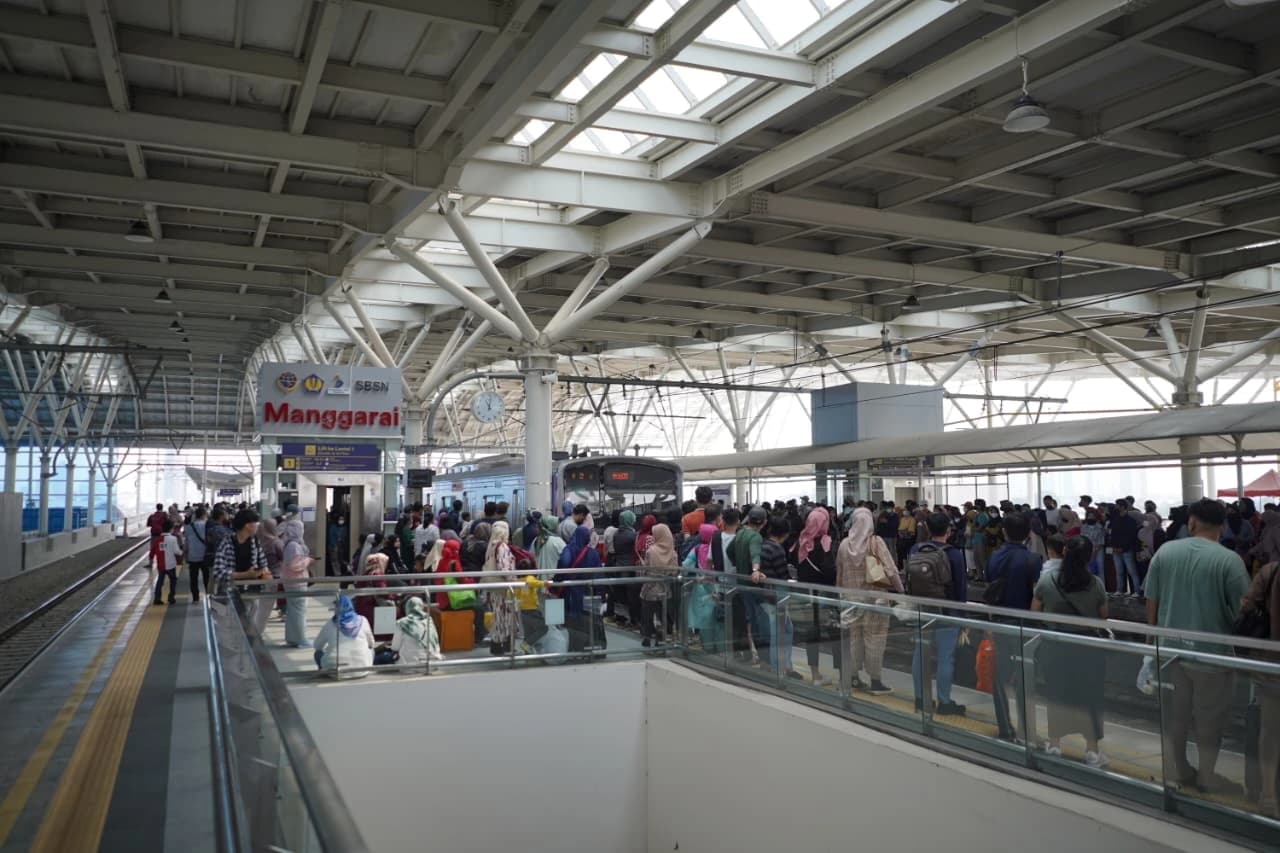
LRT Jakarta Has Reached Manggarai, KAI Supports Completion of Direct Access to KAI Manggarai Station
PT Kereta Api Indonesia (Persero) supports the development of public transportation integration in the Manggarai area following the operation of the Kelapa Gading–LRT Manggarai Station route of LRT Jakarta since September 16, 2026.
LRT Manggarai Station and KAI Manggarai Station are two physically separate stations located in the Manggarai area. The completion of direct connecting facilities between the two is currently underway so that future intermodal transfers for customers can become easier.
The Kelapa Gading–Manggarai route of LRT Jakarta is 12.2 kilometers long, serves 11 stations, and has a travel time of approximately 28 minutes.
Vice President Corporate Communication KAI Anne Purba said the presence of LRT Jakarta in the Manggarai area opens up broader connectivity opportunities for people using public transportation.
“LRT Manggarai Station and KAI Manggarai Station are two different facilities. Both are located within the same area and are intended to be connected through integration facilities. LRT Jakarta is already operating to Manggarai, while direct access to KAI Manggarai Station is still in the process of being completed together with the relevant parties,” said Anne.
8.17 Million KRL Gate Activities Through September
The significant integration potential can be seen from customer activity at KAI Manggarai Station. Based on KAI Commuter data, throughout January–September 2026, 4,149,826 customers recorded gate-ins and 4,022,954 customers recorded gate-outs for KRL Commuter Line services.
Thus, total activity through the KRL gates at KAI Manggarai Station during the first nine months of 2026 reached 8,172,780 customer activities.
In September 2026 alone, there were 500,934 gate-ins and 485,049 gate-outs, or a total of 985,983 customer activities in one month.
These figures represent customers entering and exiting through the gates and do not yet include customers transferring between trains within the station area without exiting through the gates.
“Manggarai has a travel pattern characterized by substantial transit flows. Many customers arrive on one journey and then continue on another. Therefore, completing intermodal connectivity will provide direct benefits for people's daily journeys,” said Anne.
On March 22, 2026, KAI Manggarai Station recorded 201,617 transit customers in a single day, setting a transit record during the 2026 Eid Transportation Period.
KRL Bogor, Cikarang, and Airport Trains Meet at Manggarai
KAI Manggarai Station serves Commuter Line Bogor and Commuter Line Cikarang journeys. Through these two services, Manggarai forms part of people's journeys to and from Bogor, Depok, Nambo, Bekasi, Cikarang, and various areas in Jakarta.
Manggarai also serves the Soekarno-Hatta Airport Commuter Line. Throughout January–September 2026, 340,002 customers recorded gate-ins and 375,915 customers recorded gate-outs for this service at KAI Manggarai Station. Total Airport Commuter Line gate activity during that period reached 715,917 customer activities.
Several long-distance trains traveling to and from Gambir Station also pass through the Manggarai area, but they do not serve customer boarding and alighting at KAI Manggarai Station.
KAI previously recorded that Manggarai Station served approximately 700–750 train journeys per day, covering Jabodetabek Commuter Line and Soekarno-Hatta Airport Commuter Line journeys. Because the available corporate data is presented within that range, KAI has not converted it into a single figure.
Direct Connecting Facilities Planned in Three Zones
The integration concept for LRT Manggarai Station and KAI Manggarai Station is divided into three connecting zones. Based on the integration planning documents, Zone 1 is located on the side toward the Sultan Agung Hospital and Pasaraya Manggarai areas, Zone 2 is intended to connect with the TransJakarta bus stop and Manggarai Terminal, while Zone 3 is located in the KAI area and is designed to connect with the Airport Train concourse at the West Entrance of KAI Manggarai Station through a linkway.
In the construction area, the integration facilities also intersect with existing infrastructure, including the pedestrian bridge owned by the Bina Marga Agency, the TransJakarta bus stop, the Ciliwung River Basin area, and the KAI Manggarai Station area.
The integration documents also show that the connecting structure to KAI Manggarai Station is designed to be located on the West Entrance side of Manggarai Station, including the use of part of KAI's parking area for construction needs.
Anne said this stage is important because good integration needs to make intermodal transfers clearer and more comfortable for customers.
“When the direct connecting facilities are completed, the public will have broader travel options. Customers from Bogor, Depok, Bekasi, Cikarang, and Soekarno-Hatta Airport will be able to continue their journeys to the LRT Jakarta network, and vice versa. The focus is on making these transfers simpler for customers,” said Anne.
The Jakarta Provincial Government previously stated that the process of establishing a direct connection between LRT Manggarai Station and the KAI Manggarai Station area is being carried out together with KAI.
“Manggarai already serves large-scale movements every day. The presence of LRT Jakarta adds travel options in this area. KAI will continue to coordinate so that the completion of intermodal access can proceed well and provide a more comfortable travel experience for the public,” concluded Anne.
VP Corporate Communication KAI