
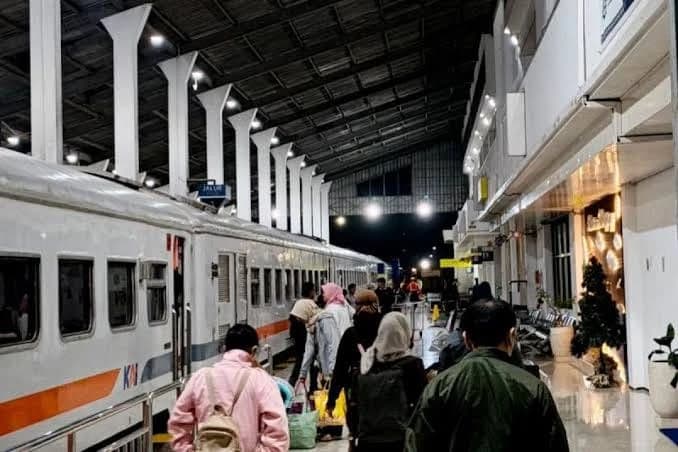
Five Stations in Urban and Port Areas Record Nearly 12 Million Customer Activities
Train and maritime transportation journeys intersect in a number of corridors in Indonesia. Throughout January–September 2026, five stations located in port cities or areas, namely Tanjung Priok, Semarang Tawang, Surabaya Pasar Turi, Merak, and Ketapang, recorded a total of approximately 11,986,400 customer activities.
The largest volume was at Tanjung Priok Station with 4,311,585 gate-in and gate-out activities, followed by Semarang Tawang with 3,329,748 boarding and alighting activities, Surabaya Pasar Turi with 2,789,112, Merak with 940,794, and Ketapang with 615,161. The calculation is based on customer activity levels according to each operator's system, thereby reflecting the intensity of movement at each station.
KAI Vice President Corporate Communication Anne Purba stated that this pattern indicates rail-based journeys serve distinct functions across various port regions.
“In a number of cities, customer journeys continue from trains to ships or vice versa. This data of nearly 12 million activities highlights the importance of viewing customer journeys as a single multimodal chain,” said Anne.
The connectivity characteristics vary. Merak Station serves as access to Merak Port for Java–Sumatra cross-strait travel. Ketapang Station is located near Ketapang Port, which serves Java–Bali crossings. Meanwhile, Tanjung Priok Station serves an area adjacent to passenger ship terminals at Tanjung Priok Port. KAI previously recorded that these three stations served 3.88 million customer activities in the first semester of 2026.
On an urban scale, Semarang Tawang and Surabaya Pasar Turi serve as rail travel gateways to two major port cities in Java. Subsequent travel toward the Tanjung Emas area in Semarang or Tanjung Perak in Surabaya is carried out using connecting transportation through urban road networks.
Maritime transportation activity in both cities is also substantial. Statistics Indonesia (BPS) data notes that during January–August 2026, Tanjung Priok Port served approximately 422,947 arriving and departing passengers, while Tanjung Perak served around 1.51 million passengers.
According to Anne, these figures provide context for the development of multimodal integration. Information on onward travel, station entry and exit access, the availability of connecting transportation, and the ease of carrying luggage are elements that influence the customer experience when transferring modes.
KAI views the land–sea travel pattern as a mobility market that needs to be continually analyzed, particularly ahead of holiday periods when inter-island travel increases. Each station possesses distinct characteristics, meaning integration approaches must be tailored to the distance to the port, customer travel patterns, and the availability of connecting modes.
“The goal is simple: customers can understand from the outset how to continue their journey after getting off the train. The clearer the multimodal connection, the easier it is for the public to plan intercity and inter-island trips,” Anne concluded.
VP Corporate Communication KAI