
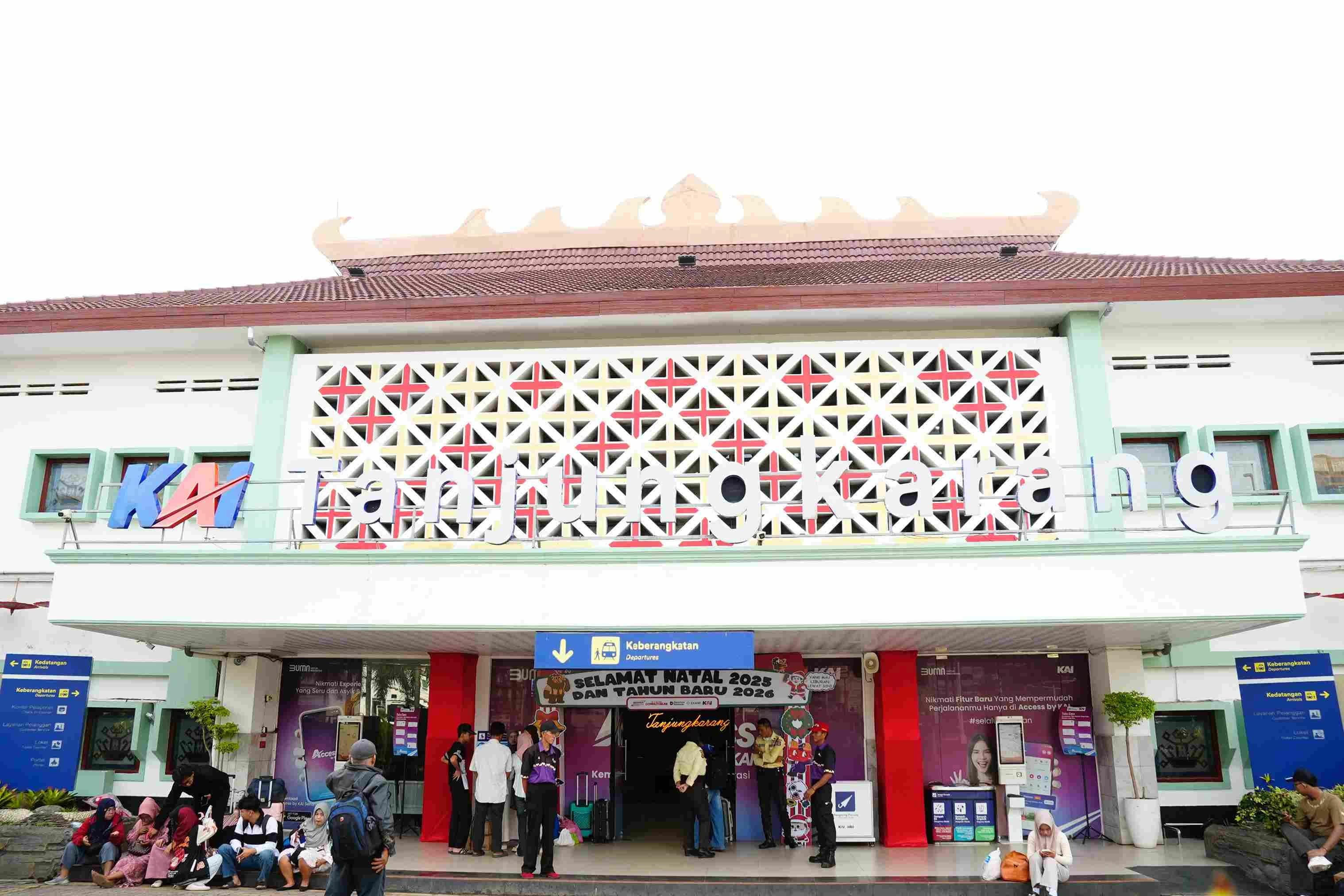
Over a Century of Lampung Railways: KAI Strengthens Connectivity in Southern Sumatra
President Prabowo Subianto's directive to give top priority to the development of the national railway system brings a new context to the long history of railways in Sumatra. In Lampung, railway tracks have been present for more than a century. The lines that were once built to connect production centers, ports, and cities have now evolved into a driver of public mobility and strategic cargo distribution in southern Sumatra.
The railway line in Lampung was first constructed in 1911 by the Zuid-Sumatra Staatsspoorwegen (ZSS) during the Dutch colonial era. In the initial phase, development was directed to connect Tanjungkarang with commodity-producing areas in South Sumatra. As it developed, the Lampung rail network was connected to port areas, including Panjang and Tarahan, thereby holding a crucial role from the beginning in distributing agricultural produce, coal, and industrial needs.
“The history of railways in Lampung shows that trains have been present from the start to open access. From agricultural routes, ports, to residential centers, railways have shaped connectivity that remains an important part of public life and the regional economy today,”
Currently, KAI's operational area in Lampung and parts of South Sumatra covers 451.280 track kilometers (km'sp) with 43 operational stations. The network spans from Bandar Lampung, South Lampung, Central Lampung, North Lampung, Way Kanan, East Ogan Komering Ulu, Ogan Komering Ulu, Muara Enim, to Prabumulih. Tanjungkarang and Tarahan stations serve as major nodes, while Kotabumi and Baturaja further strengthen passenger and freight services along the line.
For passenger services, KAI operates the Rajabasa Train for the Tanjungkarang–Kertapati route and the Kuala Stabas Train for the Tanjungkarang–Baturaja round trip (PP). From January to May 2026, passenger services in this region recorded 498,104 passengers. In detail, the Rajabasa 2 Train for the Tanjungkarang–Kertapati route served 185,167 passengers, while the Kuala Stabas Train for the Tanjungkarang–Baturaja round trip served 312,937 passengers.
On the freight side, railways play a major role in the logistics chain of southern Sumatra. From January to May 2026, KAI transported 11,437,080 tons of cargo across 4,029 freight train journeys. Coal on the Tanjung Enim Baru–Tarahan route was the largest commodity with 11,280,793 tons. Other commodities handled included bagged cement at 83,680 tons, fuel (BBM) at 52,593 tons, and bulk cement at 20,014 tons.
The massive volume of cargo demonstrates Lampung's position as a vital logistics gateway in southern Sumatra. The routes leading to Tarahan, Panjang, Tanjungkarang, Kotabumi, Baturaja, and up to Kertapati connect production areas, industries, ports, and consumption centers. In the context of national logistics costs, rail provides large hauling capacity, more efficient energy consumption, and distribution certainty for strategic commodities.
“Lampung's potential must be understood from its connectivity map. It features ports, industrial hubs, passenger lines, and high-volume freight routes. When the railway is reinforced, the benefits can be felt through more efficient distribution, easier public mobility, and improved regional competitiveness,”
Historically, Lampung also possesses traces of old lines, such as the Garuntang–Telukbetung route, which previously strengthened the connection between the city and port areas. Changing times have caused parts of these old traces to change functions, while the active network continues to serve the needs of the public and industry. From this history, it is evident that the development of cities, ports, and economic zones in Lampung has long been connected by rail.
Moving forward, the potential of Lampung's railways lies in strengthening energy logistics, building material distribution, port connectivity, and cross-provincial passenger mobility between Lampung and South Sumatra. Lampung's position as the southern gateway of Sumatra is also aligned with the strategic direction of national railway network development, including interregional connectivity and mass-transport-based economic equality.
“KAI continues to reinforce safety, operational reliability, and service quality so that the long history of rail in Lampung delivers increasingly relevant benefits. Railways are not merely a story of the past, but part of how the region grows, communities connect, and the economy moves more efficiently,”
VP Corporate Communications KAI