
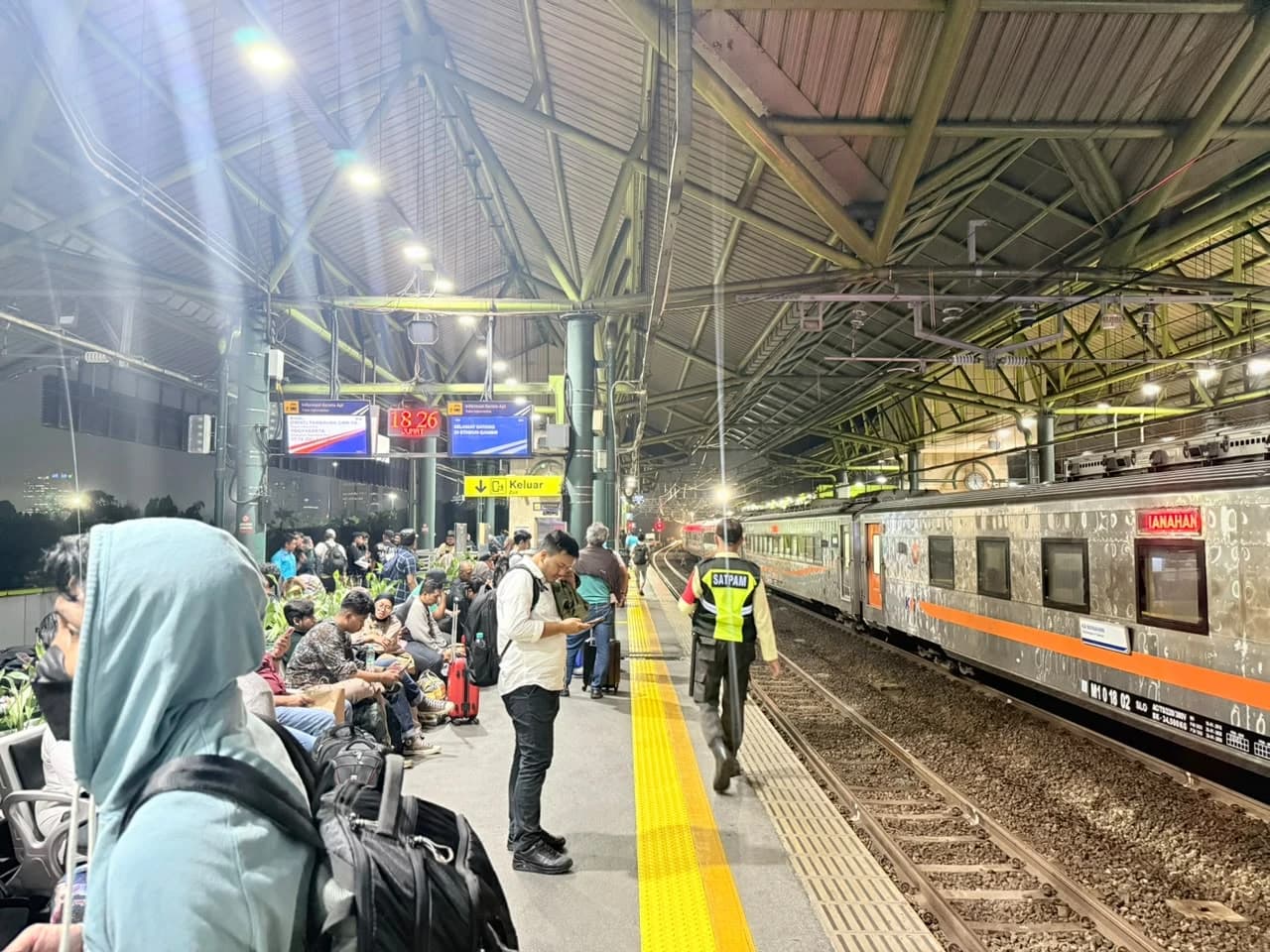
Growing Demand for Rail Connectivity: KAI Group Serves 214.05 Million Passengers as of May 2026
The mobility of the Indonesian public continues to expand alongside rising economic activity, urbanization, and domestic tourism. Statistics Indonesia (BPS) recorded that domestic tourist trips throughout 2025 reached approximately 1.2 billion journeys, a 17.55 percent increase compared to the previous year. This growing mobility drives the demand for transportation systems capable of efficiently and sustainably connecting residential areas, economic hubs, tourist destinations, educational zones, and airports.
In this context, rail-based transportation plays an increasingly vital role as a connector for various community activities. Railways serve daily commutes to workplaces and schools, link intercity economic growth centers, provide airport access, and support leisure travel across various regions.
This upward trend is clearly reflected in the performance of KAI Group. From January to May 2026, KAI Group served 214,045,803 passengers, marking a 7.20 percent growth compared to the 199,663,907 passengers recorded during the same period in 2025.
KAI’s Vice President of Corporate Communication, Anne Purba, stated that this passenger growth demonstrates the strengthening role of rail transport in supporting public connectivity across various regions in Indonesia.
"Trains have become an essential part of the public's daily routines. Passengers utilize them for commuting to work, studying, conducting business, traveling, or accessing other transportation modes. Evolving connectivity makes travel simpler, more efficient, and highly reliable,"
Passenger growth across various services indicates that rail-based connectivity is increasingly becoming an integral part of modern public mobility patterns. Journeys that previously relied on private vehicles are shifting toward integrated public transport, particularly in high-density urban areas and on medium- to long-distance intercity trips.
The largest contributor came from KAI Commuter, which served 169,047,494 passengers, a 6.24 percent increase compared to the 159,111,614 passengers in January–May 2025.
With this substantial volume, KAI Commuter stands as one of the largest rail-based mass transit systems in Southeast Asia. Daily, this service links residential zones with employment centers, education, trade, and public services within the Greater Jakarta metropolitan area and its surroundings. This role becomes increasingly crucial as the growth of commuter buffer zones drives up daily transit demands.
Beyond daily commuting, the growth of intercity travel also highlights strengthening inter-regional connectivity. From January to May 2026, KAI's Long-Distance and Local Trains served 24,372,733 passengers, up 9.94 percent from the 22,168,570 passengers during the same period last year.
These travel flows bridge various economic centers, industrial zones, educational cities, trade hubs, and tourist destinations spread across Java and Sumatra. This connectivity directly supports workforce mobility, business activities, and the development of the domestic tourism sector.
In the modern urban service segment, Jabodebek LRT served 13,211,856 passengers, representing a significant 23.16 percent surge compared to the 10.727,798 passengers in January–May 2025.
This customer growth demonstrates the reinforcing role of rail-based public transit in supporting mobility across Jakarta, Bogor, Depok, and Bekasi. Integration with commuter rails (KRL), intercity trains, bus networks, and Transit-Oriented Development (TOD) areas broadens public travel reach within a single, interconnected transport ecosystem.
Services connecting the public to air transportation also continued to grow. KAI Bandara (KAI Airport) served 2,905,389 passengers, a 1.78 percent increase compared to the 2,854,707 passengers in the same period of the previous year, driven by the Srilelawangsa Train service in Medan and the YIA Airport Train in Yogyakarta.
The presence of airport trains provides a more predictable travel alternative regarding transit time while backing the seamless movement of passengers heading to airports in various cities.
Meanwhile, KCIC through the Whoosh High-Speed Train service carried 2,415,736 passengers, a 1.43 percent increase compared to the 2,381,619 passengers in January–May 2025.
The high-speed rail reinforces the economic ties between Jakarta and Bandung, which have long served as two primary activity nodes in Indonesia. Shorter travel times encourage the mobility of business players, professionals, tourists, and the general public making same-day round trips.
In the eastern region of Indonesia, the Makassar–Parepare Train served 145,735 passengers, a 25.48 percent jump compared to the 116,146 passengers during the same period last year.
This growth highlights the increasing utilization of railway services in South Sulawesi. The presence of this service supports public access to economic centers, educational zones, public services, and tourist destinations along its operational corridor.
In the leisure travel segment, KAI Wisata (KAI Tourism) recorded the highest growth rate, serving 131,843 passengers, a remarkable 72.78 percent surge compared to the 76,309 passengers in January–May 2025.
This increase aligns with the expanding domestic tourism trend, where the train journey has become part of the travel experience itself. Premium services such as the Panoramic Train, Tourist Train (Kereta Wisata), Imperial/Special Train (Kereta Istimewa), and Compartment Suite deliver distinct travel choices that offer alternative experiences for passengers.
Concurrently, the South Sumatra LRT served 1,815,017 passengers from January to May 2026. As the first urban rail transit system in Sumatra, the South Sumatra LRT links vital activity centers in Palembang, ranging from residential areas, central business districts, offices, and universities to the Jakabaring Sports City complex and Sultan Mahmud Badaruddin II International Airport. This connectivity supports public movement with more predictable travel times amidst growing urban activity.
Anne added that the rising customer volume across KAI Group reflects the expanding role of rail-based transport in supporting public mobility while strengthening regional integration.
"As railway services become more interconnected, they yield greater benefits for the public. KAI Group will continuously elevate service quality, reinforce multimodal integration, and deliver connectivity that supports sustainable economic growth and national mobility,"
VP of Corporate Communication KAI
