
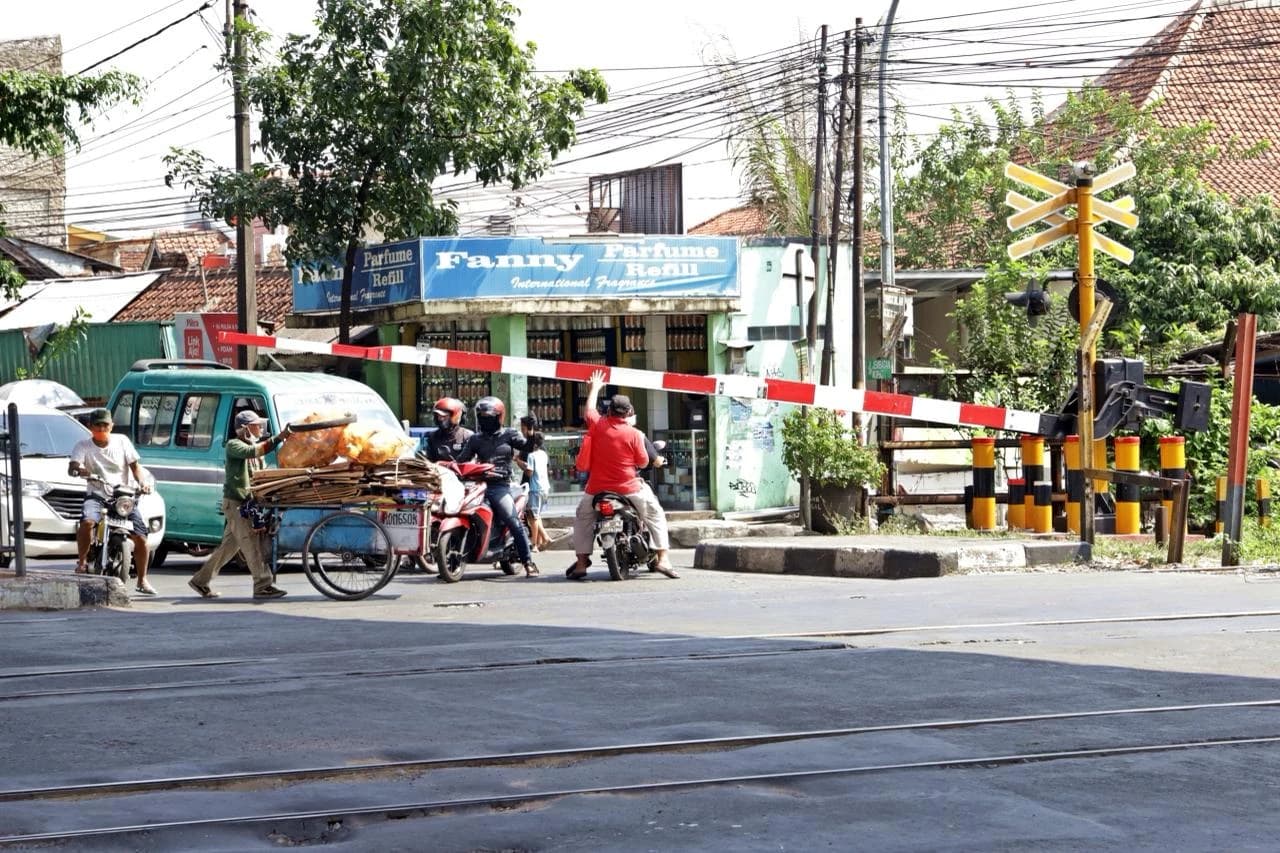
Crossing Safety is a Shared Responsibility: KAI Closes 144 Out of 172 Priority Points
Safety at level crossings is a shared responsibility. The government manages road access, law enforcement assists in regulation, KAI ensures the safety of train operations, and the public plays a role through compliance when crossing. When each party fulfills its role, the risk of accidents can be minimized, and safe spaces for the public can be strengthened.
PT Kereta Api Indonesia (Persero) continues to accelerate the management of level crossings by closing hazard-prone points, strengthening security, educating the public, and coordinating with the central government, regional governments, the police, transportation agencies, local authorities, and residents living along the tracks.
KAI Vice President of Corporate Communications Anne Purba stated that level crossing management needs to be viewed through the logic of risk. Leaving a single hazardous access point open can foster a habit of crossing. When that habit persists, the potential for recurring accidents remains.
“Crossing safety is a shared responsibility. KAI safeguards train operations, the government holds authority over the roads, law enforcement assists in regulation, and the public determines safety through discipline when crossing,”
Based on KAI data as of June 14, 2026, there were 128 recorded accident incidents at level crossings resulting in 105 casualties, consisting of 44 fatalities, 27 severe injuries, and 34 minor injuries. In terms of causes, 113 incidents or 88% were triggered by vehicles forcing their way through, followed by 9 incidents or 7% due to stalled vehicles, and 6 incidents or 5% caused by late or unclosed gates.
This data indicates that the behavior of road users is highly decisive for safety at crossings. When signs, sirens, gates, and officer directions are ignored, the safe space vanishes instantly. In such situations, a decision made in a matter of seconds can impact the safety of drivers, train passengers, officers, and the surrounding community.
“Trains operate on fixed tracks and have long braking distances. Therefore, road vehicles must stop and grant priority. An access point that looks close is not necessarily safe. The safest option is to use official, organized, and compliant crossings,”
Out of those 128 incidents, 74 affected vehicles were motorcycles or 58%, while the other 54 units were cars or 42%. KAI also recorded that 69 incidents occurred at unguarded crossings and 59 incidents at guarded crossings. This means that unsecured points need immediate handling, while locations that already feature gates and signs still require road user discipline.
KAI noted that the number of crossing accident casualties in 2026 has decreased compared to the previous period. In 2025, there were 140 casualties, consisting of 57 fatalities, 23 severe injuries, and 60 minor injuries. In 2026, the number of casualties dropped to 105 people, a decrease of approximately 25%. This decline shows that access management, security, education, and public compliance must continue to be consistently reinforced.
From a regulatory standpoint, the direction for handling level crossings has been clearly established. Law Number 23 of 2007 concerning Railways, Government Regulation Number 56 of 2009 jo. Government Regulation Number 6 of 2017, and Ministry of Transportation Regulation Number 94 of 2018 emphasize that ideally, railway crossings should be built with grade separation. If they remain at-grade, crossings are mandatory to meet safety standards such as gates, signs, signals, and personnel. Unauthorized crossings must be closed by the central or regional government.
The regulations also reaffirm that gates and crossing safety devices are the responsibility of the government according to road jurisdiction. National roads fall under the authority of the central government, provincial roads come under provincial government authority, while regency/city roads are within the jurisdiction of the respective local government.
“The closure of hazardous crossings must be understood as an effort to protect human lives. KAI understands that communities need access, but safe access must be the primary choice. Points that pose a danger need to be organized so that residents are directed toward safer paths,”
As of June 14, 2026, at 4:00 PM WIB, out of 172 priority points targeted for level crossing closures, 144 points have been closed, reaching 84%. This program is focused on hazardous crossings that require immediate handling so that the potential for accidents can be suppressed.
In addition to the priority program, KAI is also executing closures and narrowing of crossings in various regions. The realization has reached 201 points out of 177 programs, or equivalent to 114%. This step was taken by considering safety aspects, field conditions, and the need for managing community access.
KAI is also strengthening surveillance through patrols and safety campaigns. As of June 15, 2026, at 6:00 AM WIB, drone patrols have been carried out for 1,287 patrol days, with 2,562 sorties and a total of 43,069 minutes of monitoring. On the education front, KAI has conducted 1,606 safety dissemination activities, covering education at crossings, schools, community gatherings, and the installation of advisory banners.
Anne emphasized that the success of level crossing management requires the support of many parties. Regional governments are expected to continually accelerate the evaluation of at-grade points, close unauthorized access, improve security at official crossings, and prepare safe traffic engineering. Law enforcement and local authorities also play vital roles to ensure that closures are effective and well-received by the community.
“We invite all parties to view level crossing management from a safety perspective. Access that is slightly farther, but orderly and protected, is far better than a close access point that holds a fatal risk,”
KAI urges road users to always stop for a moment before crossing railway tracks, look right and left, obey signs, follow officer instructions, and avoid forcing their way through crossing gates. The public is also requested to use official crossings and support the closure of hazardous points.
“Every crossing is a decision point. Stopping for a few seconds, looking right and left, and obeying signs can save many lives. Let us turn crossing safety into a collective movement,”
VP Corporate Communications KAI