
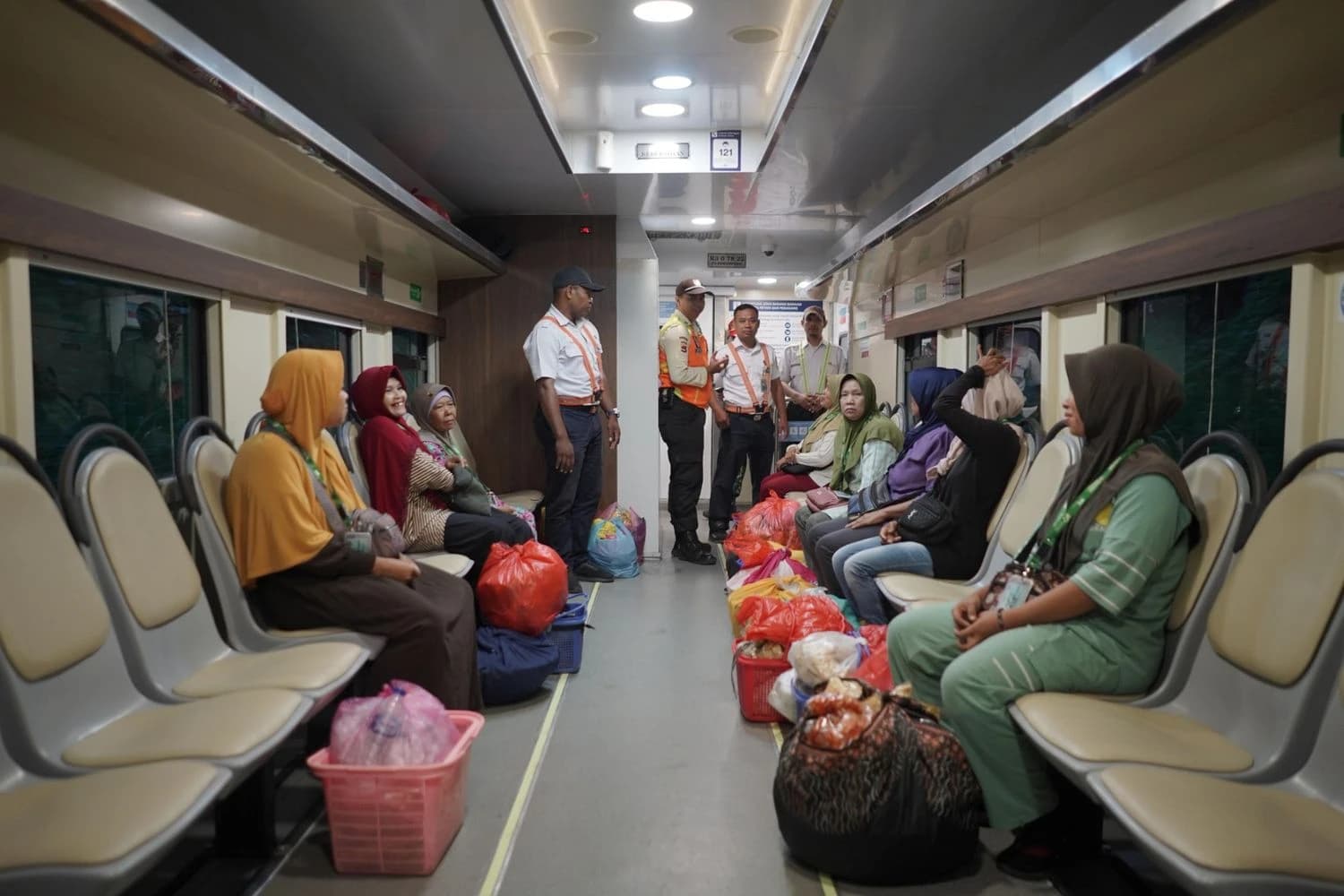
Farmers and Traders Train Serves 35,843 Passengers, Expanding Economic Access for Communities
PT Kereta Api Indonesia (Persero) continues to provide services that are closely aligned with the needs of the community through the Farmers and Traders Train operating on the Rangkasbitung–Merak route, as well as designated facilities for farmers and traders on the Cikuray Train serving the Garut–Pasarsenen round-trip route.
Overall, these services have been utilized by 35,843 customers. The total comprises 35,661 customers on the Rangkasbitung–Merak route since the service commenced on 1 December 2025 through 29 July 2026, and 182 customers on the Cikuray Train from 11 June to 26 July 2026.
Specifically, from 1 January to 29 July 2026, the Farmers and Traders Train on the Rangkasbitung–Merak route served 31,546 customers.
KAI Vice President of Corporate Communication Anne Purba stated that the service helps communities transport agricultural produce, food commodities, home industry products, and merchandise to markets and other economic centers.
“Every journey carries a story of livelihoods and family aspirations. There are harvests waiting to be sold, merchandise ready to reach the market, and hopes that small businesses will continue to grow,” said Anne.
The Farmers and Traders Train on the Rangkasbitung–Merak route is available at a fare of IDR 3,000 per trip. Meanwhile, the longest-distance journey on the Cikuray Train between Garut and Pasarsenen is priced at IDR 45,000.
These affordable fares are supported by the Government through the Public Service Obligation (PSO) scheme. This policy enables communities to continue enjoying safe, reliable, and scheduled public transportation services at fares that remain within their economic reach.
KAI appreciates the Government’s commitment to supporting the mobility needs of the public, particularly those engaged in daily economic activities. Through the PSO scheme, public transportation serves as an essential public service policy that connects communities to markets, workplaces, educational institutions, and sources of livelihood.
“The Government’s support through the PSO scheme provides significant benefits to the community. Affordable fares help farmers, traders, workers, students, and small business owners carry out their daily activities with more manageable transportation costs,” Anne added.
For farmers and traders, lower travel expenses can have a direct impact on their businesses. Savings on transportation costs can be redirected toward purchasing raw materials, increasing working capital, maintaining product quality, or meeting household needs.
On the Rangkasbitung–Merak route, the service connects residential areas, production centers, traditional markets, and economic hubs across Banten Province. Meanwhile, the dedicated facilities for farmers and traders on the Cikuray Train extend these benefits from Garut to various destinations across West Java and Jakarta.
The service also provides designated space for customers to place their goods in accordance with applicable regulations. This arrangement helps ensure a more orderly, safer, and more comfortable journey for all passengers.
For customers transporting agricultural produce and food commodities, reliable train schedules offer significant economic value. Predictable departure and arrival times enable customers to estimate their arrival at markets more accurately while helping preserve the quality of the goods being transported.
Traveling by train also reduces the need to transfer between multiple modes of transportation. This helps lower additional transportation costs, reduces the physical effort required to carry goods, and minimizes the risk of damage to commodities during transit.
Anne added that the benefits of the service are also felt by communities along the railway corridor. Passenger activities contribute to local economic circulation around stations, supporting feeder transportation services, food stalls, traditional markets, and various other community-based businesses.
“The Farmers and Traders Train demonstrates how Government policies and KAI’s services complement one another in supporting community economic development. KAI will continue to maintain and enhance the quality of this service so that its benefits become even broader and remain relevant to the evolving needs of our customers,” Anne concluded.
VP Corporate Communication KAI