
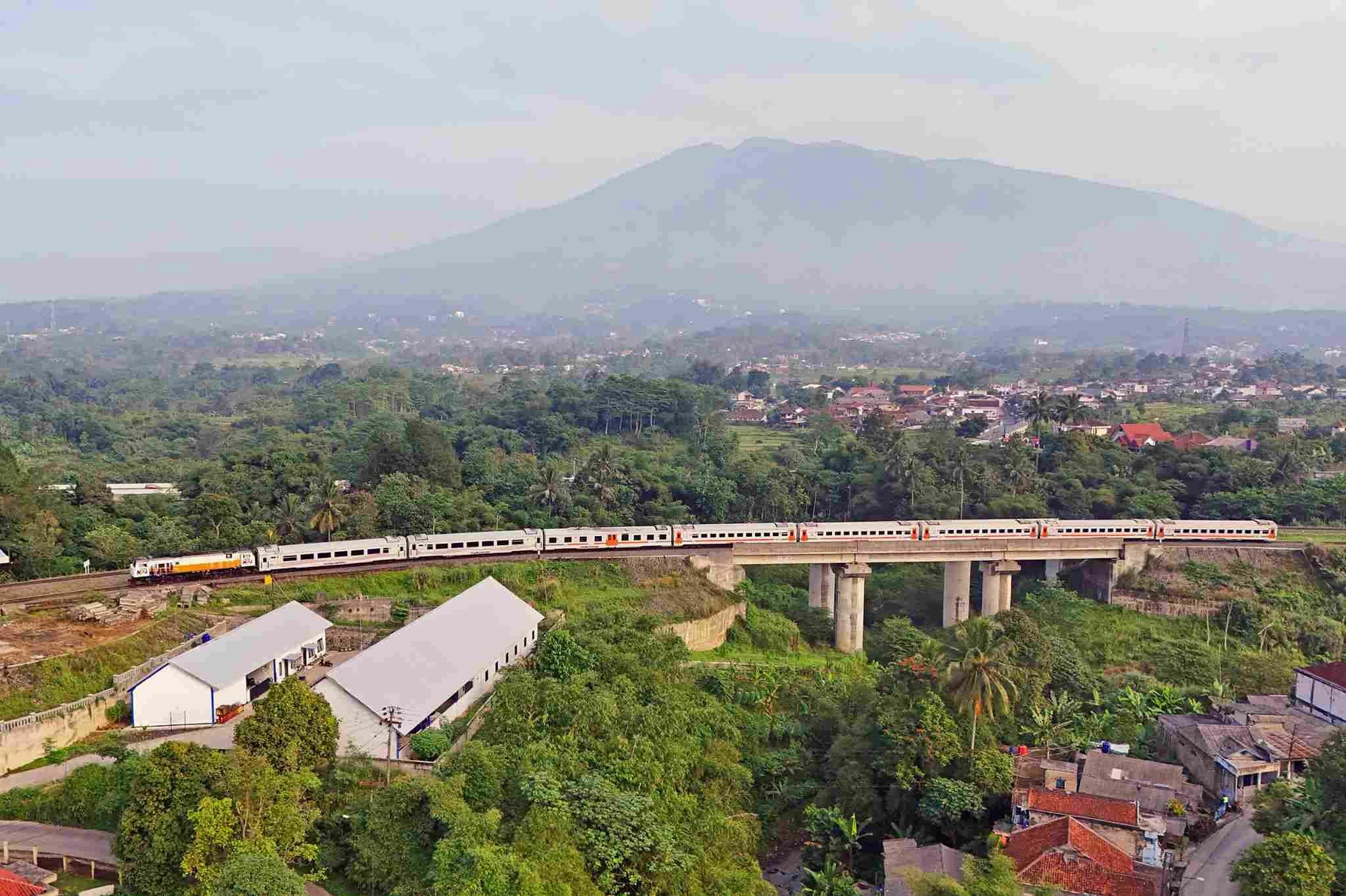
Formulating Net Zero Emission Strategies, KAI Reinforces the Role of Railways in Indonesia’s Energy Transition
PT Kereta Api Indonesia (Persero) is formulating its PT KAI Net Zero Emission Strategy as a long-term roadmap to reduce emissions and support Indonesia’s national Net Zero Emission (NZE) target by 2060. The strategy was presented during the forum "Towards a Green Rail Future: Delivering a Decarbonized Railway in Indonesia," held at the Four Points by Sheraton Hotel Jakarta on Thursday (June 11). The initiative is backed by the UK Government through the UK Partnering for Accelerated Climate Transition (UK PACT) program, implemented by Palladium in collaboration with Kynergy Consulting.
The formulation of this strategy also aligns with Presidential Regulation (Peraturan Presiden) No. 110/2025 regarding climate change mitigation within the transportation sector. Through this roadmap, KAI has established four primary pillars for emission reduction: rail line electrification, operational efficiency improvements, utilization of cleaner energy sources, and carbon sequestration through reforestation programs.
This strategic move is driven by the inherently low-emission nature of rail transport. According to studies presented at the event, railways contribute only around 1 percent of the total greenhouse gas emissions within the national transportation sector, whereas road-based vehicles account for approximately 89 percent.
KAI’s Vice President of Corporate Communication, Anne Purba, stated that rail-based transportation plays a pivotal role in supporting the national energy transition agenda due to its capability to serve mass mobility with significantly lower environmental impacts.
"Railways hold distinct advantages in terms of energy and emission efficiency. Through the Net Zero Emission Strategy, KAI is laying out long-term measures to ensure that the expansion of our railway services aligns seamlessly with national energy transition goals and the public's evolving mobility needs,"
One of the primary steps undertaken by KAI is expanding the electrification of its railway networks. Currently, electrified rail tracks have reached 1,038.7 kilometers, encompassing the KRL Commuter Line, Jabodebek LRT, and Whoosh High-Speed Train services.
On the operational front, KAI implements various energy efficiency initiatives and has adopted the EDGE Green Building certification for its stations, depots, and corporate offices. These efforts are directed at curbing energy consumption while simultaneously optimizing corporate operational efficiency.
In terms of energy sources, KAI continuously scales up the utilization of eco-friendly fuels. The company’s biodiesel blending program has advanced from B0 in 2017 to B40 in 2025, and is slated to progress toward B50 in 2026. Furthermore, KAI capitalizes on solar energy by installing solar power systems with a cumulative capacity of 3,435.5 kWp across 66 operational sites.
These emission reduction efforts are further complemented by tree-planting campaigns. From 2021 through 2025, KAI has planted 107,757 trees across various operational jurisdictions as part of its carbon sequestration initiatives.
Through this comprehensive strategy, KAI targets a 25.76 percent emission reduction—equivalent to 166,873 tons of CO2e—by 2030, from an emission baseline of 647,785 tons of CO2e. This target escalates to a 33.55 percent reduction by 2035 and a 78.17 percent reduction by 2050. By 2060, KAI aims to fully achieve Net Zero Emission with a total emission reduction of 1,093,311 tons of CO2e.
During her presentation, KAI’s Vice President of Sustainability, Tria Mutiari Melian, explained that KAI plays an essential role in driving the decarbonization agenda within the national transport sector.
"As the backbone of national mass transit, KAI holds a vital role in supporting the transition toward a low-carbon economy. The assessments and recommendations produced will be aligned with the long-term policy formulation and decarbonization roadmap of the national transportation sector," Tria elaborated.
The assessment compiled alongside UK PACT and Kynergy Consulting further validates the low carbon footprint of rail-based modes. The Jabodebek LRT generates approximately 15 grams of CO2-eq per passenger-kilometer, Intercity Trains account for 16.43 grams of CO2-eq per passenger-kilometer, and the KRL Commuter Line produces 34.03 grams of CO2-eq per passenger-kilometer.
The technical assistance from UK PACT and Kynergy Consulting in drafting this strategy encompasses feasibility studies for B50 implementation, analytical frameworks for accelerating the transition from Diesel Multiple Units (DMUs/KRD) to Electric Multiple Units (EMUs/KRL), signaling system modernization, and the development of financing frameworks that unlock access to international green funding sources.
Speaking at the same event, the Project Director of Kynergy Consulting, Rekyan Eckersley, noted that strengthening railway services is a core element in reducing emissions within the transport sector.
"Railways are inherently a low-emission mode of transport. Enhancing their capacity and service appeal is a crucial component of Indonesia's long-term national transportation decarbonization roadmap, and we are proud to assist KAI in strengthening these strategic steps,"
Anne added that a successful energy transition requires multi-stakeholder collaboration to ensure its benefits are felt widely across the country.
"Collaborations among the government, business enterprises, financial institutions, and international development partners are critical factors in accelerating the growth of low-carbon transportation. Railways possess massive opportunities to cement their contribution to national emission targets while supporting highly efficient public mobility,"
VP of Corporate Communication KAI