
KAI Prepares FRMCS Study for Next-Generation Railway Communication System
PT Kereta Api Indonesia (Persero) has begun preparing a Future Railway Mobile Communication System (FRMCS) study as part of its railway communication technology planning for long-term needs. FRMCS is a next-generation communication system based on 5G technology designed to support voice, data, and video exchange in railway operational activities.
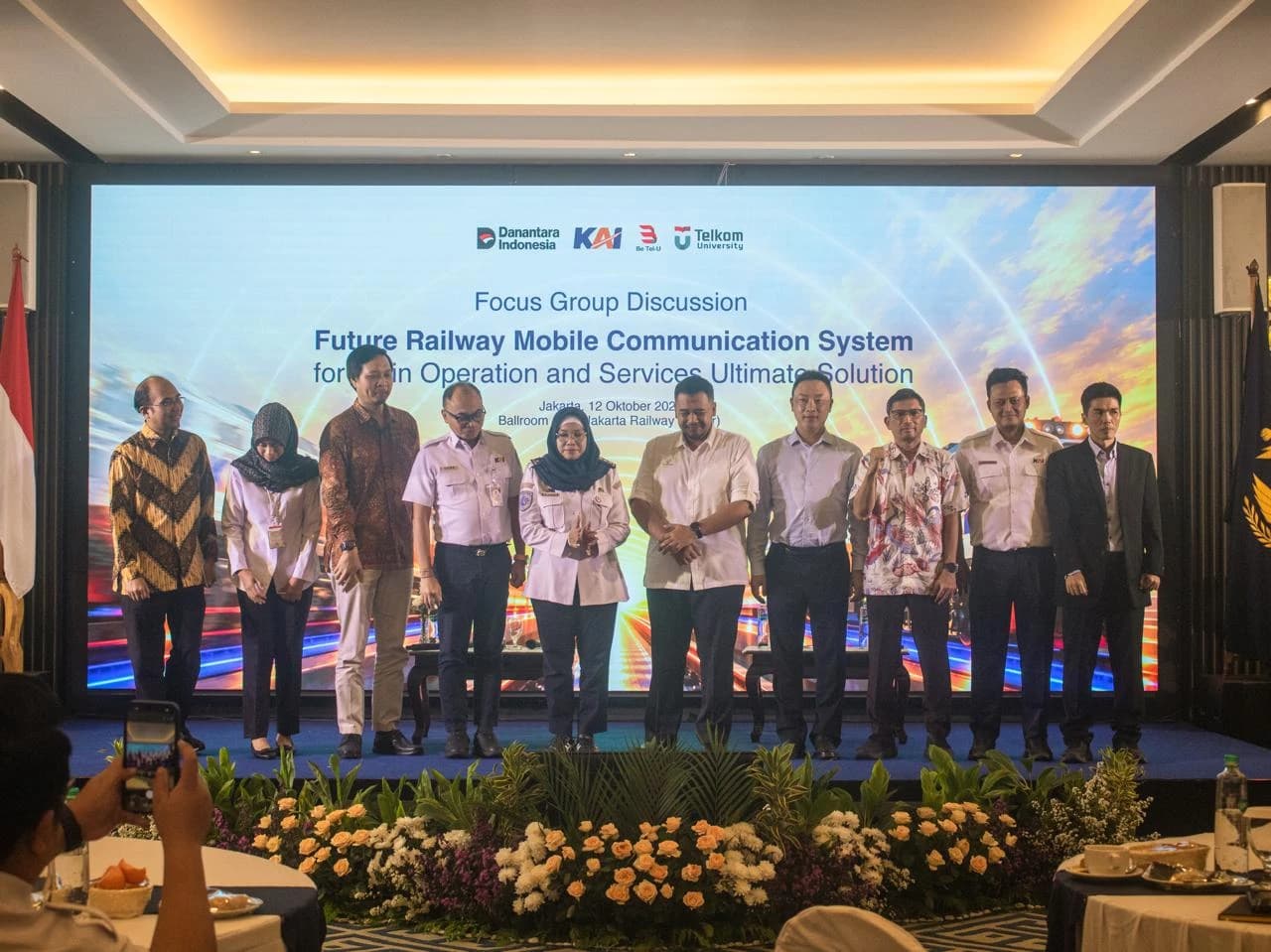
The discussion was held through a Focus Group Discussion on FRMCS for Train Operation and Services Ultimate Solution at the Jakarta Railway Center on Monday (12/10). The forum involved KAI, the Directorate General of Railways of the Ministry of Transportation, the Ministry of Communication and Digital, academics, and telecommunications industry players. The topics discussed included operational needs, technology readiness, frequency usage, network provisioning options, financing, and implementation stages.
KAI Director of Portfolio Management and Information Technology I Gede Darmayusa stated that the development of FRMCS needs to start from needs that truly arise in the field. The technology used must be relevant to train operations and provide benefits to safety, efficiency, and service reliability.
“Technology must answer real needs. Therefore, the FRMCS study looks at various possibilities for its utilization, ranging from communication related to safety, travel management, infrastructure and facility maintenance, to needs during emergency conditions,” said I Gede.
KAI's study identified a number of needs that can be supported through FRMCS, including communication between personnel and control centers, train position information, facility condition monitoring, journey management, crossing monitoring, disruption handling, and communication in emergency situations.
According to I Gede, communication directly related to safety and operations must obtain a higher level of reliability compared to general communication services.
“In train operations, there is communication that must be available at all times because it relates to travel safety. The system used must be designed so that important information can be delivered quickly, safely, and according to priority,” said I Gede.
FRMCS is also designed so that several communication needs can run on a single network with different priority levels. With this approach, communication for safety, operations, and support functions can be arranged according to their respective needs.
Frequency usage is another part discussed in the study. Regulation of the Minister of Communication and Digital Number 8 of 2026 concerning the Indonesian Radio Frequency Spectrum Allocation Table has included the 1,900–1,910 MHz band for FRMCS and advanced technology for railway signaling purposes.
Although already available in regulations, the utilization of this band still requires further testing and study. This is important because the frequency used must be able to support train communication stably without being disturbed by other networks around it.
The FRMCS study also considers the condition of railway communication systems which are currently still diverse. Some services use analog systems, while other services already use digital technology according to their respective needs.
These conditions mean that the process of transition toward new technology needs to be done gradually. According to I Gede, the existing systems must still be usable while the preparation and development process is carried out.
“We must look at current conditions, future needs, device readiness, regulations, investment, and the transition process. Technology changes need to be designed carefully so that operational activities remain reliable,” he said.
KAI is also reviewing several options in providing communication networks. The options can range from self-building and management to cooperation with telecommunications operators. Each scheme will be compared in terms of operational needs, investment, security, management costs, and sustainability of usage.
The development of FRMCS is planned through several stages. The process starts from mapping current conditions and KAI's needs, then proceeds with system design, field testing, limited implementation as a pilot project, to the possibility of gradual operation. This roadmap is still an initial recommendation and will be the subject of further discussion with regulators and related stakeholders.
“FRMCS is a long-term discussion. Our current focus is ensuring that the study is mature so that every decision made later is based on operational needs, appropriate technology, healthy investment calculations, and regulatory support. Coordination with DJKA, Komdigi, academics, and industry is an important part of that process,” I Gede concluded.
VP Corporate Communication KAI