
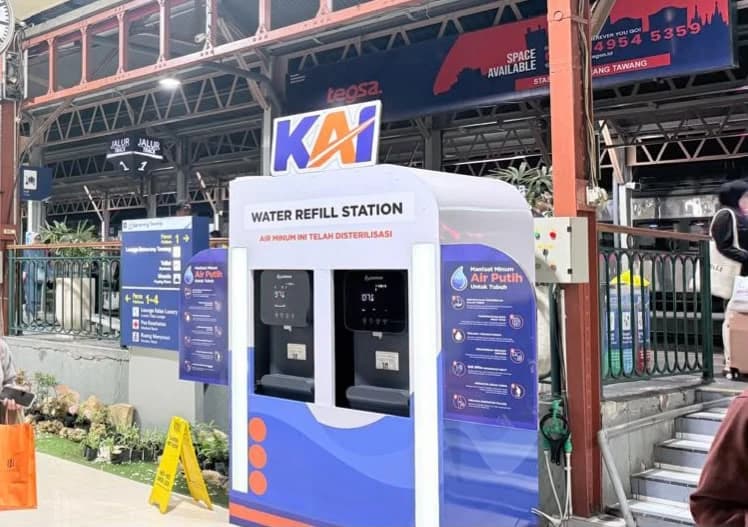
KAI Provides 124 Water Stations at 58 Stations, Potentially Reducing 2.99 Million Plastic Bottles in Six Months
PT Kereta Api Indonesia (Persero) continues to make train travel more convenient by expanding access to free drinking water at its stations. As of June 2026, a total of 124 Water Stations have been installed across 58 stations, serving customers at 70 service areas.
The initiative comes as rail travel continues to grow. During the first half of 2026, KAI's Long-Distance and Local Train services served 29,858,267 passengers, an 8.72% increase compared to 27,463,555 passengers during the same period in 2025.
Vice President Corporate Communication KAI Anne Purba said that the growing number of passengers should be accompanied by facilities that support customers' everyday travel needs.
"A total of 29.86 million customers traveled on KAI's Long-Distance and Local Train services during the first six months of 2026. With such high mobility, access to drinking water has become a simple yet valuable facility. Customers can conveniently refill their tumblers or reusable water bottles before boarding the train or continuing their journey," Anne said.
The Water Stations are available free of charge for passengers who bring their own tumblers or reusable bottles. The facility offers customers a convenient alternative to purchasing bottled water in single-use plastic containers.
Based on a conservative estimate, if one out of every ten passengers (10%) using KAI's Long-Distance and Local Train services during the first half of 2026 refilled their bottle just once, the initiative could potentially reduce the use of approximately 2.99 million single-use plastic bottles over six months.
The estimate assumes that each refill replaces one 600-milliliter bottled water purchase. Under this assumption, the total volume of water potentially refilled would reach approximately 1.79 million liters.
Anne emphasized that the estimate of 2.99 million bottles is based on passenger numbers and the assumption of a 10% utilization rate, rather than actual recorded Water Station usage.
"This calculation illustrates the positive impact that can be achieved when more people make it a habit to carry reusable water bottles. A single refill may seem small, but when millions of passengers do the same, the reduction in plastic bottle consumption becomes significant," Anne added.
The 124 Water Stations are distributed across 70 customer service areas. The difference between the number of stations, service areas, and units reflects the fact that several stations have multiple service zones and more than one Water Station.
For example, Gambir Station and Pasarsenen Station each feature eight Water Station units across four service areas, while Malang Station has six units across three areas. Both Surabaya Gubeng Station and Surabaya Pasarturi Station are equipped with five units each.
Water Stations are also available at several other stations, including Bekasi, Jatinegara, Cikampek, Sukabumi, Bandung, Kiaracondong, Cirebon, Semarang Tawang Bank Jateng, Semarang Poncol, Purwokerto, Yogyakarta, Solo Balapan, Madiun, Kediri, Jember, Medan, Kertapati, and Tanjungkarang.
"The placement of Water Stations is based on each station's characteristics and customer service needs. At busier stations, multiple refill points are provided to make them easier for passengers to find and use," Anne explained.
KAI ensures that the water provided through its Water Stations is safe and suitable for consumption. Water quality is tested at the Water Quality Laboratory, operated by Coway International Indonesia in collaboration with the Bandung Institute of Technology (ITB), and complies with applicable drinking water quality standards.
According to previously published KAI test results, the Water Station water meets all 20 drinking water quality parameters. The testing covers microbiological parameters such as E. coli and total coliform bacteria, physical parameters including temperature, total dissolved solids (TDS), turbidity, color, and odor, as well as various chemical parameters.
"The water available at our Water Stations has undergone quality testing, allowing customers to use the facilities with confidence. Regular inspections and maintenance are also carried out to ensure the water remains hygienic and safe," Anne said.
Every customer has different travel needs. Some begin their journeys early in the morning, while others travel with children, are senior passengers, students, workers, or customers taking longer trips lasting several hours.
Easy access to drinking water helps passengers stay hydrated, refill children's water bottles, or simply prepare for their journey before boarding.
"Caring for our customers often comes through simple everyday conveniences. Parents can refill their children's bottles, senior passengers can take their medication, and those traveling long distances can stay properly hydrated throughout their journey," Anne said.
KAI encourages passengers to bring reusable tumblers, refill only as needed, keep the facilities clean, and use the Water Stations responsibly so everyone can enjoy the service.
"A refreshing drink of water before boarding can make every journey more comfortable. By carrying reusable bottles, passengers also help reduce the use of single-use plastic packaging throughout their travels," Anne concluded.
VP Corporate Communication KAI