
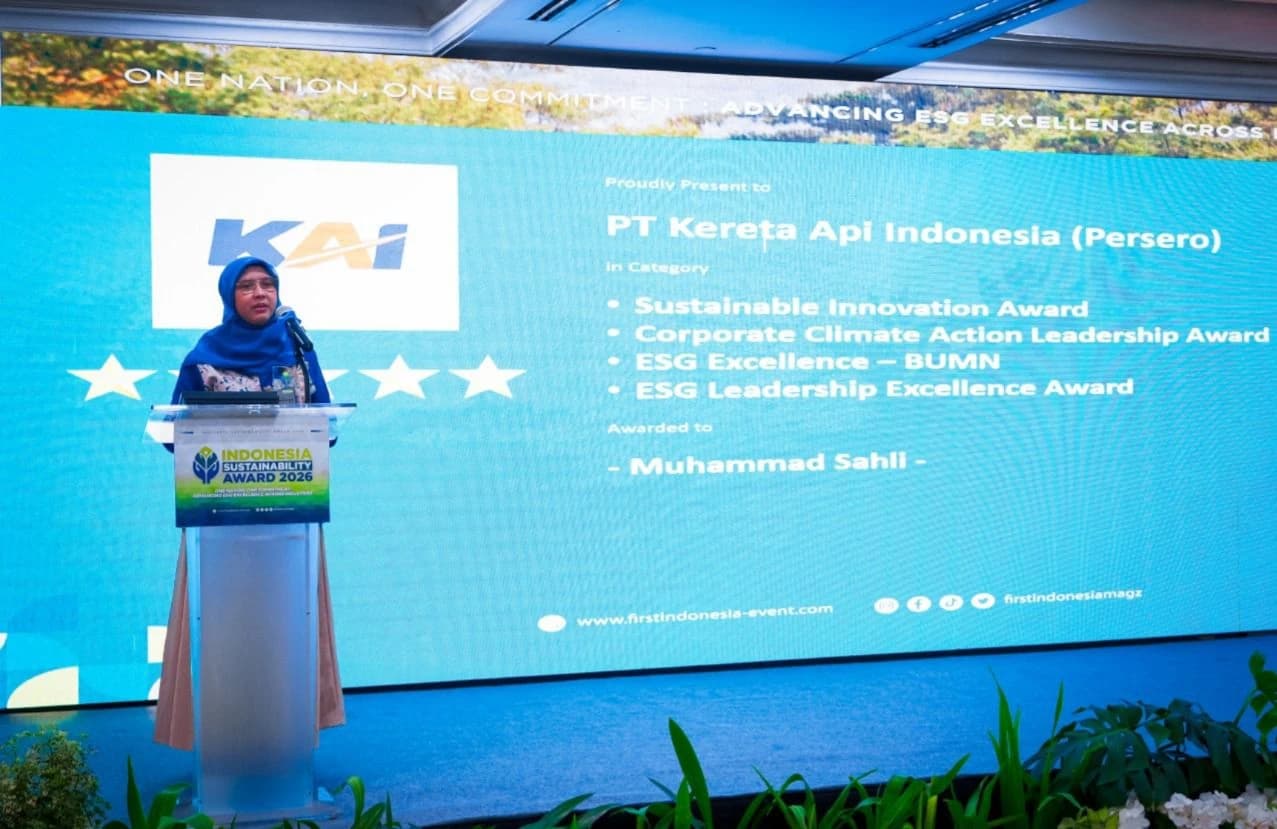
KAI Secures 5 Accolades at the 2026 Indonesia Sustainability Awards, Strengthening Inclusive Services and Low-Emission Transportation
PT Kereta Api Indonesia (Persero) secured five awards at the 2026 Indonesia Sustainability Awards held at the Menara Peninsula Hotel, Jakarta on Thursday (18/6). This event carried the theme "One Nation, One Commitment: Advancing ESG Excellence Across Industries" and serves as a platform to appreciate companies implementing Environmental, Social, and Governance (ESG) principles in their business operations.
The awards received by KAI include:
- Sustainable Innovation Award with a five-star rating
- Corporate Climate Action Leadership Award with a five-star rating
- ESG Excellence – BUMN with a five-star rating
- ESG Leadership Excellence Award with a five-star rating, presented to Muhammad Sahli
- The Most Inclusive Business 2026 – Best of The Best
KAI Vice President of Corporate Communications Anne Purba stated that these awards serve as a motivation for KAI to continually reinforce services that align with customer needs, maintain operational efficiency, and deliver benefits to society.
“ESG is implemented through things that are directly felt by customers and the public. Journeys must be on time, service access needs to be easier, energy use must be more efficient, and freight distribution via rail must be strengthened. These awards remind KAI to continue working with clear data, measurable metrics, and tangible results,”
KAI operates on a massive scale to support national mobility and logistics. KAI manages 608 stations, 6,031 km of active infrastructure, and 11,312 units of rolling stock comprising locomotives, passenger cars, freight wagons, commuter trains (KRL), diesel trains (KRD), and LRT. This scale requires KAI’s sustainability agenda to be implemented progressively, measurably, and across various service regions.
The reinforcement of KAI's ESG principles goes hand in hand with service growth. Based on data from January to May 2026, KAI Group served 214,045,803 passengers, a 7.2 percent increase compared to the same period in 2025, which recorded 199,663,907 passengers. During this period, the On-Time Performance of Passenger Trains was recorded at 99.89 percent for departures and 96.84 percent for arrivals.
This passenger growth was supported by various KAI Group services, ranging from Long-Distance and Local Trains, KAI Commuter, KAI Bandara, LRT Jabodebek, LRT Sumsel, KAI Wisata, the Makassar–Parepare Train, to Whoosh. In terms of customer experience, KAI's Customer Satisfaction Index for 2025 stood at 4.52, falling into the excellent category.
The Most Inclusive Business 2026 – Best of The Best award aligns with KAI's steps in expanding user-friendly services for diverse passenger groups. In the Access by KAI application, the Female Seat Map feature has been available since March 23, 2025. This feature helps female passengers view the seating positions of other female passengers before choosing their seats, allowing journeys to be planned with greater comfort.
At stations, KAI is progressively preparing accessibility facilities for passengers with disabilities and those requiring assistance. These facilities include ramps, wheelchairs, accessible toilets, elevators or escalators at selected stations, tactile guiding blocks, waiting lounges, and staff assistance tailored to on-field service needs.
“Public transportation must become increasingly accessible to various customer groups. Therefore, KAI continues to refine its services so that female passengers, the elderly, individuals with disabilities, families, and the general public can plan their trips more safely, comfortably, and according to their needs,”
In addition to serving public mobility, KAI also strengthens the role of rail in the national supply chain. From January to May 2026, KAI transported 26,486,417 tons of freight. The largest commodity was coal at 21,563,901 tons, followed by containers at 2,428,471 tons, fuel (BBM) at 1,096,998 tons, cement and clinker at 977,983 tons, plantation yields at 268,728 tons, retail goods at 48,684 tons, and other commodities at 101,652 tons.
According to Anne, rail-based cargo services hold significant value in the sustainability agenda because they are capable of hauling large volumes more efficiently and helping maintain seamless distribution.
“Rail provides a more competitive logistics option for businesses. When freight distribution becomes more efficient, the benefits flow into the broader economic chain, ranging from smooth supply, industrial competitiveness, to the reduction of road congestion,”
On the environmental front, KAI is expanding the use of clean energy through Solar Power Plants (PLTS). As of June 2026, KAI has developed 113 solar power units with a total installed capacity of 4,430.65 kWp spread across 92 locations. The solar units and locations are recorded as two distinct figures, as more than one unit can be installed at a single location.
These solar panels are installed across various KAI operational facilities, such as stations, workshops (balai yasa), staff quarters (griya karya), depots, offices, and the record center building. With this capacity, KAI's solar installations have the potential to generate approximately 5.8 million to 6.6 million kWh of clean electricity per year and reduce carbon emissions by around 5,100 to 5,800 tons of CO₂ annually.
KAI's climate agenda is also reinforced through a biodiesel roadmap. Fuel usage within KAI has progressed from B0 in 2017, B20 in 2018–2019, B30 in 2020–2022, B35 in 2023–2024, B40 in 2025–2026, and toward B50 in 2026. In KAI's strategic decarbonization action program for 2025–2030, the transition from B35 to B50 fuel is targeted to reduce emissions by 133,676 tons of CO₂e.
In the digitalization sector, KAI has enhanced its services through the Face Recognition Boarding Gate. As of June 3, 2026, this service has been utilized more than 25 million times, with 5.4 million passengers registered. The digitalization of the boarding process helps accelerate service speed, improve passenger comfort, and support the saving of approximately 64 million sheets of paper.
Anne added that the ESG Leadership Excellence Award presented to Muhammad Sahli indicates that KAI's sustainability agenda is driven by leadership, cross-functional teamwork, and team consistency in managing programs.
“KAI will continue to ensure that every initiative has clear metrics, whether from the number of passengers served, the tonnage of freight distributed, the energy saved, the emissions reduced, or the convenience felt by customers. In this way, sustainability becomes part of an ever-improving service for the public,”
VP Corporate Communications KAI
