
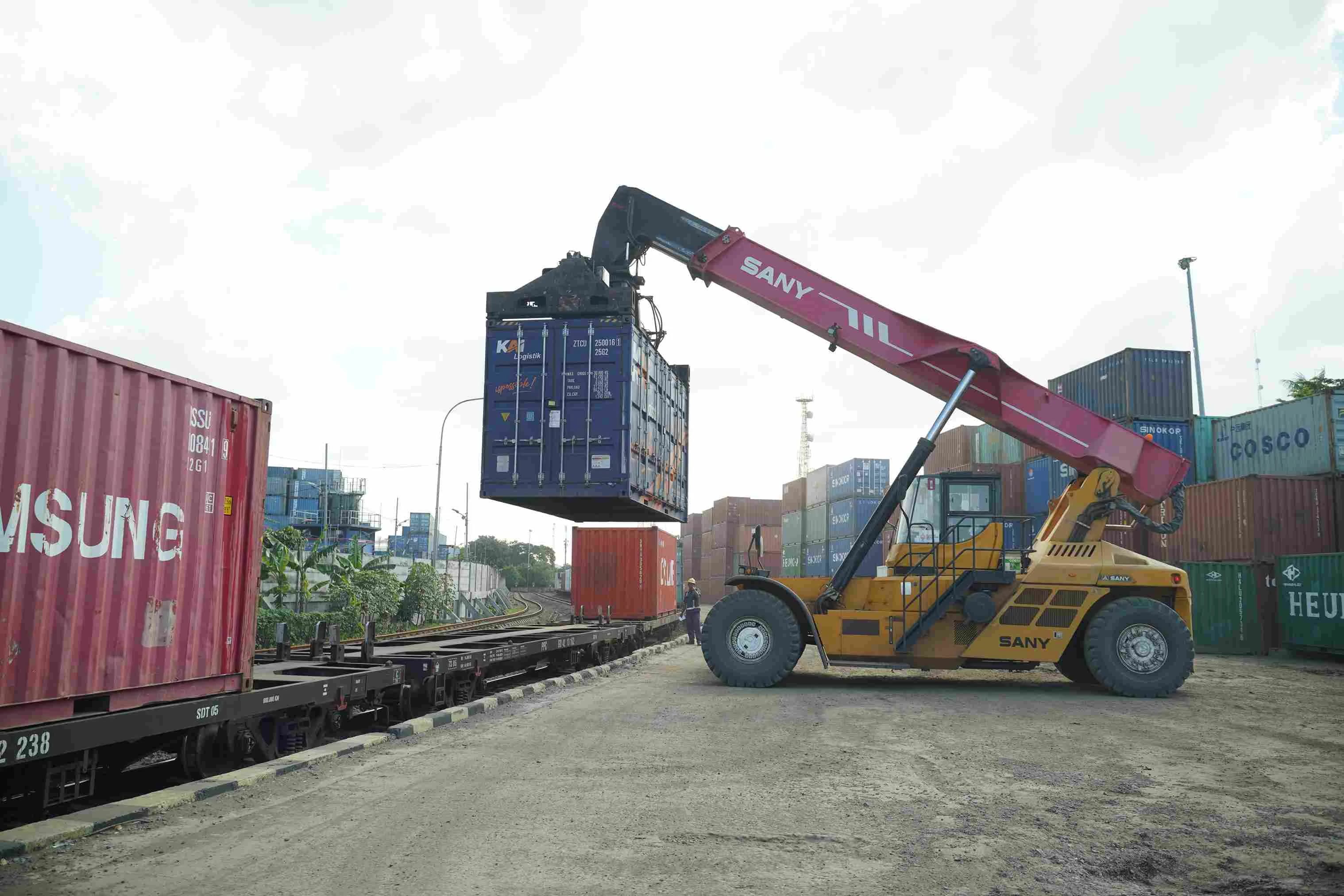
Driving Economic Efficiency: KAI Reinforces the Strategic Role of Rail Freight in Reducing National Logistics Costs
PT Kereta Api Indonesia (Persero) continues to strengthen the role of rail freight services to support national logistics efficiency. Rail transport offers massive carrying capacities and precisely measured trip schedules, while seamlessly interconnecting production centers, industrial zones, deep-water ports, and distribution hubs.
From January to May 2026, KAI transported a total of 26,486,417 tons of freight. This volume comprised 21,563,901 tons of coal, 2,428,471 tons of containerized cargo, 1,096,998 tons of fuel (BBM), 977,983 tons of cement and clinker, 268,728 tons of agricultural plantation yields, 48,684 tons of retail goods, and 101,652 tons of other essential commodities.
KAI’s Vice President of Corporate Communication, Anne Purba, stated that rail freight plays a vital role in ensuring the seamless distribution of primary goods, spanning energy resources, industrial raw materials, construction supply materials, and public consumer goods.
"Rail freight helps make distribution costs far more efficient due to its capability to move massive volumes in a single trip. For business entities, more controlled distribution overheads help maintain product price competitiveness. For the general public, a seamless supply chain directly supports more stable market prices,"
Logistics cost refers to the aggregate expenditures incurred to move goods from production sites down to the end consumers. These expenditures encompass shipping, warehousing, cargo handling, and other downstream distribution processes. When logistics costs are elevated, consumer commodity prices are inevitably pushed upward. Conversely, when logistics costs decrease, business operators gain greater financial breathing room to keep their product pricing competitive.
Based on data from BPS (Statistics Indonesia), Indonesia’s Gross Domestic Product (GDP) at current prices reached Rp23,821.1 trillion in 2025. GDP represents the total market value of all finished goods and services produced within the country over a one-year period. Utilizing this baseline figure, every 1 percentage point reduction in logistics costs relative to GDP translates into approximately Rp238.2 trillion in annual efficiency gains for the Indonesian economy.
This calculation is derived using a straightforward formula: multiplying the percentage variance of logistics costs by Indonesia’s total GDP value. For instance, 1 percent of Rp23,821.1 trillion yields roughly Rp238.2 trillion. This calculation serves as a national economic simulation, providing a clear visualization of potential financial efficiencies.
Within the National Medium-Term Development Plan (RPJMN) 2025–2029, Indonesia’s logistics cost was recorded at 14.29 percent of GDP (using 2022 as the baseline year). The planning document explicitly targets a reduction in logistics costs to 13.52 percent, with a long-term progression down toward 12.50 percent of GDP.
Using Indonesia's 2025 GDP as the simulation baseline, lowering logistics costs from 14.29 percent to 13.52 percent of GDP could unlock roughly Rp183.4 trillion in annual efficiency. Furthermore, if logistics costs can be successfully driven down to 12.50 percent of GDP, the annual efficiency gains could expand to approximately Rp426.4 trillion.
"These metrics demonstrate that logistics efficiency is not solely an industrial concern. When distribution costs drop, the socioeconomic benefits are felt on a much broader scale. Business operations become more streamlined, commodity prices remain protected, and public purchasing power is effectively reinforced,"
By comparison, World Bank studies indicate that logistics costs in the Latin America and Caribbean regions hover around 16 to 26 percent of GDP, whereas developed nations maintain their logistics costs at around 9 percent of GDP. Within Asia, official government studies from India recorded their national logistics costs at 7.97 percent of GDP for the 2023–2024 period.
These global and regional data points underscore that logistical efficiency is a primary driver of a nation's global competitiveness. For Indonesia, expanding the network of rail freight, cargo terminals, handling facilities, dedicated logistics corridors, operational technologies, and multi-modal transit integration to and from freight stations represents a critical national agenda to drive down distribution overheads.
KAI continuously optimizes its rail freight services by strengthening operational patterns, upgrading the reliability of rolling stock and track infrastructure, and forging strategic partnerships with corporate clients and logistical partners. These concerted efforts are directed at ensuring that goods distribution becomes increasingly scheduled, stable, efficient, and capable of anchoring the competitiveness of the national industry.
"Investing in rail-based logistics is fundamentally an investment in Indonesia’s global competitiveness. The larger the volume of goods we can efficiently move via rail, the greater the opportunity for Indonesia to compress logistics costs, reinforce domestic industries, and safeguard public purchasing power,"
VP of Corporate Communication KAI