
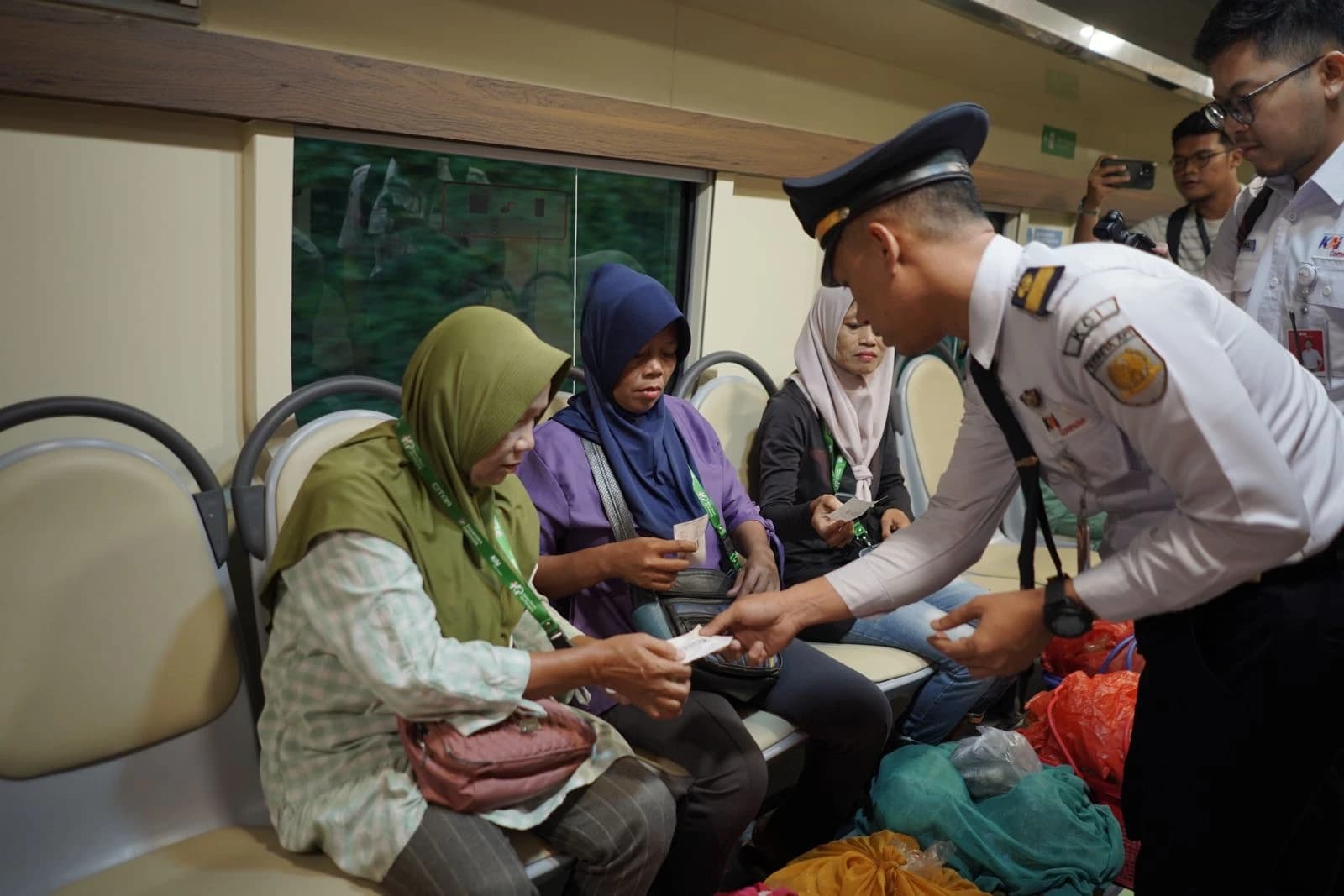
KAI Strengthens PSO Trains for the Public Economy: Cikuray Train and Farmers-Traders Rail Become Productive Access for Communities
PT Kereta Api Indonesia (Persero) strengthens the role of Public Service Obligation or PSO trains as safe, affordable public transportation that supports the public's economic activities. This reinforcement is carried out through the implementation of the Grassroots Economy Train (Kereta Ekonomi Kerakyatan) on the Pasar Senen–Lempuyangan round-trip service and the Cikuray Train operating the Garut–Pasar Senen round-trip route, alongside the Farmers-Traders Train (Kereta Petani-Pedagang) on the Rangkasbitung–Merak line and the Cikuray Train.
KAI Vice President of Corporate Communications Anne Purba stated that the Grassroots Economy Train and the Farmers-Traders Train were introduced to ensure that railway services increasingly align with the needs of daily commuters, farmers, traders, MSME players, workers, students, families, and communities requiring productive access at affordable costs.
“Trains connect people with jobs, education, markets, public services, and economic opportunities. Through PSO services, KAI together with the government aims to ensure that the benefits of railways are increasingly felt in the daily lives of our customers,”
The Grassroots Economy Train was first introduced to the public through the Additional Lempuyangan–Pasar Senen round-trip train during the 2026 Eid Transportation period, spanning from March 11 to April 5, 2026. Based on the latest data during that period, this service recorded 24,398 passengers, consisting of 12,262 passengers on the Lempuyangan–Pasar Senen route and 12,136 passengers on the Pasar Senen–Lempuyangan route.
Following that implementation, the Grassroots Economy Train was also utilized on the Cikuray Train for the Garut–Pasar Senen round-trip route. The Cikuray Train first operated on March 25, 2022. Since June 11, 2026, the Cikuray Train has been served by the Grassroots Economy Train and the Farmers-Traders Train after being launched at Garut Station alongside the Directorate General of Railways of the Ministry of Transportation (DJKA Kemenhub) and the Garut Regency Government.
During the period of June 11–17, 2026, the Grassroots Economy Train and Farmers-Traders Train services on the Cikuray Train recorded 10,448 passengers. This total consisted of 10,426 Grassroots Economy Train passengers and 22 Farmers-Traders Train passengers.
In detail, Train (KA) 299A on the Garut–Pasar Senen route served 5,700 passengers, Train (KA) 300A on the Pasar Senen–Garut route served 4,726 passengers, Train (KA) 299PP on the Garut–Pasar Senen route served 10 farmers-traders passengers, and Train (KA) 300PP on the Pasar Senen–Garut route served 12 farmers-traders passengers during the June 11–17, 2026 period.
With its application on the Additional Lempuyangan–Pasar Senen round-trip trains for the 2026 Eid Transportation period and the Cikuray Train, the Grassroots Economy Train has served 34,824 passengers based on the latest data from the periods of March 11–April 5, 2026, and June 11–17, 2026.
“This figure indicates that the public has responded positively to the Grassroots Economy Train since its initial introduction. The pattern shows that services with larger seating capacities and affordable fares are needed by customers during peak travel seasons as well as for productive daily commuting lines,”
The performance of the Cikuray Train has continued to grow since it began operating. In 2022, the Cikuray Train served 293,265 passengers. This number rose to 514,767 passengers in 2023, then to 591,089 passengers in 2024, and reached 615,723 passengers in 2025. From January to May 2026, the Cikuray Train has served 266,993 passengers. Cumulatively, the Cikuray Train has served 2,281,837 passengers since its inaugural run.
The Cikuray Train serves 12 stopping stations: Garut, Cibatu, Leles, Kiaracondong, Bandung, Cimahi, Purwakarta, Cikampek, Karawang, Cikarang, Bekasi, and Pasar Senen. This line connects agricultural and horticultural hubs in Garut, educational and commercial centers in Greater Bandung, industrial zones in Purwakarta, Karawang, and Cikarang, up to the heart of national economic activity in Jakarta.
Meanwhile, the Grassroots Economy Train service on the Additional Lempuyangan–Pasar Senen round-trip route connects Yogyakarta, the Central Java region, Cirebon, and Jakarta. This line generates passenger demand from the education, tourism, and trade sectors, as well as workers, families, and public travel during the Eid holiday season.
The profile of these regions demonstrates that the Grassroots Economy Train holds strong relevance on lines with high travel demand. Garut possesses agricultural, horticultural, MSME, and tourism potential. Greater Bandung serves as a hub for education, services, trade, and the creative economy. Purwakarta, Karawang, and Cikarang have a massive industrial and worker base, while Bekasi and Jakarta stand as primary destinations for commuting, education, commerce, and public services. Along the Lempuyangan–Pasar Senen line, passenger potential stems from the mobility of families, students, workers, tourists, and small business owners.
Through its new formation, the Cikuray Train utilizes six Grassroots Economy Train cars and one Farmers-Traders Train car. The Grassroots Economy Train is a result of seating configuration innovation by Balai Yasa Manggarai, optimizing the capacity to 93 seats per car. Within a single trainset, the capacity of the Grassroots Economy Train reaches 558 seats.
Balai Yasa Manggarai played a vital role in preparing the rolling stock for the Grassroots Economy Train. The innovation was carried out through seating adjustments so that service capacity is more optimal, journeys remain orderly, and PSO fares can support public access to affordable mass transit.
“Balai Yasa Manggarai is an essential part of enhancing passenger rolling stock services. Through seating configuration innovations on the Grassroots Economy Train, KAI can optimize service capacity while maintaining comfort, safety, and affordability for our customers,”
Meanwhile, the Farmers-Traders Train is a rolling stock innovation from Balai Yasa Surabaya Gubeng. This train is prepared with a capacity of 73 seats, a more organized cargo space, longitudinal seating, and an interior arrangement tailored to the needs of farmers, market traders, and small business owners.
Balai Yasa Surabaya Gubeng played a key role in preparing the Farmers-Traders Train, ranging from interior styling, cargo space, boarding and alighting access arrangements, to operational safety aspects. This rolling stock is designed so that agricultural produce, processed products, handicrafts, and small merchandise can be transported in a more orderly manner during the journey.
The Farmers-Traders Train first served the Rangkasbitung–Merak line on December 1, 2025. Based on the latest data from the period of December 1, 2025, to June 17, 2026, this service has been utilized by 27,824 passengers.
In detail, the Rangkasbitung–Merak Farmers-Traders Train served 4,115 passengers in December 2025, 4,535 passengers in January 2026, 3,558 passengers in February 2026, 3,249 passengers in March 2026, 4,622 passengers in April 2026, 4,937 passengers in May 2026, and 2,808 passengers from June 1 to 17, 2026. All these figures yield a total of 27,824 passengers.
Along the Rangkasbitung–Merak line, the Farmers-Traders Train is coupled into 14 Commuter Line Merak journeys daily, consisting of seven Merak–Rangkasbitung journeys and seven Rangkasbitung–Merak journeys. This service connects 11 stations: Rangkasbitung, Jambu Baru, Catang, Cikeusal, Walantaka, Serang, Karangantu, Tonjong Baru, Cilegon, Krenceng, and Merak.
Passenger generation for the Farmers-Traders Train on the Rangkasbitung–Merak line originates from residential areas, agricultural centers, traditional markets, local trade, industrial estates, and access toward the Port of Merak. High passenger activity is heavily seen in Cikeusal, Rangkasbitung, Serang, Cilegon, and Merak, which have consistently served as nodes for public mobility in Banten.
“On the Rangkasbitung–Merak line, the Farmers-Traders Train helps communities carry agricultural produce, processed food, handicrafts, and small retail goods in a more orderly manner. The benefits are directly felt by customers who depend on rail-based daily travel for their economic activities,”
The positive response toward the Farmers-Traders Train was evident during its inaugural journey on the Rangkasbitung–Merak line. Sumarni, one of the traders who joined the first trip, expressed the benefits of this service on her business activities.
“This heavily impacts our daily income,”
According to Anne, customer voices like Sumarni's show that the needs of farmers and traders must be taken seriously in public service planning.
“For farmers and traders, train journeys relate directly to the smooth operation of their businesses. Therefore, we organize this service to be more orderly, safe, affordable, and supportive of the community's economic activities,”
To utilize the Farmers-Traders Train, customers working as farmers or traders can register at station ticket counters that handle enrollment. Customers bring their personal identification, fill out their data, and undergo verification by officers. Once registered, customers can purchase tickets according to the applicable terms, quotas, baggage regulations, and safety procedures.
Permitted baggage includes agricultural produce, processed products, handicrafts, and small merchandise in accordance with regulations. Baggage management is enforced to ensure journeys remain safe, comfortable, and do not disturb other passengers.
Government support through the PSO scheme remains a vital part of this service's sustainability. On the Cikuray Train, PSO support from DJKA Kemenhub keeps the furthest route fare for Garut–Pasar Senen at Rp45,000. On the Farmers-Traders Train for the Rangkasbitung–Merak line, PSO support from DJKA Kemenhub keeps the fare flat at Rp3,000, ensuring it remains accessible for farmers and small traders.
“The PSO creates space for the public to have access to affordable public transportation. When travel expenses can be minimized, customers have more financial room for family needs, education, business, and other economic activities,”
Moving forward, KAI will conduct gradual evaluations regarding the expansion of the Grassroots Economy Train and the Farmers-Traders Train. The determination of subsequent lines will consider rolling stock readiness at Balai Yasa Manggarai and Balai Yasa Surabaya Gubeng, operational patterns, safety, customer needs, regional demand potential, as well as coordination with DJKA Kemenhub.
KAI prioritizes lines that possess high potential for farmers, market traders, MSMEs, educational zones, workers, daily commuters, and connectivity toward markets and economic hubs. The next routes will be established after operational reviews, rolling stock readiness, and regulator coordination are finalized.
“The tracks connect people with opportunities. When farmers can reach markets more easily, traders have travel choices, workers can access activity centers, and families secure affordable transportation, the railway truly stands as an integral part of community life,”
VP Corporate Communications KAI