
KAI Pays Attention to Train Travel Readiness Amid Changing Weather Conditions
Changing weather is one of the factors that needs to be considered in train travel. Heavy rainfall can affect environmental conditions around railway lines, making regular infrastructure inspections and maintenance necessary to support safety and operational reliability.
The Meteorology, Climatology, and Geophysical Agency (BMKG) predicts that the onset of the 2026/2027 rainy season will be delayed in several regions of Indonesia. Different weather conditions across regions mean that travel readiness needs to take into account the characteristics of each railway section, including track conditions and the surrounding environment.
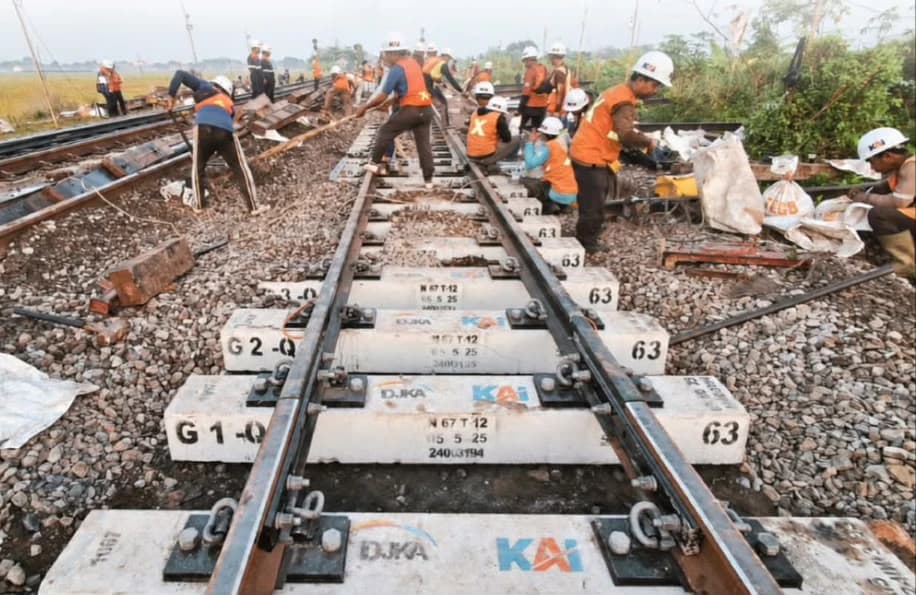
PT Kereta Api Indonesia (Persero) continues to maintain various infrastructure components, including railway sleepers, which play a role in maintaining rail alignment and transferring train loads to the structures beneath them. KAI's maintenance implementation throughout this year has reached 20,581 railway sleepers, consisting of 17,025 concrete sleepers and 3,556 synthetic sleepers.
Sleeper maintenance is part of ongoing track maintenance. The condition of rails, sleepers, switches, bridges, and drainage channels also needs to be monitored based on field inspection results to support track stability and anticipate potential operational disruptions.
KAI Vice President of Corporate Communication Anne Purba said that infrastructure maintenance is carried out according to plan, taking into account track conditions and maintenance needs in each region.
“Each track component plays a role in maintaining travel safety. Therefore, inspections and maintenance are carried out regularly to ensure that infrastructure conditions remain in accordance with operational standards,” said Anne.
In addition to concrete sleepers, KAI uses synthetic sleepers made from Fiber Reinforced Foamed Urethane in certain structures, including steel bridges. This material is resistant to environmental conditions and potentially has a longer service life than wooden sleepers, making it one alternative for infrastructure maintenance.
The procurement of synthetic sleepers from 2022 to 2026 was recorded at 68,501 units. The use of this material also supports efforts to reduce the need to replace wooden sleepers in suitable structures.
Track readiness amid changing weather conditions also requires attention to soil conditions, slopes, and drainage systems around the railway lines. Inspections and remedial measures are carried out based on actual field conditions so that potential disruptions can be identified and addressed as needed.
“Infrastructure maintenance is an ongoing task that needs to be adapted to the conditions of each railway section. We continue to pay attention to inspection results and maintenance needs to support safe and reliable train journeys,” said Anne.
KAI urges customers to follow travel information through official channels and pay attention to staff instructions if operational adjustments occur.
“Through planned maintenance and the use of materials suited to specific needs, KAI continues to maintain infrastructure quality to support train journeys under various weather conditions,” Anne concluded.
VP Corporate Communication KAI