
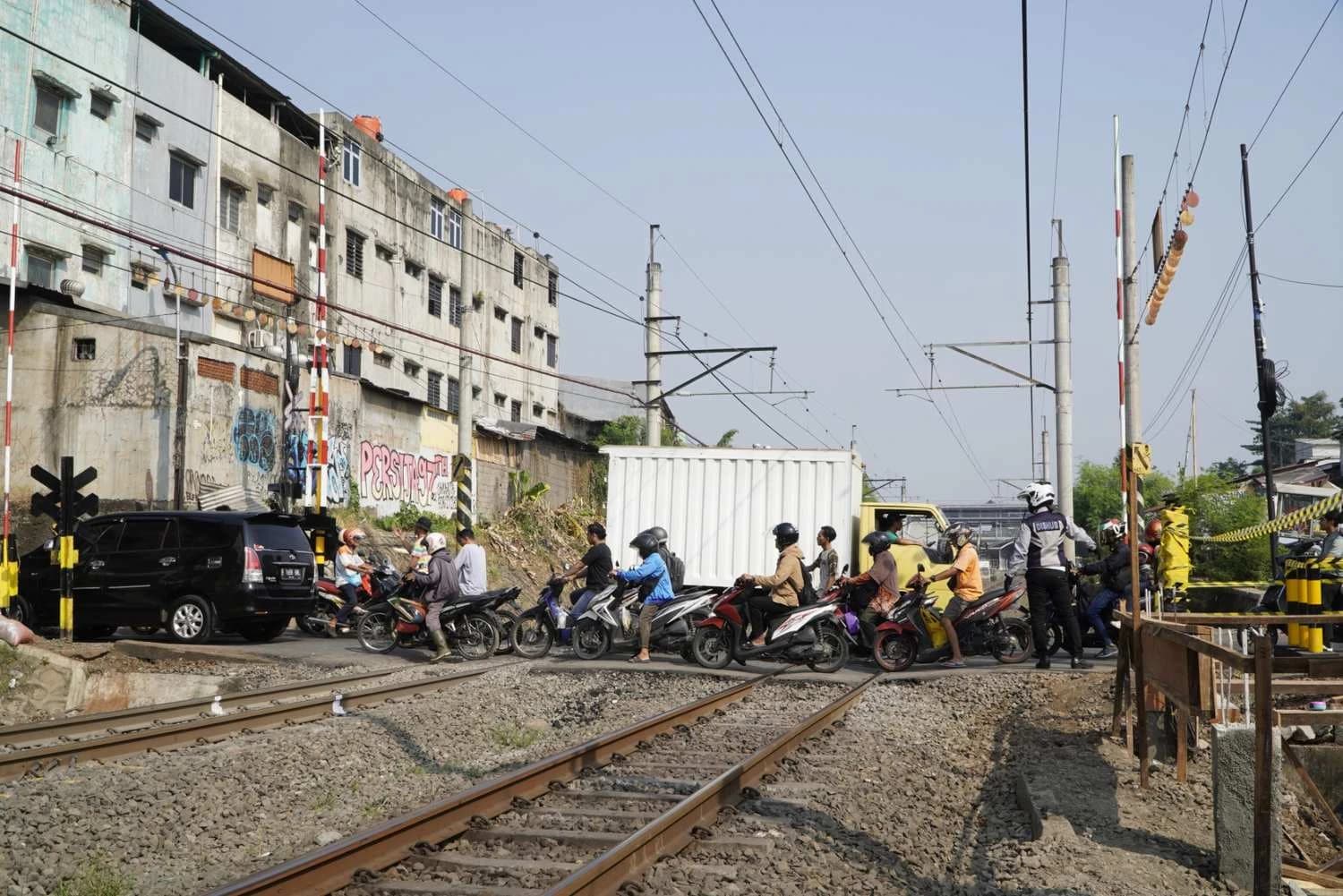
KAI Accelerates Level Crossing Improvements to Strengthen Travel Safety at 1,638 Crossings
PT Kereta Api Indonesia (Persero) continues to accelerate the improvement of level crossings in collaboration with regional governments and stakeholders across various regions. This initiative aims to strengthen railway travel safety while enhancing road user safety at intersections between railway tracks and public roads.
Between April 27 and May 12, 2026, KAI, together with its stakeholders, closed 20 level crossings and narrowed 7 crossings across several operational regions and regional divisions.
The improvements were carried out in Jakarta, Banten, West Java, Central Java, Yogyakarta, East Java, North Sumatra, West Sumatra, and South Sumatra, primarily targeting illegal crossings, unauthorized access points, and locations with high safety risks.
In addition to closures and road narrowing, KAI is gradually enhancing safety at 1,638 level crossings through the installation of safety facilities, strengthening crossing guards, improving operational monitoring, and coordinating with relevant agencies to reinforce the safety of both railway operations and road users.
One of the current safety improvement projects is located in the Ampera area near Bekasi Timur Station. At this location, KAI has installed a new level crossing gate, which is currently undergoing final adjustments and operational trials as part of efforts to enhance railway and road user safety.
Vice President of Corporate Communication KAI, Anne Purba, stated that accelerating the improvement of level crossings has become an essential part of strengthening a risk-based transportation safety system.
“Level crossings are locations where railway operations and public mobility intersect at the same time. Therefore, improvements must be carried out more quickly, systematically, and in an integrated manner to create a safer environment on the ground,” said Anne.
During the finalization of safety facilities in the Ampera area, railway operations continue to be secured using the existing crossing gates, which remain operational. Temporary safety measures are also supported through community initiatives while awaiting the construction of a guard post and the deployment of official personnel.
According to Anne, collaboration on the ground plays an important role in maintaining safety throughout the facility improvement process. The presence of safety facilities must also be accompanied by road users' compliance with traffic rules when crossing railway intersections.
“We encourage the public to be more disciplined when passing through level crossings by not forcing their way through closed crossing gates, stopping briefly, looking both ways, and ensuring it is safe before continuing their journey,” Anne explained.
Based on data from the first quarter of 2026, Indonesia has 3,888 level crossings. Of these, 2,112 crossings are currently guarded, while the remaining 1,776 are unguarded.
“For guarded level crossings, management responsibilities are shared among various parties. KAI currently manages 977 crossings, representing approximately 46 percent of all guarded crossings. Regional governments, through provincial and regency/city transportation agencies, manage 680 crossings, or around 32 percent. In addition, 417 crossings are guarded through community initiatives, while 38 crossings are managed by private entities,” Anne explained.
Meanwhile, the unguarded crossings are distributed across different road classifications, consisting of 3 crossings on national roads, 4 on provincial roads, 415 on regency/city roads, and 1,354 on sub-district, village, neighborhood, and other local access roads.
According to Anne, this distribution demonstrates that improving level crossing safety requires collaboration among multiple institutions, as management authority is determined by road classification under the central government, provincial governments, and regency/city governments.
Under existing regulations, the management and safety evaluation of level crossings based on road classification falls under the authority of the Minister of Public Works for national roads, governors for provincial roads, and regents or mayors for regency/city and village roads.
Therefore, KAI has also submitted requests for delegated authority to manage and improve the safety of level crossings to several regional governments so that improvements can be implemented more effectively and gradually.
In addition to physical improvements, KAI currently operates 977 guarded level crossings supported by 3,908 Crossing Guards (Petugas Jaga Lintasan/PJL) working around the clock in shifts. These personnel regularly undergo training and competency certification to ensure railway operations remain safe and secure.
Indonesia currently has 3,674 level crossings, with 1,810 identified as priority locations for improvement. Of these, 172 crossings are targeted for closure due to limited road conditions, while the remaining 1,638 crossings require gradual safety facility upgrades.
From a technical perspective, trains require a considerable safe distance to apply emergency braking. At a speed of 120 kilometers per hour, the ideal braking distance ranges from 800 to 1,200 meters. Therefore, ensuring that railway tracks are completely clear before a train passes is a critical factor in maintaining operational safety.
“Railway travel safety requires consistent action in the field. The sooner high-risk locations are identified, improved, and jointly safeguarded, the greater the level of safety that can be provided for the public,” Anne concluded.
VP Corporate Communication KAI