
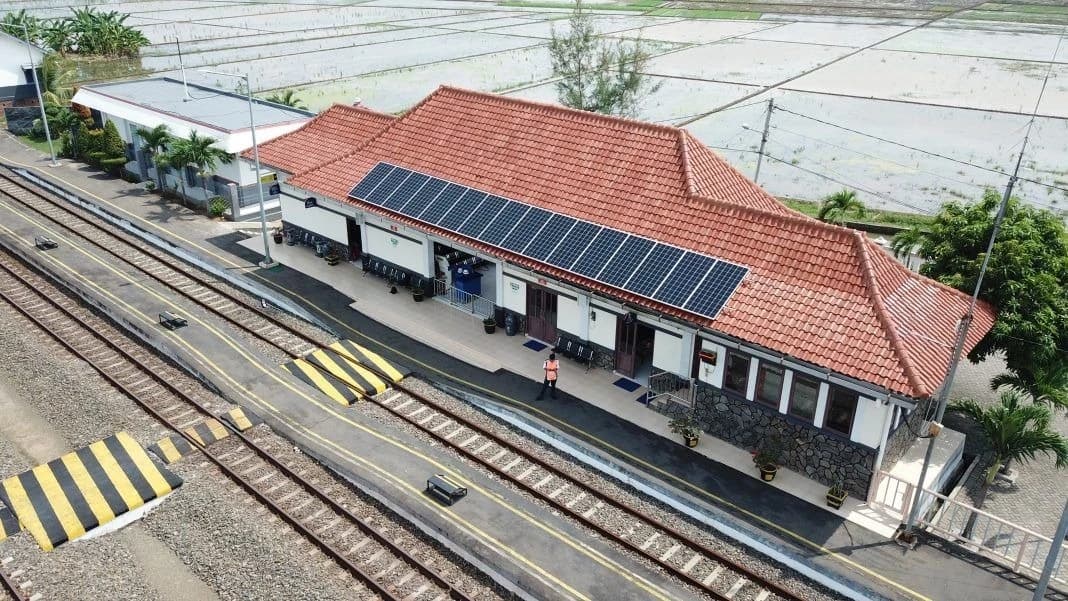
KAI Operates 113 Solar Power Units Across 92 Railway Asset Locations
PT Kereta Api Indonesia (Persero) continues to expand its use of renewable energy through the installation of Solar Power Plants (PLTS) across various company operational assets. KAI currently operates 113 solar power units across 92 asset locations, with a total installed capacity of 4,430.65 kWp, or approximately 4.43 MWp.
With this capacity, KAI’s solar power plants have the potential to generate approximately 5.8 million to 6.6 million kWh of electricity per year, based on estimated solar power production in Indonesia. The use of solar energy supports energy efficiency across various KAI operational facilities while also forming part of the company’s efforts to optimize energy management within the railway ecosystem.
Vice President of Corporate Communication KAI Anne Purba said that the use of solar power plants is one of the company’s initiatives to develop energy innovations in support of rail-based transportation operations.
“Railways require reliable infrastructure support to ensure that people’s journeys and the distribution of goods can run optimally. Energy management is an important aspect of railway operations, so KAI continues to explore opportunities to utilize technology that can improve energy efficiency across the company’s assets,” said Anne.
KAI’s solar power development has been carried out gradually since 2022. During the initial implementation stage, the installed capacity reached 206 kWp. The capacity increased to 1,314.30 kWp in 2023, then to 1,914.20 kWp in 2024, and reached 996.15 kWp in 2025. KAI is also preparing to add 500 kWp of solar power capacity in 2026.
Solar power plants are installed across various assets supporting train operations, including stations, maintenance facilities, offices, depots, and other supporting facilities. Of the 92 asset locations, solar power installations cover 62 station locations with a capacity of 1,759.90 kWp, 10 maintenance facility locations with a capacity of 1,786.50 kWp, as well as other facilities such as offices, Griya Karya, depots, and record centers.
Anne explained that the transportation sector has substantial and continuous energy needs. Therefore, energy management is an important part of maintaining operational effectiveness while supporting the management of railway assets.
“Transportation transformation encompasses train journeys as well as all supporting facilities. Through the use of renewable energy, KAI continues to optimize asset management to keep pace with technological developments and operational needs,” said Anne.
The use of solar power supports electricity needs across various company facilities, including customer service areas, operational buildings, rolling stock maintenance facilities, and other supporting facilities. Solar energy is one of the alternative energy sources utilized to support electricity needs at assets with solar energy potential.
Based on KAI’s 2025 Sustainability Report, electricity generated from solar panels is one of the indicators of the company’s energy performance. The report notes that KAI records electricity generated from solar panels as part of its energy management efforts and has expanded the use of solar power plants across more than 90 operational assets with a capacity of approximately 4.4 MWp.
The use of solar energy also supports KAI’s efforts to reduce the environmental impact of its operations. The development of solar power plants is part of various energy efficiency and emissions reduction initiatives carried out by the company to support low-carbon transportation.
As a rail-based public transportation company, KAI continues to develop innovations that support greater operational efficiency. The use of solar power plants across railway assets demonstrates how renewable energy technologies can be applied to transportation infrastructure to support operations that are increasingly efficient and responsive to future needs.
“KAI will continue to evaluate various opportunities for innovation in energy and company asset management. Through the use of technology, KAI is committed to providing transportation services that are increasingly efficient, reliable, and sustainable for the community,” Anne concluded.
VP Corporate Communication KAI