
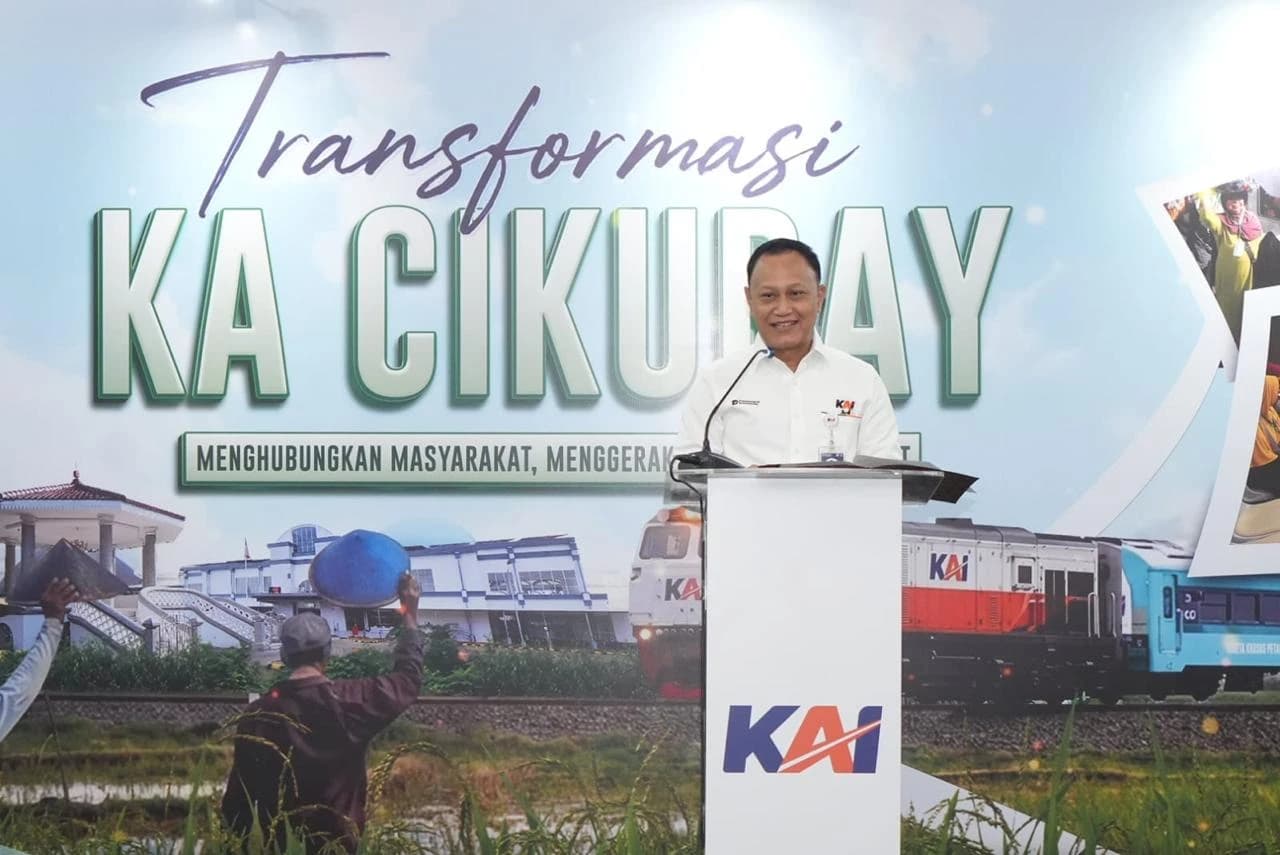
KAI Introduces 'Rel Ekonomi Rakyat' via KA Cikuray in Garut, Enhancing Affordable Public Connectivity
PT Kereta Api Indonesia (Persero), in collaboration with the Directorate General of Railways under the Ministry of Transportation and the Regional Government of Garut Regency, officially launched the Rel Ekonomi Rakyat (People's Economic Rail) program at Garut Station on Thursday (June 11). The initiative debuts through the operation of the Kereta Ekonomi Kerakyatan (People's Economy Carriage) and Kereta Petani-Pedagang (Farmer-Trader Carriage) integrated into the KA Cikuray service. This program presents services that support public mobility while strengthening connectivity among agricultural centers, trade hubs, MSMEs, industrial zones, and economic centers linked along the KA Cikuray corridor.
The launch is part of the ongoing service enhancement for KA Cikuray, which has consistently served the public's diverse travel needs. Traversing areas with varied economic characteristics, KA Cikuray plays an essential role in backing productive community activities while reinforcing inter-regional connectivity.
KAI’s Director of Business and Corporate Development, Rafli Yandra, stated that the operation of these specialized carriages on KA Cikuray aligns with KAI’s commitment to providing safe, comfortable, affordable transportation accessible to all segments of society.
"Through this service, we hope to significantly improve the mobility of communities, farmers, traders, and MSME actors. The presence of the People's Economy Carriage and the Farmer-Trader Carriage is expected to deliver broader social benefits while driving local economic activities that thrive along the KA Cikuray route,"
In its operations, KA Cikuray utilizes a train set consisting of six People's Economy Carriages and one Farmer-Trader Carriage. The seating capacity for the People's Economy Carriage has been upgraded from 80 to 93 seats per carriage, while the Farmer-Trader Carriage accommodates 73 seats. The rolling stock modifications, carried out by KAI workforce (Insan KAI) at the Manggarai Workshop in Jakarta and the Surabaya Gubeng Workshop, are engineered to facilitate daily community commuting while offering better space allotments for farmers, traders, and MSME vendors traveling by rail.
Acting (Plh.) Director of Railway Traffic and Transport at the Directorate General of Railways, Ministry of Transportation, Aditya Karsa, remarked that the program expands public access to mass transport while underpinning the community's economic activities.
"The arrival of this service is anticipated to ease the mobility of farmers, traders, and grassroots business actors. Besides supporting the distribution of agricultural yields, this service also contributes to the smooth continuity of the food supply chain, which is a critical element of the regional economy,"
The Regent of Garut, Abdusy Syakur Amin, warmly welcomed the launch of the program. He noted that Garut Regency holds immense potential in agriculture, MSMEs, and tourism, which can be further optimized with the backing of reliable transportation connectivity.
"Garut possesses many superior local products born from the hard work of our community. This service opens up wider windows to showcase regional potential, reinforce market access, and bolster grassroots economic activities," Abdusy explained, adding that Garut's selection as the pioneer location for this program's launch in West Java serves as an important momentum for local economic development.
KAI’s Vice President of Corporate Communication, Anne Purba, explained that the service expansion of KA Cikuray was prompted by the rising public mobility demand along the Garut–Pasar Senen route.
KAI's data shows that passenger volume for KA Cikuray has risen steadily year over year. In 2022, KA Cikuray served 293,265 passengers. This number grew to 514,767 passengers in 2023, reached 591,089 passengers in 2024, and expanded further to 615,723 passengers in 2025. Meanwhile, from January to May 2026, KA Cikuray has already served 266,993 passengers.
Cumulatively, KA Cikuray has served over 2.2 million passengers since its inaugural run. This growth indicates an expanding public reliance on transportation services that connect various social and economic activity hubs along its path.
"Each region traversed by KA Cikuray has a distinct economic character, ranging from agricultural belts, trade districts, and educational zones to industrial estates and the national economic epicenter. Rel Ekonomi Rakyat is here to tighten the links between these diverse activities through affordable, safe, and comfortable transportation,"
As a Public Service Obligation (PSO) train service subsidized by the government through the Ministry of Transportation's Directorate General of Railways, KA Cikuray offers a flat fare of IDR 45,000 for its furthest route (Garut–Pasar Senen), making it accessible to citizens from all walks of life.
KA Cikuray serves 12 stations: Garut, Cibatu, Leles, Kiaracondong, Bandung, Cimahi, Purwakarta, Cikampek, Karawang, Cikarang, Bekasi, and Pasar Senen. The rail line connects regions with complementary economic traits, from the agricultural and horticultural hubs in Garut, the trade and education hubs in Greater Bandung, the industrial manufacturing corridors in Purwakarta, Karawang, and Cikarang, to the national economic core in Jakarta.
This chain of regions forms an economic corridor that unites production centers, distribution networks, industrial estates, and consumer markets in a single train journey. Such connectivity highlights the unique strength of railway transport in facilitating inter-regional economic and public mobility.
"Through Rel Ekonomi Rakyat, KA Cikuray is expected to bring widespread advantages to the public. The railway acts as a conduit that interfaces various productive activities, unlocks greater access to economic opportunities, and cements inter-regional ties,"
VP of Corporate Communication KAI
