
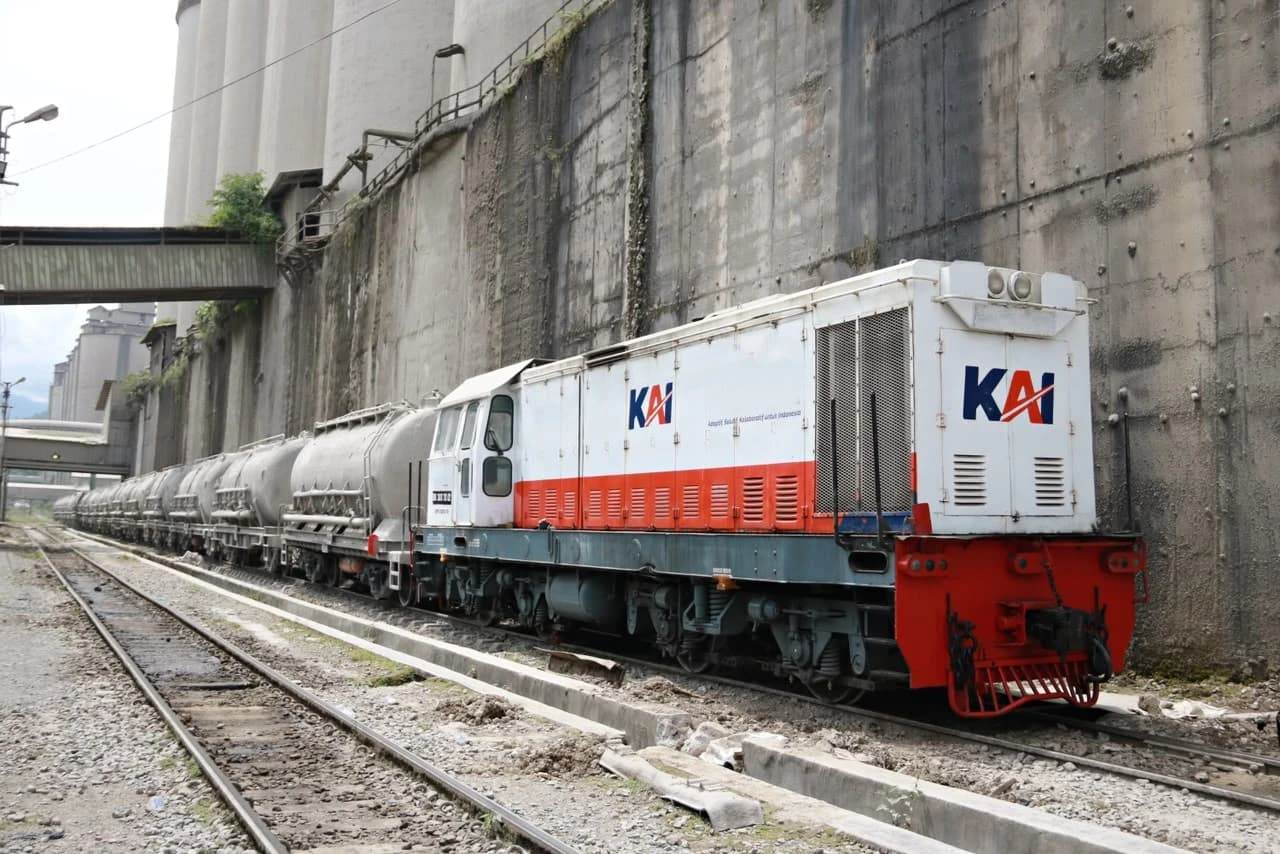
KAI Serves 1.36 Million Tons of Cement and Clinker Until July 2026, Strengthening the Industrial and Infrastructure Supply Chain
PT Kereta Api Indonesia (Persero) continues to strengthen the role of rail-based transportation in supporting the national industrial supply chain. Throughout January–July 2026, KAI served 1,357,524 tons of cement and clinker transportation. This volume is equivalent to approximately 19.4% of KAI's total non-coal freight transportation, which reached 6,987,150 tons during the same period. Based on KAI's performance report, the cement and clinker transportation generated revenue of Rp82.51 billion.
Vice President of Corporate Communication KAI Anne Purba said that cement and clinker transportation has an important position because it is directly related to the material supply chain for construction, area development, and various economic activities. Railways provide large and scheduled delivery capacity, helping industries maintain distribution continuity from production areas to processing and distribution points.
“Cement and clinker are an important part of the development supply chain. Through railways, large volumes can be delivered on a scheduled and integrated basis, enabling industrial logistics flows to operate more efficiently while providing certainty for customers,” said Anne.
One of the customers utilizing railway services is PT Semen Baturaja. As of July 2026, the volume served by KAI for the company was recorded at 153,734 tons. Its main factory is located in Baturaja, Ogan Komering Ulu Regency, South Sumatra. In its production process, clinker from Baturaja is transported by rail to the Cement Mill in Palembang, while bulk cement is also distributed using capsule railway cars. The use of railways has become part of Semen Baturaja's distribution network connecting Baturaja with several points in South Sumatra and Lampung.
In West Sumatra, KAI also supports the supply chain of PT Semen Padang. The realization of Semen Padang's clinker transportation from January–July 2026 was recorded at 200,950 tons. Cement and clinker transportation services in the region operate on the Indarung–Bukit Putus route, which is connected to distribution activities toward the Teluk Bayur Port area. The role of the railway is strategic because it connects the Indarung industrial area with port access and supports the movement of Semen Padang products to domestic markets as well as export distribution chains.
The utilization of railways for high-volume commodities provides broader benefits to the logistics system. Train capacity allows large quantities to be shipped in a single trip, helping reduce the need for heavy vehicle movements on highways, maintaining the flow of goods between production and distribution points, while also creating opportunities for a more efficient and lower-emission freight transportation system. On the Indarung route, for example, freight train services serve as a direct link between the production area and distribution facilities leading to the port.
KAI views the integration of industrial areas, railway networks, distribution centers, and ports as one of the important directions for strengthening its logistics business. As of July 31, 2026, KAI's total non-coal freight transportation reached 6.99 million tons, or 102.3% of the cumulative program target of 6.83 million tons. This achievement demonstrates the industry's demand for rail-based logistics services capable of handling large volumes consistently.
“KAI will continue to build collaboration with industry players so that railway networks become increasingly productive for the economy. When production areas can be efficiently connected with distribution centers and ports, the benefits reach further: supply chains become stronger, highways are utilized more optimally, and national products become increasingly competitive,” concluded Anne.
VP Corporate Communication KAI