
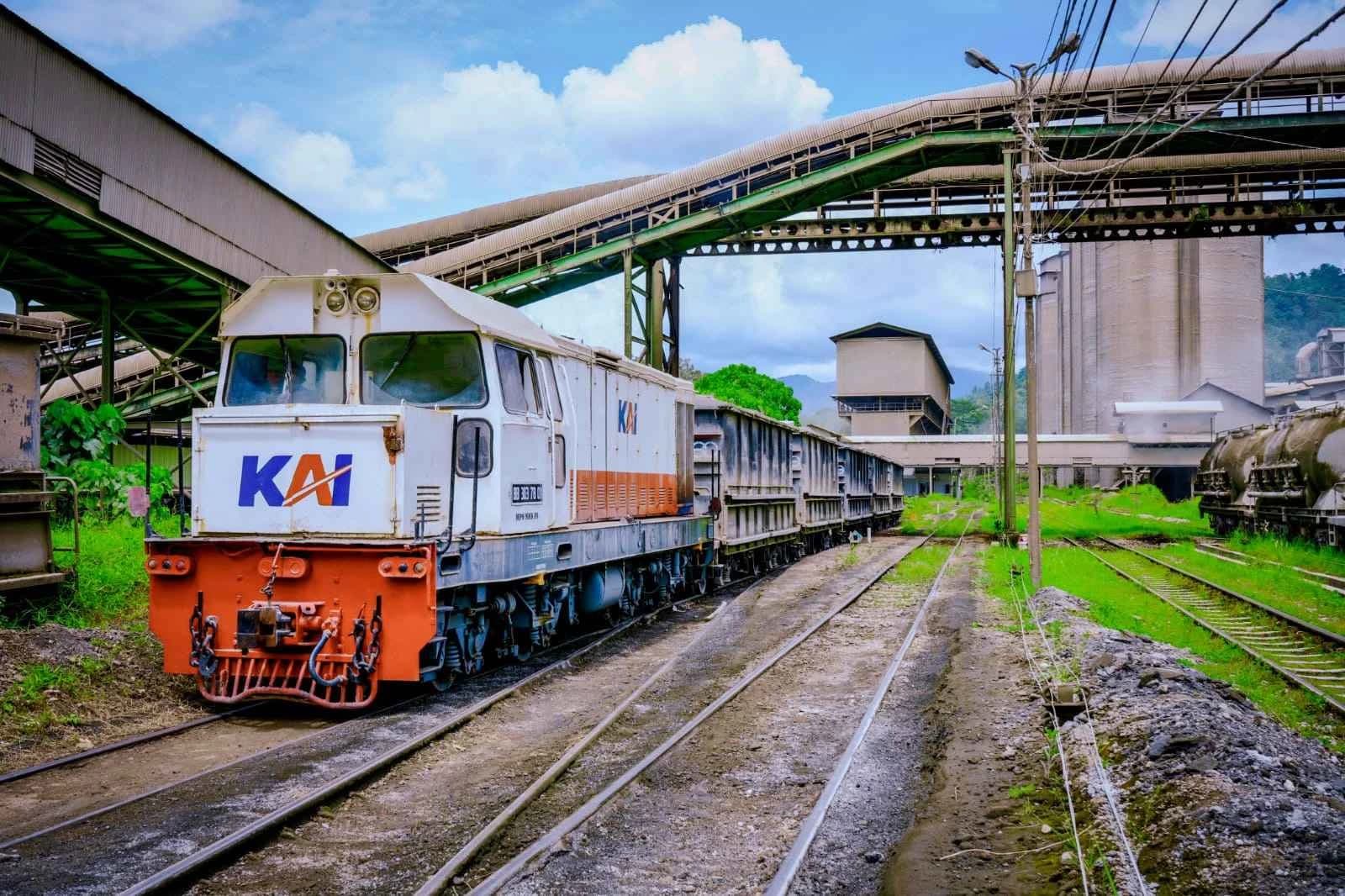
KAI Transported 1.17 Million Tons of Cement and Clinker, Strengthening Rail-Based Development Logistics
PT Kereta Api Indonesia (Persero) continues to strengthen the role of rail-based freight services in supporting the national supply chain. The supply chain is a series of processes that ensure goods are delivered from producers to distribution points and end users.
One of the commodities served by KAI is cement and clinker. Clinker is a semi-finished material that serves as the primary component in the cement production process. This commodity plays an important role in infrastructure development, housing, public facilities, industrial areas, as well as various construction needs of the community.
Throughout January–June, or the first semester of 2026, KAI transported 1,170,912 tons of cement and clinker. As an annual reference, throughout 2025 KAI’s cement and clinker services reached 2,851,615 tons.
Vice President Corporate Communication KAI Anne Purba stated that cement and clinker services are an important part of KAI’s contribution to supporting the smooth progress of development across various regions.
“Every ton of cement and clinker transported by train holds significance for the development supply chain. From factories to distribution points, this service helps maintain the supply of materials in a more planned and stable manner, benefiting both businesses and the public,” said Anne.
Anne explained that railways have strong characteristics for handling large volumes of goods over medium to long distances. In a single train set, rail transport can carry substantial loads with more predictable schedules. This helps ensure more efficient distribution of cement and clinker, particularly for industrial and development needs that require supply certainty.
“For corporate customers, schedule certainty and large capacity help improve the distribution process. For the public, a smooth supply chain can support the availability of construction materials, sustain regional economic activities, and help businesses manage distribution costs,” Anne added.
The role of rail freight is becoming increasingly relevant as logistics costs remain one of the major challenges to Indonesia’s competitiveness. Logistics costs refer to all expenses incurred in the process of moving, storing, and distributing goods until they reach their destination.
In the National Medium-Term Development Plan (RPJMN) 2025–2029, Indonesia’s logistics costs were recorded at 14.29% of Gross Domestic Product (GDP) as the 2022 baseline. Gross Domestic Product (GDP) is the total value of goods and services produced by a country within a certain period.
The RPJMN 2025–2029 targets a reduction in Indonesia’s logistics costs to 13.52% and 12.50% of GDP. Using Indonesia’s 2025 GDP at current prices of IDR 23,821.1 trillion based on data from the Central Statistics Agency (BPS), reducing the logistics cost ratio from 14.29% to 12.50% of GDP is equivalent to a potential efficiency space of approximately IDR 426.40 trillion per year.
This figure illustrates the potential efficiency of the national logistics system. The more efficient the distribution costs, the greater the economic space that can be utilized to strengthen industry, ensure smooth supply chains, support regional development, and provide benefits to the public.
“Logistics affects many aspects. It includes production costs, material prices, the smooth progress of development, employment opportunities, and public purchasing power. Therefore, strengthening rail-based freight services is essential to ensure that distribution becomes more efficient, scheduled, and adds value to the national economy,” said Anne.
From a global perspective, the International Energy Agency (IEA) notes that rail accounts for around 6% of global freight transport based on ton-kilometers but contributes only about 1% of transport emissions. Ton-kilometer is a unit of freight transport work. For example, 1 ton of goods transported over a distance of 1 kilometer is calculated as 1 ton-kilometer.
From a sustainability perspective, shifting logistics from road to rail also has the potential to reduce emissions. Emissions are exhaust gases released into the air. CO₂ or carbon dioxide is one of the main gases contributing to climate change. CO₂e or carbon dioxide equivalent is a metric used to measure the impact of various greenhouse gases in a single unit.
Referring to international freight rail sector benchmarks, transporting goods by rail can reduce greenhouse gas emissions by up to approximately 75% compared to trucks for the same volume of goods. Using an estimation approach, KAI’s cement and clinker volume in the first semester of 2026 of 1,170,912 tons is equivalent to 117,091,200 ton-kilometers for each 100-kilometer distance scenario.
Using a global comparative assumption of road emissions at approximately 62 grams of CO₂e per ton-kilometer, the use of rail for that volume has the potential to avoid around 5,444 tons of CO₂e emissions for every 100 kilometers of delivery. This figure is an estimated scenario based on international references and may vary depending on actual distance, operational patterns, types of rolling stock, load factors, track conditions, and emission calculation methods used.
Anne stated that the benefits of rail-based freight services extend beyond cost efficiency. These services can also help organize logistics traffic, reduce the burden of heavy vehicles on roads, support travel safety, and strengthen the company’s sustainability agenda.
“When goods can be transported in large volumes, more predictably, and with greater energy efficiency, businesses gain better capacity to manage costs. In the long term, efficient logistics can enhance industrial competitiveness and support more stable prices for goods in the market,” Anne said.
KAI continues to optimize freight services through improvements in operational patterns, the reliability of rolling stock and infrastructure, collaboration with corporate customers, and the strengthening of logistics services with partners. KAI is also encouraging rail-based freight services to become more connected with industrial areas, factories, freight terminals, ports, and distribution centers.
“The better the railway infrastructure and logistics connectivity, the greater the benefits that can be realized. Industries can operate more efficiently, regional development gains support in material supply, roads become more orderly, and the public benefits from a healthier supply chain,” Anne concluded.
VP Corporate Communication KAI