
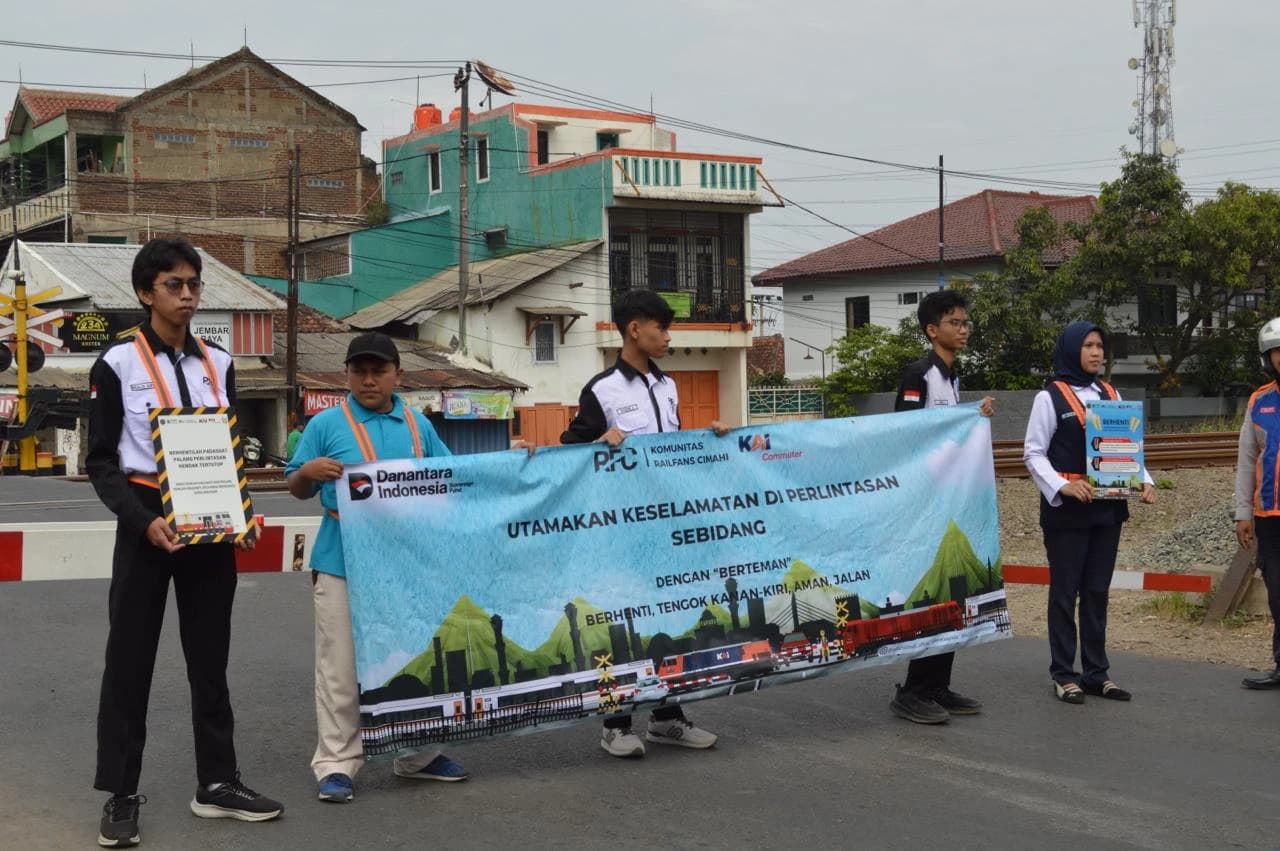
KAI Reminds Road Users During School Holidays That Stopping at Crossings Could Save Lives
PT Kereta Api Indonesia (Persero) urges the public to increase their vigilance when crossing level crossings, especially during school holidays when family mobility tends to increase. KAI encourages road users to develop safety habits: stop, look left and right, listen to their surroundings, obey signals, and then cross when it is completely safe.
KAI Vice President of Corporate Communications Anne Purba stated that level crossings are the meeting point between the highway and the railway line. At this point, the discipline of road users is crucial for the safety of many people.
"An open barrier still requires vigilance; don't immediately proceed. A closed barrier is a command to stop. Every driver must stop, look right and left, listen to their surroundings, and then ensure the lane is completely clear. If the barrier begins to close, the siren sounds, or an officer signals a stop, don't look for a gap,"
Anne explained that trains have dedicated lanes and long braking distances. Therefore, vehicles crossing crossings are at very high risk. One hasty decision can impact families, other road users, officers, train passengers, and the community around the tracks.
According to KAI data as of June 22, 2026, there were 134 accidents at level crossings. Of these, 118 incidents, or 88 percent, were caused by breaking and entering. Other causes included vehicle breakdowns (7 incidents) and gates being opened late or not closing (6 incidents).
The impact of accidents at level crossings also directly impacts family safety. During the same period, 113 victims were recorded, consisting of 48 fatalities, 29 seriously injured, and 36 slightly injured. In terms of vehicles, 134 vehicles were affected, consisting of 77 motorcycles (57 percent) and 57 cars (43 percent).
The data also shows that accidents can occur at both gated and ungated crossings. A total of 62 incidents occurred at level crossings with gates, or 46 percent, while 72 incidents occurred at level crossings without gates, or 54 percent. Therefore, gates should be understood as a safety aid, while the decision to stop, observe, and wait safely remains with road users.
Compared to the same period in 2025, the number of accidents at level crossings decreased from 138 to 134, a 3 percent decrease. Vehicles affected decreased from 144 to 134, a 7 percent decrease. The number of victims decreased from 151 to 113, a 25 percent decrease. Despite the improving trend, KAI assesses that the 48 fatalities remain a serious alarm for all parties.
"The decline in numbers shows that safety efforts are working, but even one life is too precious to risk in a rush. It's better to lose a minute or two at a level crossing than to lose a family's future."
KAI also continues to implement physical measures at level crossings by closing and narrowing vulnerable points in collaboration with relevant stakeholders. As of June 22, 2026, at 4:00 PM WIB, out of a program of 177 points, closures and narrowings had reached 226, or 128 percent, completed. This includes 136 closures of illegal crossings, 29 closures of registered crossings, 43 narrowings of illegal crossings, and 18 narrowings of registered crossings.
From a training perspective, between January and May 2026, KAI conducted 1,036 safety awareness campaigns, 167 safety awareness activities in schools, places of worship, and the community, installed 308 safety warning signs in the form of banners, participated in 44 Community and Environmental Health (TJSL) activities, demolished 24 illegal structures, and erected four crossing barriers. This education program aims to instill a habit of stopping and checking surroundings into daily life, especially for children and adolescents enjoying the school holidays.
Anne added that vigilance also applies outside level crossings. As of June 22, 2026, KAI recorded 260 incidents of train collisions on non-level crossings, consisting of 242 incidents involving people (93 percent) and 18 incidents involving vehicles (7 percent). In these incidents, there were 253 casualties: 188 fatalities, 46 serious injuries, and 19 minor injuries. In the collision, four people died, including one fatality and three minor injuries.
"We remind the public not to walk, play, take photos, park vehicles, place items, or engage in any other activities on the railway tracks. Railway tracks are operational areas that must be sterile. The safety of train travel and the safety of citizens both depend on our compliance,"
KAI invites local governments, regional authorities, police, transportation agencies, schools, communities, and families to reinforce safety messages at level crossings. Parents are also encouraged to set an example for their children by stopping at a safe distance and waiting until conditions are completely clear before crossing.
"We must abandon the habit of breaking through. A culture of safety starts with simple decisions: stop, look right, look left, listen to your surroundings, and then cross when it is safe. School holidays should be a fun journey with a safe return,"
KAI VP Corporate Communication