
KAI Group Manages Five Railway Technologies, from Diesel Locomotives to 350 km/h High-Speed Trains
PT Kereta Api Indonesia (Persero), together with the KAI Group ecosystem, manages five types of railway technology, ranging from diesel locomotives, electric commuter trains (KRL), diesel-electric rail trains (KRDE/I), automated Light Rail Transit (LRT) systems, to high-speed trains operating at speeds of up to 350 kilometers per hour.
This diverse range of technologies enabled KAI Group to serve 258,993,359 passengers during the first half of 2026, an increase of 7.55 percent compared with 240,805,920 passengers during the same period in 2025. Over the same period, KAI also transported 32,498,043 tons of freight, consisting of 26,534,095 tons of coal and 5,963,948 tons of non-coal commodities.
As of June 2026, KAI operates 551 locomotives, 1,064 electric commuter train cars (KRL), 2,238 passenger coaches, 8,907 freight wagons, and 96 KRDE/I train sets. KAI also operates LRT Jabodebek, while PT Kereta Cepat Indonesia China (KCIC), as part of the KAI Group ecosystem, operates the Whoosh high-speed railway.
KAI Vice President of Corporate Communication Anne Purba said that each railway technology features distinct operational characteristics, power sources, control systems, and maintenance requirements.
"Despite their technological differences, all systems are managed through consistent safety standards, operational reliability, workforce competency, and operational discipline. The objective remains the same: to ensure every journey is safe, punctual, reliable, and comfortable for our customers," said Anne.
Diesel locomotive technology remains the backbone of KAI's intercity, local, tourism, and freight rail services. During the first half of 2026, KAI's Long-Distance and Local Train services carried 29,858,267 passengers, an increase of 8.72 percent compared with 27,463,555 passengers during the same period in 2025.
Diesel locomotives also support freight transportation across Java and Sumatra.
Throughout the first half of 2026, KAI transported 32.50 million tons of freight to support supply chains in the energy, industrial, plantation, container, fuel, cement, and other sectors.
In the tourism segment, KAI Wisata served 164,743 passengers, representing a 64.45 percent increase from 100,176 passengers during the same period last year. This growth was supported by a variety of travel options, including tourist trains, Panoramic trains, luxury charter trains, and other rail-based travel services.
For urban mobility, electric commuter train (KRL) technology supports KAI Commuter in serving 204,151,200 passengers, an increase of 6.58 percent compared with 191,540,583 passengers during the first half of 2025. This service remains the largest contributor to KAI Group's passenger volume, covering Greater Jakarta, Bandung, Yogyakarta–Solo, Surabaya, Merak–Rangkasbitung, and several other regions.
Meanwhile, KRDE/I technology supports regional rail services and airport connectivity. During the first half of 2026, KAI Bandara served 3,482,897 passengers, up 0.99 percent from 3,448,622 passengers during the same period in 2025. The Makassar–Parepare railway carried 172,011 passengers, an increase of 15.42 percent from 149,035 passengers.
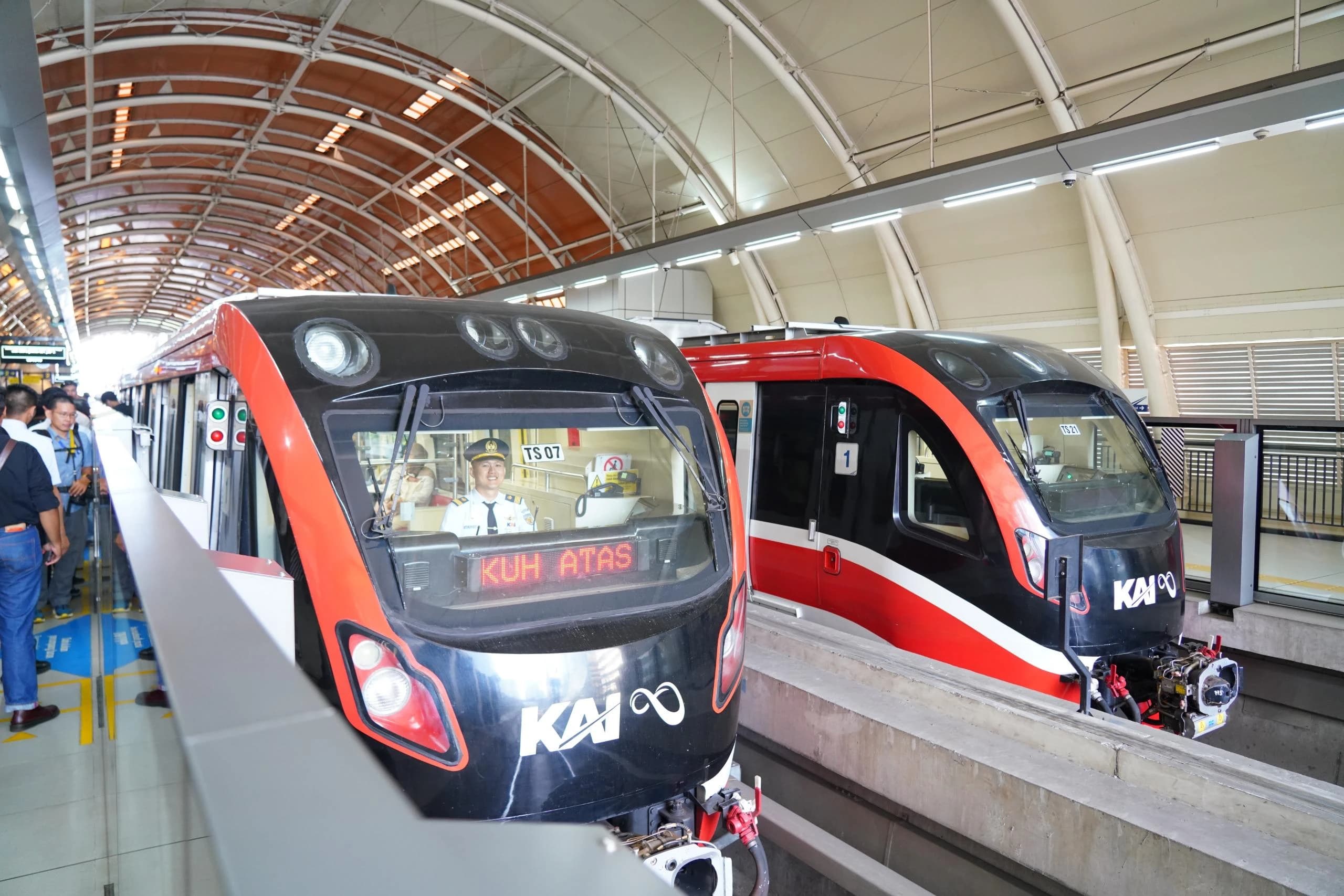
In the automated rail segment, LRT Jabodebek utilizes a Communication-Based Train Control (CBTC) signaling system with Grade of Automation 3 (GoA3). This technology enables train speed regulation, train spacing, station stopping, and train operations to be performed automatically under continuous supervision from the Operations Control Center.
Throughout the first half of 2026, LRT Jabodebek served 16,018,911 passengers, representing a 22.84 percent increase compared with 13,040,403 passengers during the same period in 2025. LRT South Sumatra served 2,206,496 passengers over the same period.
In the high-speed rail segment, Whoosh operates trains capable of reaching operational speeds of up to 350 kilometers per hour. During the first half of 2026, Whoosh served 2,938,834 passengers, a slight increase of 0.08 percent from 2,936,578 passengers in the first half of 2025.
Anne noted that these achievements demonstrate how each technology plays a unique role in meeting different mobility needs.
"Commuter passengers require high capacity and frequent services, while intercity travelers prioritize comfort and travel certainty. Regional, airport, tourism, and high-speed rail services each have their own operational characteristics. KAI Group develops technology and service models tailored to the needs of each segment," Anne explained.
The reliability of these technologies is supported by maintenance facilities located across Java and Sumatra. KAI operates six Balai Yasa (major maintenance workshops), namely Balai Yasa Manggarai, Tegal, Yogyakarta, and Gubeng in Java, as well as Balai Yasa Pulubrayan and Lahat in Sumatra.
These six workshops perform major overhauls, comprehensive inspections, repairs, and reliability improvements for locomotives, passenger coaches, freight wagons, and other railway assets according to their respective functions. Periodic maintenance is also supported by depots and technical units throughout KAI's operational regions.
On the infrastructure side, KAI operates the Cirebon Prujakan Mechanical Workshop, which is responsible for maintaining and repairing heavy railway maintenance machinery and mechanical equipment. This facility ensures that maintenance equipment remains ready to preserve track geometry and railway conditions.
KAI also operates the Kiaracondong Bridge Workshop in Bandung, which has been in operation since 1921. The workshop manufactures and repairs steel railway bridges and produces infrastructure maintenance equipment to support railway operations across Java and Sumatra.
"Technologies with varying levels of complexity require specialized maintenance facilities, equipment, procedures, and technical expertise. Regular inspections and scheduled maintenance ensure that both rolling stock and infrastructure remain ready for safe operations," Anne said.
KAI also continues to strengthen the competencies of employees responsible for operating, inspecting, maintaining, and controlling railway operations. The number of certified employees increased from 14,150 in 2022 to 15,983 in 2023, 16,186 in 2024, and reached 19,167 in 2025.
The 2026 certification program covers 18,297 certification requirements across various operational fields, including train crews, train traffic controllers, rolling stock and infrastructure inspectors and maintenance personnel, as well as level crossing attendants.
Every operational employee undergoes education, training, competency assessments, and certification before assuming operational duties. Skills development is further reinforced through operational simulations, technical workshops, refresher training, and emergency response exercises.
As railway technology continues to evolve, new competencies have become increasingly important, including automated system operations, electronic systems, communication-based signaling, digital rolling stock monitoring, operational data analysis, and centralized traffic control.
KAI also utilizes the Safety Railway Information (SRI) application as a reporting platform for potential hazards and unsafe conditions. Reports submitted through the application help accelerate risk mitigation efforts and prevent safety incidents that could affect railway operations.
"From diesel locomotives to high-speed trains, the technologies may differ, but the operational principles remain the same. Safety is ensured through competent personnel, reliable maintenance facilities, strict operational discipline, and continuous 24-hour monitoring," Anne concluded.
VP Corporate Communication KAI