
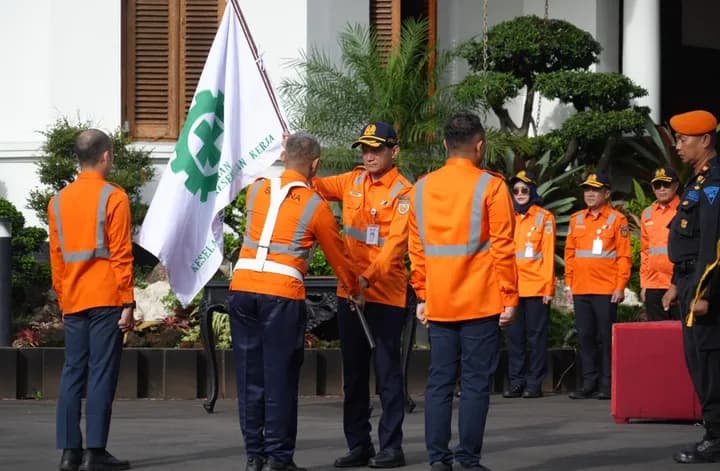
KAI Holds the 2026 National OSH Month Roll Call: KAI President Director Emphasizes Strengthening a Proactive Safety Culture
PT Kereta Api Indonesia (Persero) (KAI) held the 2026 National Occupational Safety and Health (OSH/K3) Month Roll Call at the KAI Headquarters in Bandung on Monday, 19 January 2026, as a momentum to strengthen the safety culture across the KAI Group.
The event reaffirmed the company’s commitment to building a professional, reliable, and collaborative Occupational Safety and Health (OSH/K3) management ecosystem, in line with the evolving dynamics and complexity of railway operations.
During the event, the KAI Board of Directors jointly signed the Railway Safety Policy and the Occupational Safety, Health, and Environment (OSHE/K3L) Policy, establishing a strategic foundation for the company’s future safety management.
KAI President Director Bobby Rasyidin emphasized that the achievements and challenges in safety performance during the previous year should serve as the basis for strengthening safety performance in 2026.
"The year 2025 serves as a collective reflection. We recorded 10 railway accidents and four workplace accidents. These figures show that safety challenges remain significant and require greater active involvement from all KAI personnel, particularly frontliners as the operational frontline. Professionalism, competent expertise, and strong collaboration among employees, management, and business partners are essential to creating a safe, healthy, and sustainable working environment and railway service," Bobby said in a press release on Monday.
Bobby added that, in line with the 2026 National OSH Month theme, "Building a Professional, Reliable, and Collaborative National OSH Management Ecosystem," KAI aims to reduce both the number and severity of accidents, minimize security disruptions, and prevent environmental pollution through integrated technical, managerial, and behavioral approaches.
Meanwhile, KAI Vice President of Corporate Communication Anne Purba explained that this policy direction has been reflected in the strengthening of the company’s safety culture. Based on an assessment conducted in December 2024, KAI’s safety culture maturity reached the Proactive level with a total score of 2.91 out of 4.00, indicating the establishment of effective two-way communication between frontline employees and management.
"This improvement is reflected in the utilization of the Safety Railway Information (SRI) application, with follow-up actions on reported potential hazards exceeding 97 percent. In addition, Hazard Identification and Risk Assessment (HIRA/IBPR) reports have continued to show an upward trend, indicating employees' active participation in safety management," Anne explained.
Throughout 2025, KAI implemented various operational and public safety mitigation measures. The company permanently closed 316 level crossings and removed 52 illegal structures within the Railway Right-of-Way (RUMAJA) to maintain infrastructure reliability.
On the public education side, KAI conducted 2,016 railway safety awareness activities, 212 educational programs in schools, installed 687 safety banners, and engaged 6,455 railfan community members in public railway safety campaigns.
Safety leadership was further strengthened through the involvement of management up to two organizational levels below the Board of Directors (BOD-2) in the Management Safety Walkthrough (MSWT) program. In addition, KAI established a Safety Committee in every work unit and implemented the Contractor Safety Management System (CSMS) to ensure effective safety management with business partners.
All of these OSH policies and implementations are aligned with Law No. 1 of 1970 on Occupational Safety and Government Regulation No. 50 of 2012 on the Implementation of Occupational Safety and Health Management Systems, serving as the foundation for achieving KAI’s safety performance targets through the end of 2026.
Anne emphasized that consistency remains the key factor in the successful implementation of safety management across the KAI Group.
"KAI continues to build a sustainable safety management system through comprehensive policies, planning, implementation, and continuous improvement. Our target for 2026 is to strengthen a proactive safety culture across every level of the KAI Group, with the support of employees, business partners, and the public, to ensure railway services remain healthy, safe, and secure for everyone," Anne concluded.
VP Corporate Communication KAI