
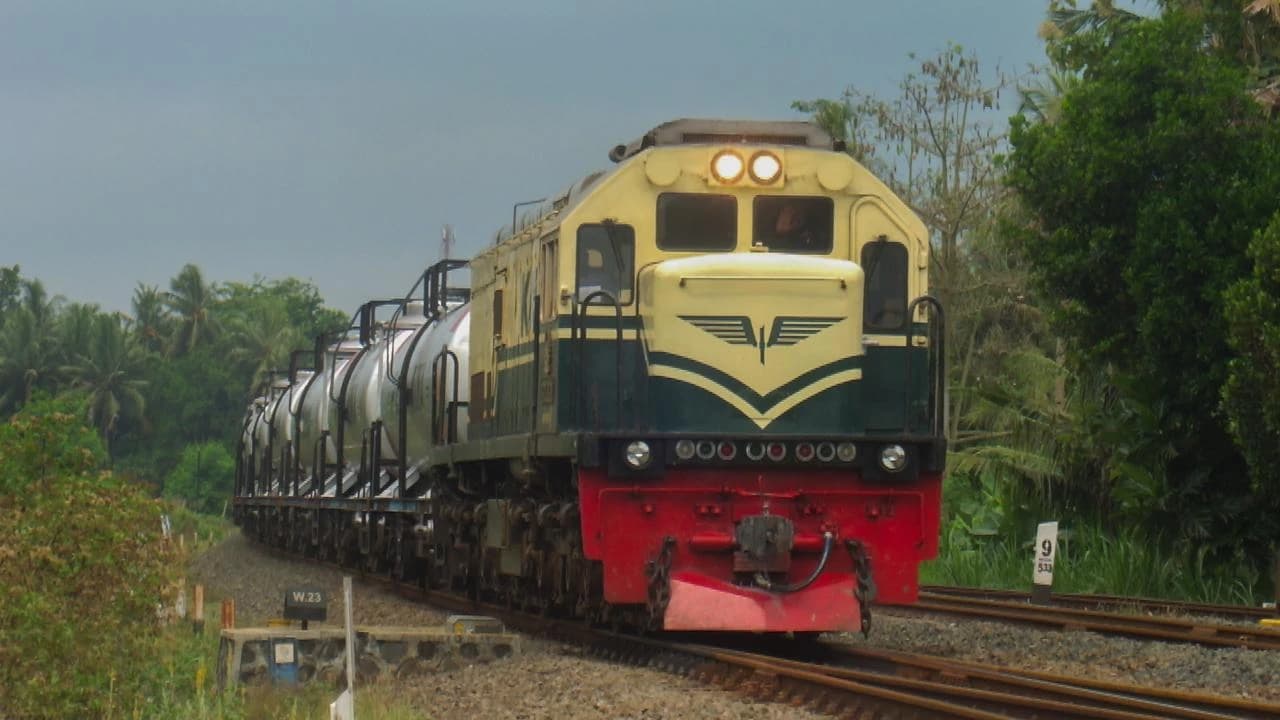
Supporting National Energy Security, KAI Transports 1.09 Million Tons of Fuel from January to May 2026
Energy serves as a primary driver for public activity and economic growth. A well-allocated and efficiently distributed fuel supply underpins smooth transportation, industrial activities, trade, and public services across various regions. Behind this seamless flow lies a distribution system working daily to ensure energy arrives precisely where it is needed.
As an integral link in the national energy supply chain, PT Kereta Api Indonesia (Persero) continuously supports the distribution of fuel (Bahan Bakar Minyak/BBM) through its rail-based transportation services. Rail transport offers distinct advantages in moving large-volume freights on a scheduled and consistent basis, making it a reliable choice for driving energy distribution to various regions.
From January to May 2026, KAI transported 1,096,988 tons of fuel. Meanwhile, throughout 2025, KAI recorded a total fuel freight volume of 2,655,780 tons. These volumes underscore the vital role of rail transport in supporting the seamless distribution of energy required by both the public and the business sector.
KAI’s Vice President of Corporate Communication, Anne Purba, stated that reliable energy distribution has a direct impact on economic activities and public mobility. Consequently, KAI continues to strengthen collaborations with various stakeholders to maintain the smooth flow of fuel distribution across the national railway network.
"Rail transport is a critical mode that supports large-scale energy distribution on a scheduled basis. Through close collaboration with various parties, KAI continuously strives to safeguard the smooth supply of fuel so that public and business activities can run optimal,"
In supporting national energy distribution, KAI maintains a strategic partnership with the Pertamina Group for fuel transport services. This collaboration plays a pivotal role in delivering energy to various regions while strengthening the connectivity between supply centers and distribution destinations.
Furthermore, to fulfill the operational needs of trains utilizing subsidized fuel, KAI coordinates closely with the Downstream Oil and Gas Regulatory Agency (BPH Migas) and the Upstream Oil and Gas Regulatory Task Force (SKK Migas), with supplies supported by PT Pertamina Patra Niaga. This synergy constitutes a vital framework in maintaining the sustainability of railway transportation services that serve the public and the national logistics sector daily.
Based on monitoring data as of June 5, 2026, KAI secured a subsidized fuel quota of 214,342,000 liters for the year 2026. Up to that period, the realized consumption reached 95,394,629 liters, or 44.51 percent of the total available quota, leaving a remaining quota of 118,947,371 liters.
Out of the total consumption, the largest share went toward passenger train operations at 85,220,668 liters, followed by container transport at 7,254,124 liters, parcel freight at 1,541,672 liters, cement transport at 1,148,414 liters, and clinker transport at 229,751 liter. These data demonstrate that energy support directly contributes to public mobility services as well as the logistics distribution that props up various economic sectors.
The utilization of railways for energy distribution also delivers added value in terms of transportation efficiency. With a massive haulage capacity per trip, rail-based distribution helps preserve supply chain continuity while backing a logistics system that is increasingly effective and sustainable.
"KAI will continue to reinforce its collaboration with the Pertamina Group, BPH Migas, SKK Migas, and other stakeholders to support national energy security. Through reliable transportation services, KAI is committed to safeguarding the seamless distribution of energy, public mobility, and economic activities across various regions,"
VP of Corporate Communication KAI