
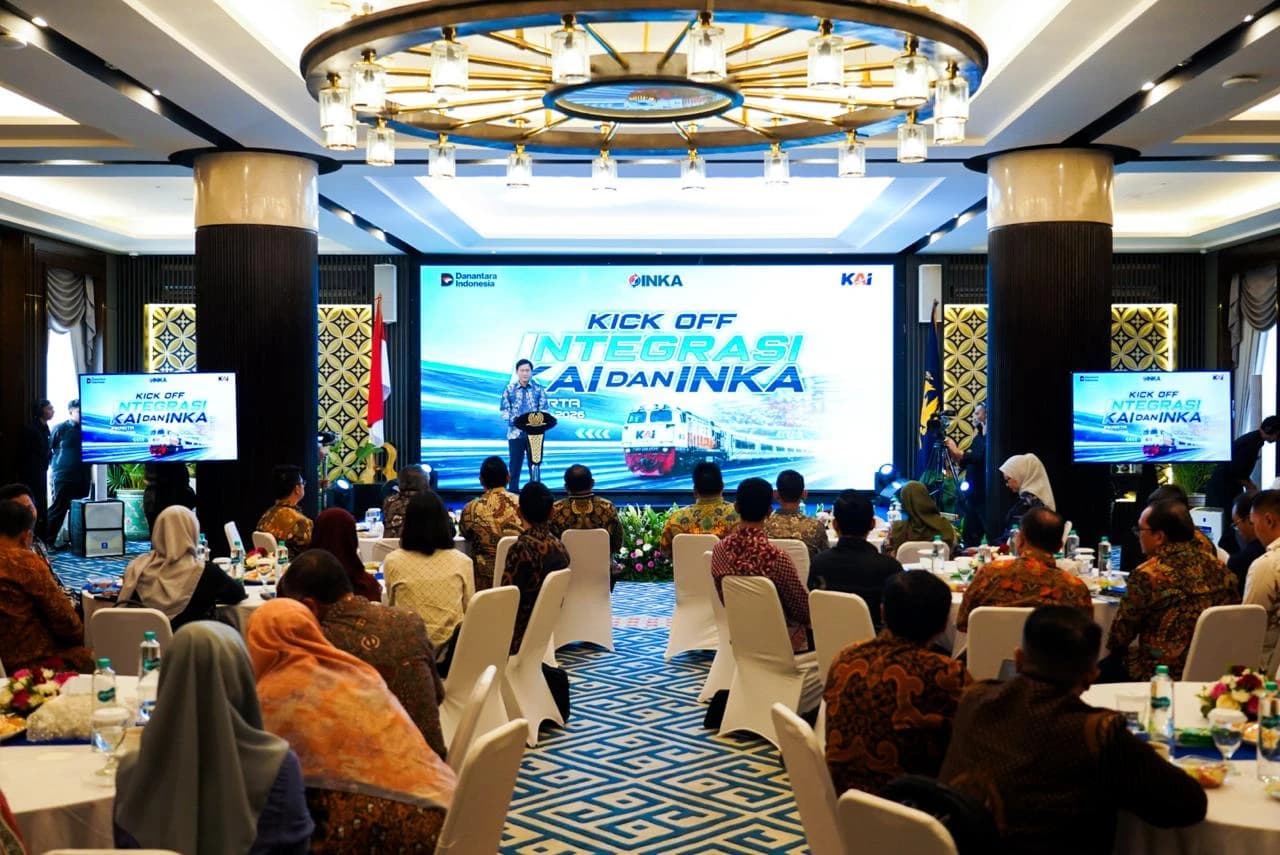
KAI and INKA Begin Strategic Integration, Strengthen Indonesia's National Railway Industry Ecosystem
PT Kereta Api Indonesia (Persero) and PT Industri Kereta Api (Persero) (INKA) officially launched their strategic integration process through the KAI–INKA Integration Kick-Off held at the Jakarta Railway Center Ballroom in Jakarta on Tuesday (21 July 2026).
The event was attended by representatives of Danantara Asset Management, the Boards of Directors of KAI and INKA, the Project Management Office (PMO), consultants, and senior executives from both companies. The integration is intended to align future railway service requirements with the capabilities of Indonesia's domestic rolling stock manufacturing industry.
Senior Vice President of Business Performance & Asset Optimization Cluster Logistic at Danantara Asset Management, Desty Arlaini, emphasized that the integration process must begin with a shared vision among the leadership and employees of both companies.
"All leaders must share the same vision, build common values, and place customer needs at the center of every decision. KAI and INKA must operate as one team while respecting each other's expertise," Desty said.
According to Desty, leadership, trust, and organizational culture are critical to the success of the integration. Every decision should create added value for railway passengers, the companies, shareholders, and the nation.
KAI President Director Bobby Rasyidin said the integration creates significant opportunities for advancing Indonesia's railway manufacturing industry. Meeting the country's long-term rolling stock requirements will require closer coordination between KAI as the railway operator and INKA as the rolling stock manufacturer.
"The integration of KAI and INKA marks a major step toward strengthening Indonesia's national railway industry ecosystem. Future rolling stock demand must be translated into more integrated planning for design, production capacity, testing, and product delivery," Bobby said.
One of the largest opportunities lies in the procurement of Electric Multiple Units (EMUs) for commuter rail services. Based on KAI's preliminary projections, demand is expected to reach approximately 156 EMU trainsets by 2040.
This projection highlights the substantial growth potential for Indonesia's domestic railway manufacturing industry. Meeting this demand will require gradual expansion of production capacity, stronger technological capabilities, consistent product quality, and close alignment between the operator's requirements and the manufacturer's capabilities.
"The projected demand for around 156 EMU trainsets by 2040 illustrates the scale of the opportunity ahead. This figure does not yet include demand for Diesel Multiple Units (DMUs), long-distance passenger trains, locomotives, or freight rolling stock," Bobby added.
According to Bobby, these long-term prospects are one of the key reasons behind KAI's support for the integration with INKA. Closer coordination between the railway operator and the manufacturer is expected to strengthen demand certainty, production readiness, and the development of rolling stock tailored to Indonesia's operational requirements.
Many countries with advanced railway industries have established close collaboration between operators and manufacturers. Such a model enables long-term alignment of rolling stock planning, technological development, product standardization, and manufacturing capacity.
"KAI fully supports this integration because its impact extends directly to the future of railway services. The stronger our domestic manufacturing industry becomes, the greater our ability to provide safe, reliable, comfortable, and customer-oriented rolling stock," Bobby said.
He added that manufacturing will become an increasingly important pillar of KAI's business ecosystem. The integration provides both companies with an opportunity to develop more accurate long-term demand projections while enhancing the competitiveness of railway products manufactured in Indonesia.
KAI Group served 258.99 million passengers during the first half of 2026, an increase of 7.55 percent compared with the same period last year. This continued growth in passenger mobility must be supported by adequate rolling stock capacity to ensure safety, reliability, and service quality.
"Successful integration requires consistency, stronger competencies, and the adoption of industry best practices. Together, we aim to build a national railway manufacturing industry capable of supporting the continued growth of railway services and Indonesia's vision of Golden Indonesia 2045," Bobby concluded.
President Director of PT INKA (Persero), Bambang Jatmika, described the kick-off as an important milestone in an integration plan that has been discussed for several years. The integration will combine KAI's operational expertise with INKA's capabilities in rolling stock design, engineering, and manufacturing.
"This integration represents a shared commitment to building a strong national railway industry. KAI and INKA play complementary roles, from forecasting rolling stock requirements to manufacturing trains that support public transportation services," Bambang said.
According to Bambang, closer coordination will enable both companies to better align demand forecasting, production planning, testing schedules, delivery processes, technological development, and product quality improvement.
The integration is expected to strengthen Indonesia's domestic railway industry by enabling more systematic fulfillment of future rolling stock requirements while supporting the continued expansion of railway services across the country.
"The synergy between KAI and INKA is expected to strengthen Indonesia's railway manufacturing industry and deliver rolling stock that is safe, reliable, comfortable, and responsive to the needs of the public," Bambang concluded.
VP Corporate Communication KAI